Band 5.0 IELTS Writing Task 1 Model Answer
Overall Band Score: 5.0 · IELTS Momentum Workout · 2026-11-18
IELTS Writing Task 1 question
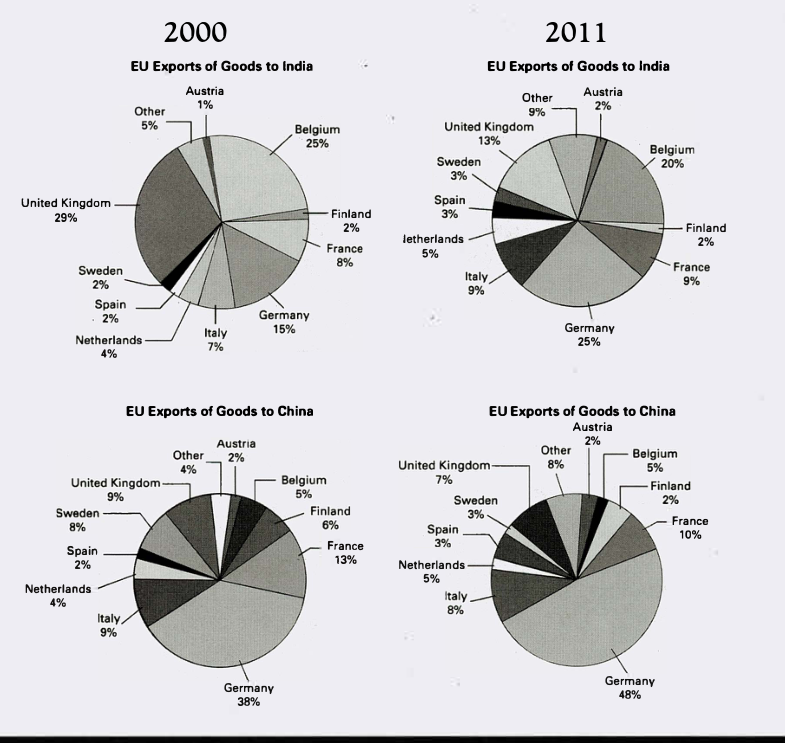
The pie charts below show exports from various EU countries to India and China in 2000 and 2011.
Summarise the information by selecting and reporting the main features, and make comparisons where relevant.
EU Exports of Goods to India and China in 2000 and 2011
Student answer (Band 5.0)
The pie chart compares , the export from various eu countries to india and china in 2000 and 2011 . There are different foods are supplied from the india and china to others countries .
In board term , the india exports 29 percent goods to the united kingdom which is higest than the china while the china exports only 9 percent in 2000 . In 2000 all the food supply of the india are higher but china exports 39 percent for germany which is higest data showen in 2000 . Sience the lowest food supply is 2 percent both countries supply this in different country .
In 2011 , the china exports 48 percent food to germany on the other hand inda supply 25 percent food to germany . India give 13 percent to united while the china cannot provide more food for united kinngdom .
In conclusion , in two year china produce more goods and supply . India also provide goods to different countries but not more than china .
AI examiner evaluation
| Criterion | Band |
|---|---|
| Task Achievement / Task Response | 4.5 |
| Coherence and Cohesion | 5.5 |
| Lexical Resource | 4.5 |
| Grammatical Range and Accuracy | 4.5 |
| Overall | 5.0 |
Task Achievement / Task Response: Band 4.5
You identify the two destinations and years, and you report some relevant figures, including the UK’s 29% share of exports to India in 2000 and Germany’s 48% share for China in 2011. However, the response only partially summarises the charts: it gives few accurate comparisons across both destinations and years, and the overview is unclear. The claim that “in 2000 all the food supply of the india are higher” is not supported; China’s share for Germany was much higher, and the charts show goods, not food. The conclusion that China supplied “more goods” is also not established by these percentage shares. Select the main patterns—such as Germany’s dominance in China’s figures and the changing leading shares for India—and compare them accurately.
Coherence and Cohesion: Band 5.5
The response has a basic paragraph structure, moving from an introduction to comparisons and a conclusion. Time markers such as “In 2000” and “In 2011” help the reader follow the intended sequence. However, progression within paragraphs is difficult to track because several comparisons are compressed or unclear, for example, “In 2000 all the food supply of the india are higher but china exports 39 percent for germany.” Linking phrases such as “on the other hand” are used, but the relationship between the compared figures is not always expressed clearly. The conclusion repeats a broad claim rather than drawing together the main chart patterns. Organise the body by destination or year, and make each comparison explicit.
Lexical Resource: Band 4.5
You use some task-related vocabulary, including “exports,” “percent,” “supply,” and “higest,” and the reader can generally recognise that you are describing shares sent to different countries. However, the vocabulary is basic and repetitive, and several choices are inaccurate or unnatural. “Food” is repeatedly used where the charts show goods, while “produce more goods” does not describe what these percentage charts measure. Spelling errors such as “Sience,” “inda,” and “kinngdom” also reduce clarity. Build a more precise range for describing proportions and changes, and check spelling carefully. For example, use “accounted for” or “represented” for a country’s share, and “rose” or “fell” when comparing the two years.
Grammatical Range and Accuracy: Band 4.5
You attempt both simple statements and longer comparisons, including “In 2011, the china exports 48 percent food to germany on the other hand inda supply 25 percent food to germany.” However, the range of sentence structures is limited, and frequent errors in sentence formation and grammar sometimes make the meaning difficult to follow. Examples include “There are different foods are supplied,” which has an incorrect clause structure, and “the india exports,” where the article and noun form are not appropriate. Tense and agreement are also inconsistent, as in “the india exports” and “India give.” Punctuation is often missing around clauses, particularly before “on the other hand.” Practise accurate simple comparisons first, then combine them using correctly punctuated contrast clauses.
See this exact question answered at other band scores. The same prompt compared across bands.
Browse more IELTS Writing model answers or get your own writing scored by the same AI examiner.