Band 5.0 IELTS Writing Task 1 Model Answer
Overall Band Score: 5.0 · IELTS Momentum Workout · 2026-11-18
IELTS Writing Task 1 question
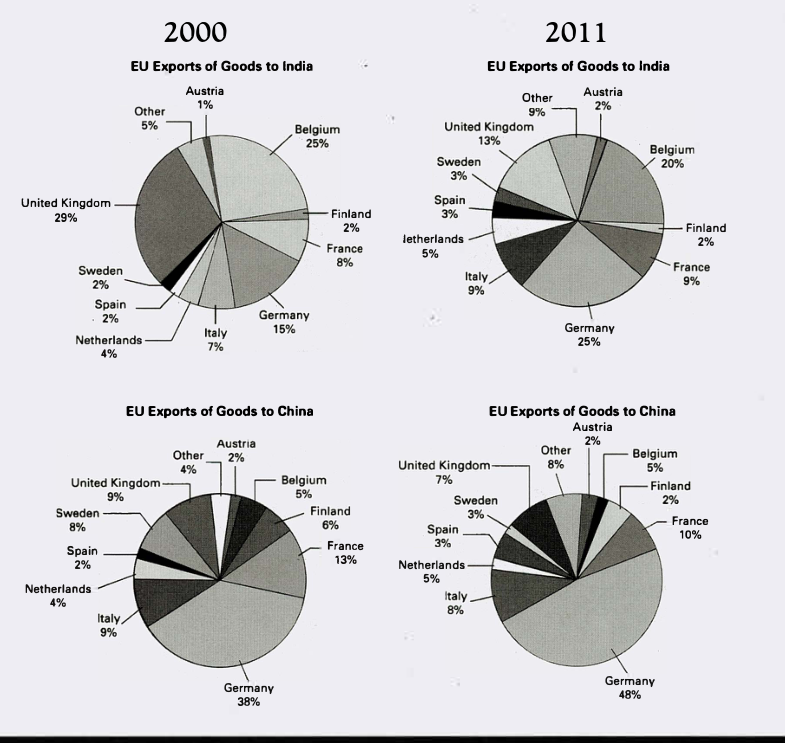
The pie charts below show exports from various EU countries to India and China in 2000 and 2011.
Summarise the information by selecting and reporting the main features, and make comparisons where relevant.
EU Exports of Goods to India and China in 2000 and 2011
Student answer (Band 5.0)
The images below illustrate the the international sale from various EU countries to India and China from 2000 to 2011.
Overall, major proportion of EU exports of goods to india are conquered by United Kingdom and Belgium which then changed to Germany and Belgium in 2011. Furthermore, Germany and France are buying majority goods from China.
In 2000, United Kingdom, Belgium and Germany contributed to major sale with 29%, 25% and 15%., while Italy, Netherlands, France and Finland exported only 7%, 4%, 8% and 2%. Sweden and Spain bought only 2% of goods from India. These figures changed in 2011, as UK and Belgium decreased to 13% and 20%. Sweden, Spain and Netherlands increased with one percentage point. Italy and Germany surged to 9% and 25%. France and Finland maintained a stable position with no major increase in 2011. Good which are bought by Other increased from 5% to 9% in 2011.
AI examiner evaluation
| Criterion | Band |
|---|---|
| Task Achievement / Task Response | 4.0 |
| Coherence and Cohesion | 5.5 |
| Lexical Resource | 5.5 |
| Grammatical Range and Accuracy | 5.5 |
| Overall | 5.0 |
Task Achievement / Task Response: Band 4.0
The response identifies some relevant features of India’s exports, including the fall in the UK share and the rise in Germany’s share, and gives several figures. However, it omits the China charts almost entirely, so the comparison between the two destinations and the major feature of Germany’s dominance in China are not reported. The overview is also inaccurate: it says Germany and France are buying the majority of goods from China, although the charts show the shares of EU countries exporting to China, with Germany alone accounting for the largest share. Some details are unclear or incorrect, such as saying France and Finland were stable when France rose from 8% to 9%. The response is 144 words, below the 150-word minimum; eight words copied from the prompt were not counted. Cover both destinations and summarise their main changes.
Coherence and Cohesion: Band 5.5
The response has a basic, recognisable structure: an introduction, an overview and a paragraph of figures for India. The sequence within the India paragraph is generally understandable, and phrases such as “These figures changed in 2011” help signal a time comparison. However, the organisation is incomplete because there is no developed discussion of China, leaving the task without a balanced progression across the charts. Some information is crowded into long lists, and the overview’s reference to China is not followed up. To improve, group the information by destination or by the most important changes, and use clear transitions to guide the reader from India to China and between the two years.
Lexical Resource: Band 5.5
The response uses some relevant chart vocabulary, including “contributed,” “decreased,” “increased,” “surged” and “percentage point,” so the main trends can often be understood. However, several word choices and collocations are inaccurate or awkward, such as “major proportion … are conquered,” “major sale,” and “buying majority goods.” These choices sometimes obscure whether the figures refer to exports or purchases. There is also repetition of basic terms such as “increased” and “goods,” and “sale” is not a precise way to describe the shares shown. Aim for accurate reporting language such as “accounted for,” “share of exports,” and “rose/fell from … to …”; check spelling and capitalisation of country names as well.
Grammatical Range and Accuracy: Band 5.5
The response attempts a mix of sentence forms, including a relative clause in “which then changed” and a time clause beginning “as UK and Belgium decreased.” Most sentences communicate the intended trend, but errors in articles, agreement and sentence construction are noticeable. For example, “major proportion … are conquered” has faulty agreement and an unsuitable passive structure, while “the the” repeats an article and “France and Finland maintained a stable position with no major increase” does not accurately express the figures. Punctuation is also unreliable, as shown by the extra full stop after “15%.” Use simpler, controlled constructions such as “The UK’s share fell from 29% to 13%,” then check articles, verb agreement and sentence-ending punctuation.
See this exact question answered at other band scores. The same prompt compared across bands.
Browse more IELTS Writing model answers or get your own writing scored by the same AI examiner.