Band 6.0 IELTS Writing Task 1 Model Answer
Overall Band Score: 6.0 · IELTS Momentum Workout · 2026-11-19
IELTS Writing Task 1 question
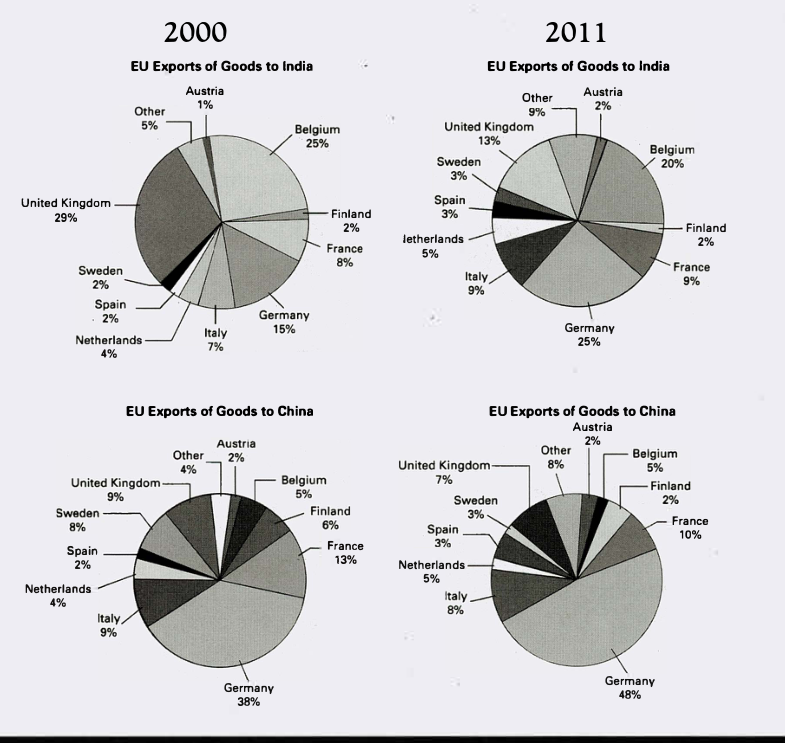
The pie charts below show exports from various EU countries to India and China in 2000 and 2011.
Summarise the information by selecting and reporting the main features, and make comparisons where relevant.
EU Exports of Goods to India and China in 2000 and 2011
Student answer (Band 6.0)
The charts illustrate foreign sales between EU nations and India and China for a decade from 2000 to 2011.
Overall, the foreign export from eurpioun union to India is vary in a decade trade among countries like United Kingdom, Belgium are reduced while foreign work among Germany and some other countries are highly build up. In China oversea sales with Germany is gained progress while some other countries face reducing issue.
In 2000, Eurpeion Union outside country trade major participant is Germany 15%, United Kingdom 29%, Belgium 25% remaining with other countries. In 2011, after the decade the number have shown great variation like United Kingdom reduced to 13% , Belgium falls to 20%. Conversely, Germany sales to India mainly appreciated to 25%. and other countries also shown slight upward growth.
In 2000, Euerpion Union export with china have that distribution like Germany 38% , France 13%, and United Kingdom 9%, Sweden 8%. However, after 10 years duration percentage with states are change progressively as Germany gain progress to 48%, France, Sweden and United Kingdom face criterial time to 10%, 3% and 7% respectively.
AI examiner evaluation
| Criterion | Band |
|---|---|
| Task Achievement / Task Response | 6.5 |
| Coherence and Cohesion | 6.5 |
| Lexical Resource | 5.0 |
| Grammatical Range and Accuracy | 5.0 |
| Overall | 6.0 |
Task Achievement / Task Response: Band 6.5
You identify the main contrasts in both markets: the UK and Belgium lost share in exports to India, while Germany rose, and Germany’s share of exports to China increased. The figures you give for these key movements are accurate, and the response covers both years and destinations. However, the overview is vague and difficult to interpret, and several comparisons are only briefly reported. For China, you mention declines in France, Sweden and the UK, but do not clearly compare their changes or include other notable movements, such as Finland’s fall from 6% to 2%. To strengthen the response, state the dominant pattern clearly in the overview and select a few more precise comparisons to support it.
Coherence and Cohesion: Band 6.5
The response has a recognisable structure: an introduction, an overview, and separate paragraphs for India and China. This gives the reader a basic route through the information, and transitions such as “Conversely” and “However” help signal contrasts. The progression is not consistently clear, though. The overview’s wording makes the trends hard to follow, and phrases such as “after the decade” and “after 10 years duration” repeat the same time reference without improving the links between details. Some comparisons are also compressed into long, loosely connected sentences. Organise each destination paragraph around the main changes, using clear topic sentences and direct comparisons between 2000 and 2011; this would make the cohesion less mechanical and the progression more assured.
Lexical Resource: Band 5.0
You attempt a range of vocabulary related to trade and change, including “foreign sales,” “distribution,” “reduced,” and “upward growth.” However, word choice and collocation are often inaccurate or unnatural, which sometimes makes the meaning difficult to understand. Examples include “foreign work,” “highly build up,” “gain progress,” and “face criterial time”; these do not express the intended changes clearly. There are also spelling errors in “eurpioun,” “Eurpeion,” and “Euerpion.” Use standard, precise terms consistently—for example, “exports,” “share,” “increased,” and “declined”—rather than searching for elaborate alternatives. This would improve clarity while retaining an appropriate academic tone.
Grammatical Range and Accuracy: Band 5.0
You use both simple statements and attempts at more complex sentences, including contrast structures such as “while” and “However.” Nevertheless, errors in sentence formation and verb patterns are frequent enough to make some sentences difficult to process. For example, “the foreign export … is vary” has problems with the verb form and agreement, while “the number have shown great variation” has an incorrect subject–verb combination. The sentence beginning “In 2000, Eurpeion Union outside country trade major participant is…” also lacks a clear grammatical structure. Punctuation is inconsistent, including the full stop after “25%.” Practise building accurate sentences with a clear subject and verb, and check tense and agreement when describing past data.
See this exact question answered at other band scores. The same prompt compared across bands.
Browse more IELTS Writing model answers or get your own writing scored by the same AI examiner.