Band 5.0 IELTS Writing Task 1 Model Answer
Overall Band Score: 5.0 · IELTS Momentum Workout · 2026-11-19
IELTS Writing Task 1 question
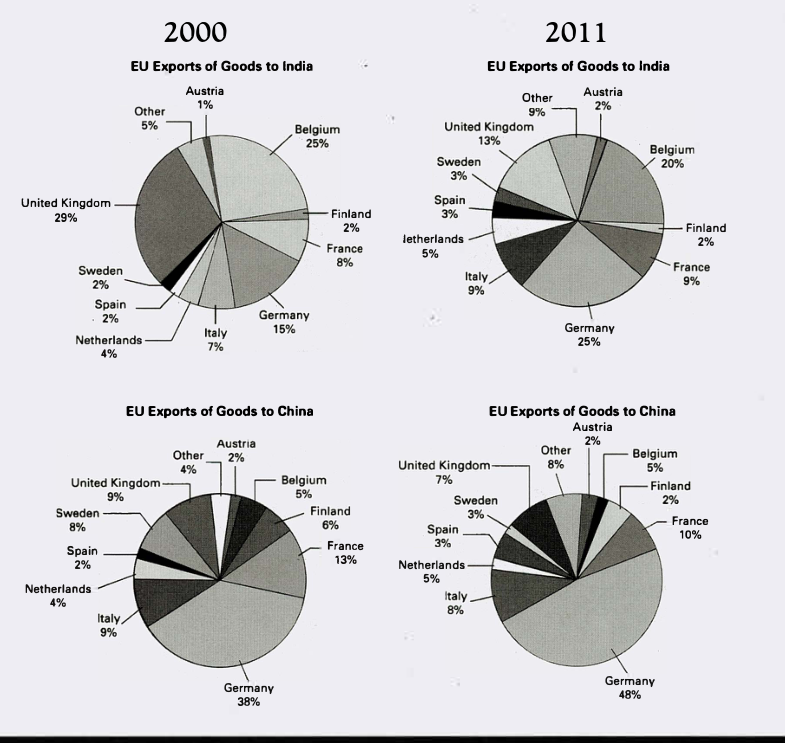
The pie charts below show exports from various EU countries to India and China in 2000 and 2011.
Summarise the information by selecting and reporting the main features, and make comparisons where relevant.
EU Exports of Goods to India and China in 2000 and 2011
Student answer (Band 5.0)
The provided pie charts compare the proportion of EU exports of goods to India and China in 2000 and 2011.
Overall, In 2000 EU exports of goods to India . United kingdom was the largest in 2000 and in 2011 United kingdom decrease there exports while Belgium also have largest exports of goods in 2000 and slidely decrease . EU exports of goods to china , Germany was the largest in 2000 and in 2011 its has increased in exports and we can observed that France may also increased in there exports .
United kingdom is a major exporter in 2000 was 29% compare to 2011 United kingdom exports 13% while Germany has increase 15% in 2000 to 25% in 2011 major change in Germany , and Belgium also decrease from 25% in 2000 to 20% in 2011 . EU exports of goods to china , Germany is a major exporter in 2000 by 38% and in 2011 its increase to 38%
AI examiner evaluation
| Criterion | Band |
|---|---|
| Task Achievement / Task Response | 5.0 |
| Coherence and Cohesion | 4.5 |
| Lexical Resource | 5.0 |
| Grammatical Range and Accuracy | 5.0 |
| Overall | 5.0 |
Task Achievement / Task Response: Band 5.0
You identify the chart topic and report several relevant comparisons, including the UK’s fall in exports to India from 29% to 13% and Germany’s rise there from 15% to 25%. However, the overview is unclear and partly inaccurate: Belgium was not the largest exporter to India in 2000 (the UK was), and Germany’s share of exports to China rose from 38% to 48%, not to 38% as stated at the end. The claim that France increased its share to China is also incorrect; it fell from 13% to 10%. The response selects only a few figures and does not clearly summarise the main patterns across both destinations. A more accurate overview and fuller, carefully checked comparisons would strengthen the report.
Coherence and Cohesion: Band 4.5
There is a basic attempt to organise the response, with an opening sentence, an overview-like paragraph and a paragraph containing figures. The reader can follow the broad topic, and comparisons such as the UK’s change in India are identifiable. However, progression is weak: the overview combines several ideas in a long, unclear sequence, and the second paragraph repeats information rather than developing a systematic comparison. Linking phrases such as “while” and “and” are used, but connections between points are often awkward, and punctuation and spacing make the text harder to follow. Grouping the India figures together and then the China figures, with a clear overview before the details, would create a more coherent progression.
Lexical Resource: Band 5.0
The response uses some relevant chart vocabulary, including “proportion,” “exports,” “largest,” “decrease,” and “increased,” so the topic is generally recognisable. However, the range is limited and several word choices or forms are inaccurate or repetitive, such as “major exporter,” “slidely decrease,” and “there exports.” The repeated use of “increase” and “decrease” also makes the account less precise. Choose vocabulary that describes shares and changes accurately—for example, “accounted for,” “rose,” “fell,” or “declined”—and check spelling and possessive forms. More precise language would help distinguish a country’s share from the overall volume of exports.
Grammatical Range and Accuracy: Band 5.0
You attempt both simple statements and longer comparisons, for example, “Germany has increase 15% in 2000 to 25% in 2011,” but the longer structures are often faulty. Verb forms and tense are frequent problems: “has increase” should be “increased,” and “United kingdom decrease” needs a past-tense verb. Agreement and sentence construction are also unclear in phrases such as “its has increased” and “United kingdom is a major exporter in 2000 was 29%.” Capitalisation and punctuation are inconsistent, including the capitalised “In” after the opening sentence and incomplete sentence boundaries. Use straightforward past-tense sentences with a clear subject and verb, then build more complex comparisons once those forms are controlled.
See this exact question answered at other band scores. The same prompt compared across bands.
Browse more IELTS Writing model answers or get your own writing scored by the same AI examiner.