Band 6.0 IELTS Writing Task 1 Model Answer
Overall Band Score: 6.0 · IELTS Momentum Workout · 2026-11-20
IELTS Writing Task 1 question
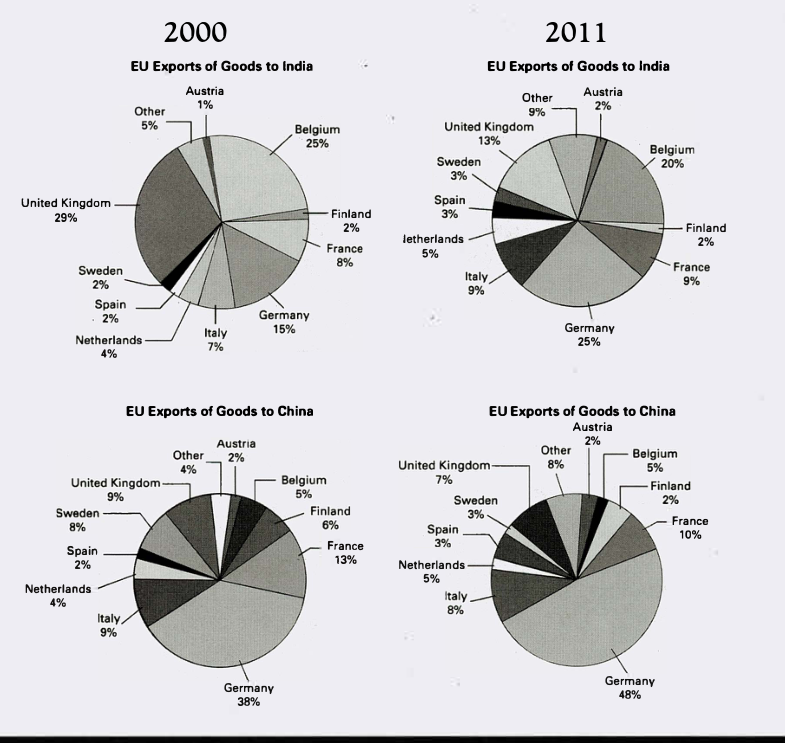
The pie charts below show exports from various EU countries to India and China in 2000 and 2011.
Summarise the information by selecting and reporting the main features, and make comparisons where relevant.
EU Exports of Goods to India and China in 2000 and 2011
Student answer (Band 6.0)
The pie charts compare the variance exportaion of goods to different two asian countries( China and India) from EU countries between 2000 and 2011
Overall, for India the United Kingdom was the first expolter then, it was replaced by Germany, while Germany recorded the highest part for China over the whole period. South european countries showed the lowest proportion.
For India, the United Kingdom was the first country with a remarkable percentage of exportation with 29% in 2000 to decline dramaticly into 13% in the next decade, followed by Belguim with 25%, and falled after with 5%, Germany came third with 15% and almost doubled in 2011, moreover, other south European countries registered the lowest rates in both years, with 8%, 7%, 4% and 2% respectively in 2000, and increased slightly in 2011 with less than 10% for all countries.
For China, Germany was the first exporter in both years with 38% in 2000 and 48% in 2011, furthermore, South European countries showed a closed low figures in both years with 13%, 9% and 2% respectively, for France, Italy and Spain in 2000 and fluctuated slightly in 2011. In addittion, the middle and north European countries demonstrated also a lwost shares with less than 10% for the two periods, where Austria raked last in both.
AI examiner evaluation
| Criterion | Band |
|---|---|
| Task Achievement / Task Response | 6.5 |
| Coherence and Cohesion | 6.5 |
| Lexical Resource | 5.5 |
| Grammatical Range and Accuracy | 5.5 |
| Overall | 6.0 |
Task Achievement / Task Response: Band 6.5
You identify the main patterns accurately: the UK’s share of exports to India fell, Germany’s rose to become the largest, and Germany dominated exports to China in both years. The overview also usefully notes that southern European countries generally had smaller shares. However, some details are unclear or inaccurate: Belgium’s Indian share fell from 25% to 20%, not by 5% as the wording “falled after with 5%” may suggest, and the claim that Austria ranked last for China in both years overlooks Finland’s 2% in 2011, equal to Austria. The broad grouping of countries as “south,” “middle” and “north” also leaves several figures and comparisons underdeveloped. More precise reporting of key changes would make the coverage more complete.
Coherence and Cohesion: Band 6.5
The response has a recognisable structure, with an introduction, an overview and separate paragraphs for India and China. This gives the reader a generally coherent route through the information. Linking expressions such as “Overall,” “For India” and “For China” help signal the stages of the report. However, some connections are mechanical or unclear, especially the long India sentence joined by “and,” “moreover” and commas. The sequence “followed by Belgium … Germany came third” is also difficult to follow because the comparison shifts without clear sentence boundaries. Grouping figures into shorter, logically ordered comparisons and using references such as “this share” more clearly would improve cohesion and progression.
Lexical Resource: Band 5.5
You attempt a range of task-related vocabulary, including “proportion,” “decline,” “registered” and “shares,” and the main meaning is usually recoverable. However, inaccurate word forms, spelling and collocations are noticeable and sometimes make the report harder to read. Examples include “variance exportaion,” “first expolter,” “dramaticly,” “falled,” “closed low figures” and “lwost shares.” Some expressions, such as “the first country with a remarkable percentage of exportation,” are also unnatural for describing chart rankings. Aim for precise, conventional language for proportions and changes, and check spelling and word forms carefully. The range is sufficient to discuss the charts, but control is not yet consistent.
Grammatical Range and Accuracy: Band 5.5
You use both simple statements and attempts at more complex sentences, including clauses introduced by “while” and “where,” so there is some variety. The overall meaning can generally be followed, but grammatical control is uneven. For example, “the United Kingdom was the first exporter then, it was replaced by Germany” joins two independent clauses with only a comma, while “Germany came third … and almost doubled in 2011” leaves the subject of the increase unclear. There are also problems with articles, number and sentence boundaries, as in “different two asian countries” and the extended sentences in both body paragraphs. Build complex sentences around one clear comparison at a time, and check agreement, articles and punctuation.
See this exact question answered at other band scores. The same prompt compared across bands.
Browse more IELTS Writing model answers or get your own writing scored by the same AI examiner.