Band 6.0 IELTS Writing Task 1 Model Answer
Overall Band Score: 6.0 · IELTS Momentum Workout · 2026-11-21
IELTS Writing Task 1 question
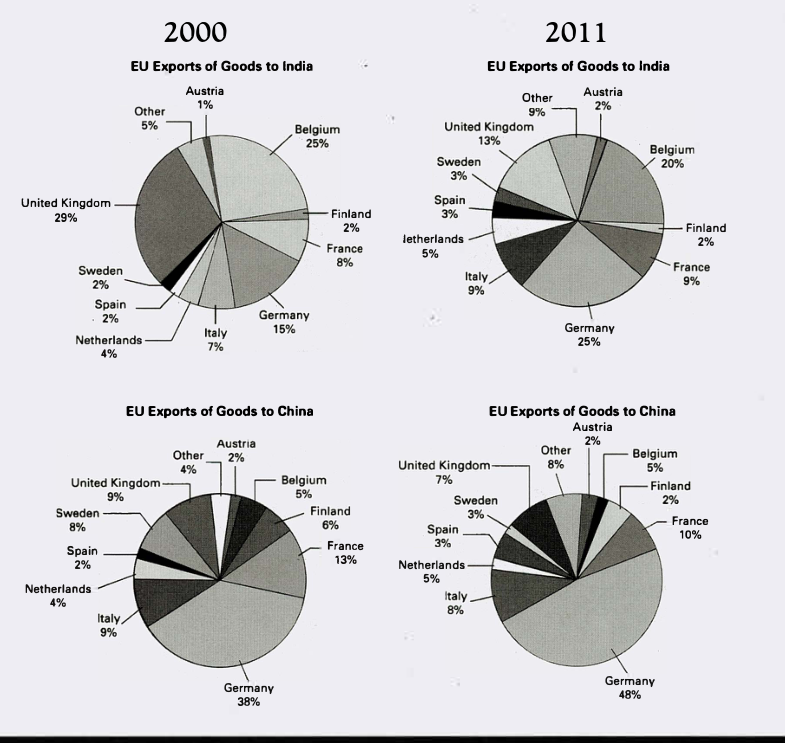
The pie charts below show exports from various EU countries to India and China in 2000 and 2011.
Summarise the information by selecting and reporting the main features, and make comparisons where relevant.
EU Exports of Goods to India and China in 2000 and 2011
Student answer (Band 6.0)
This pie chart demonstrates the data reflecting the exports of Goods from various european countries to India and China in year 2000 and 2011.
Overall the United Kingdom is the top exporter of the goods to the India in 2000 and in 2011 the Germany surpasses the UK and becomes the top goods exporter to the India Whereas in 2000 , the top Goods exporter to china was Germany and there was no competition at the top and like the year 2000, in 2011 Germany was also a top exporter to China and even increased its numbers in comparison to year 2000.
First we will get into the details of the Goods transported to the India, In 2000 the leader was UK with the 29% of the total exports and the second country was belgium with 25% and then Germany with 15% of the total Goods exported to India whereas in 2011 after 11 years the UK was dethroned and Germany became the leading Goods exporter to the India and Belgium gets second place and UK degraded from first to third among the biggest exporters of Goods to India.
Comparatively, To China, Germany remains the leading Goods exporter. In year 2000 Germany was responsible for 38% of Goods and in year 2011 it goes up to 48% of total Goods and there was no country even closer to the Germany.
AI examiner evaluation
| Criterion | Band |
|---|---|
| Task Achievement / Task Response | 6.5 |
| Coherence and Cohesion | 6.0 |
| Lexical Resource | 6.0 |
| Grammatical Range and Accuracy | 5.5 |
| Overall | 6.0 |
Task Achievement / Task Response: Band 6.5
You identify the main contrasts accurately: the UK led exports to India in 2000, Germany led in 2011, and Germany was the largest exporter to China in both years, rising from 38% to 48%. This gives the response a relevant overview and supports the key trends with figures. However, the India comparison is not fully precise: Belgium remained second in 2011 at 20%, while the UK fell to third at 13%; these figures are omitted, and “Germany surpasses the UK” could be clearer about the change in shares. Most other countries and changes are not covered, so some aspects are less fully reported. Including a few more selected figures and making the comparisons more exact would strengthen the summary.
Coherence and Cohesion: Band 6.0
The response has a clear overall arrangement: an introduction, an overview, and separate paragraphs for India and China. This helps the reader follow the main comparisons, and transitions such as “Overall” and “Comparatively” signal shifts in focus. However, some linking is mechanical or awkward, particularly “First we will get into the details,” which sounds conversational rather than like a concise report. The overview sentence is also overloaded, joining several ideas with “and” and “whereas,” while the India paragraph repeats the same ranking information. Use shorter, more clearly focused sentences and organise each paragraph around a distinct comparison. This would make progression smoother and reduce repetition.
Lexical Resource: Band 6.0
You use a reasonable range of task-related vocabulary, including “top exporter,” “leading,” “responsible for,” and “dethroned,” and the main meaning remains clear. There are, however, several imprecise or unnatural choices. “Goods transported” suggests physical movement rather than export shares, and “degraded from first to third” is not an appropriate collocation for a ranking. Repeated use of “Goods exporter” and “top” also limits variety. Capitalisation and spelling are inconsistent, as in “european” and “belgium.” Aim for precise terms such as “share of exports,” “accounted for,” and “ranked third,” while keeping the tone formal and avoiding unnecessary repetition.
Grammatical Range and Accuracy: Band 5.5
You attempt both simple and complex sentences, including comparisons with “whereas” and “in comparison to,” and the main message is generally understandable. Some grammatical errors remain, especially with articles, agreement, and sentence boundaries. Examples include “to the India” and “the Germany,” where the country names do not take “the,” and “Germany surpasses the UK and becomes,” which shifts into the present tense while describing past data. The long overview sentence beginning “Overall” also needs clearer punctuation and control of its clauses. Use the past tense consistently for the chart years, check subject–verb agreement, and divide long sentences into manageable units. These changes would improve accuracy without sacrificing structural variety.
See this exact question answered at other band scores. The same prompt compared across bands.
Browse more IELTS Writing model answers or get your own writing scored by the same AI examiner.