Band 6.0 IELTS Writing Task 1 Model Answer
Overall Band Score: 6.0 · IELTS Momentum Workout · 2026-11-22
IELTS Writing Task 1 question
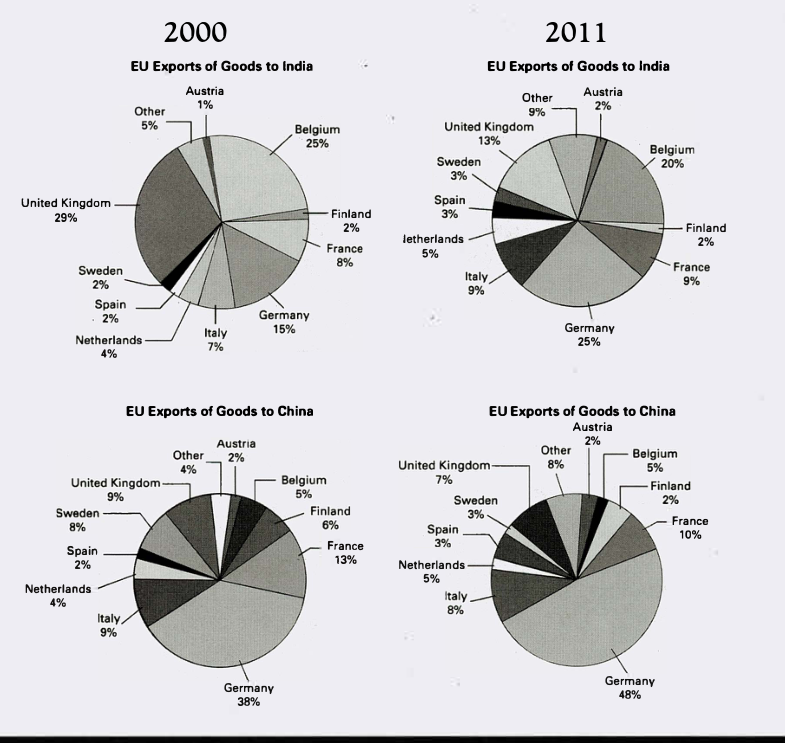
The pie charts below show exports from various EU countries to India and China in 2000 and 2011.
Summarise the information by selecting and reporting the main features, and make comparisons where relevant.
EU Exports of Goods to India and China in 2000 and 2011
Student answer (Band 6.0)
The pie charts illustrate exports of goods to countries India and China from different European countries in the two years 2000 and 2011.
Overall, Germany has the biggest share of exportation to China which is increased by almost 10% in 2011. Whereas,in the India most of the exportation takes place by United kingdom and Belgium in 2000 but Germany overtook the place in 2011. Least share was shown by the Austria followed by Spain.
EU exports were mostly by UK and Belgium of around 29% and 25% respectively. Both of which has shown the decline to 13% and 20% respectively. Germany gone through improvement of about 10% from 15% to 25%. Finland remained at the same rate that is 2%. Sweden and spain, both, showed a steady rise from 2% to 3% only.
However, in China, where Germany was at the peak, EU exportations increased from 38% to 48%. Belgium and Austria haven't shown and improvement and were at the same rate i.e. 5% and 2% respectively. Sweden has shown decline.
AI examiner evaluation
| Criterion | Band |
|---|---|
| Task Achievement / Task Response | 6.0 |
| Coherence and Cohesion | 6.0 |
| Lexical Resource | 5.5 |
| Grammatical Range and Accuracy | 5.5 |
| Overall | 6.0 |
Task Achievement / Task Response: Band 6.0
You identify the main contrast: Germany dominates exports to China and rises from 38% to 48%, while its share of exports to India increases from 15% to 25%, overtaking the UK. You also accurately report the UK and Belgium’s declines in India and note that Finland is unchanged. However, the overview is incomplete: it does not clearly summarise the contrasting distribution in China, where Germany’s share is far larger than any other country’s in both years. The statement that Austria had the smallest share, followed by Spain, is not consistently supported across the charts. Several useful changes are left undeveloped, including France’s decline in China and the changes in “Other.” A more balanced overview and more precise comparisons would make the response more complete.
Coherence and Cohesion: Band 6.0
The response has a recognisable structure, moving from an introduction and overview to details about India and then China. This makes the main subject easy to follow, and contrast markers such as “Overall” and “However” help signal shifts. Some connections are less clear or mechanical, though. “Whereas,in the India” is not smoothly attached to the preceding sentence, and “EU exports were mostly by UK and Belgium” does not clearly state that this paragraph concerns India. The final China paragraph is brief and ends with an undeveloped observation about Sweden. Grouping the figures more systematically—first comparing the two destinations, then describing the most important changes—would create clearer progression and stronger links between points.
Lexical Resource: Band 5.5
You use relevant chart vocabulary, including “share,” “decline,” “remained,” and “increased,” and the reader can generally understand the comparisons. However, several word choices and collocations are unnatural or imprecise: “share of exportation,” “EU exportations,” “shown an improvement,” and “at the peak” do not express the data as naturally as standard report language. “Improvement” also suggests a positive judgement rather than a change in percentage share. Country names and labels should be presented consistently, for example “the United Kingdom” or “the UK,” and “Spain” should be capitalised. A more precise range of terms for shares rising, falling, or remaining stable would improve clarity and control.
Grammatical Range and Accuracy: Band 5.5
You attempt a mixture of simple and more complex sentences, including a relative clause in “Germany, which is increased by almost 10%,” and a contrast introduced by “Whereas.” The meaning is usually recoverable, but some errors in verb forms, agreement, articles, and sentence construction remain. For example, “which is increased” should use a past-tense form such as “which increased,” while “Both of which has shown” has faulty agreement and is an incomplete sentence. “Germany gone through improvement” is missing an auxiliary, and “in the India” uses an unnecessary article. Punctuation is also inconsistent in “Whereas,in.” More accurate control of these patterns, alongside varied but complete sentences, would strengthen the response.
See this exact question answered at other band scores. The same prompt compared across bands.
Browse more IELTS Writing model answers or get your own writing scored by the same AI examiner.