Band 5.0 IELTS Writing Task 1 Model Answer
Overall Band Score: 5.0 · IELTS Momentum Workout · 2026-11-23
IELTS Writing Task 1 question
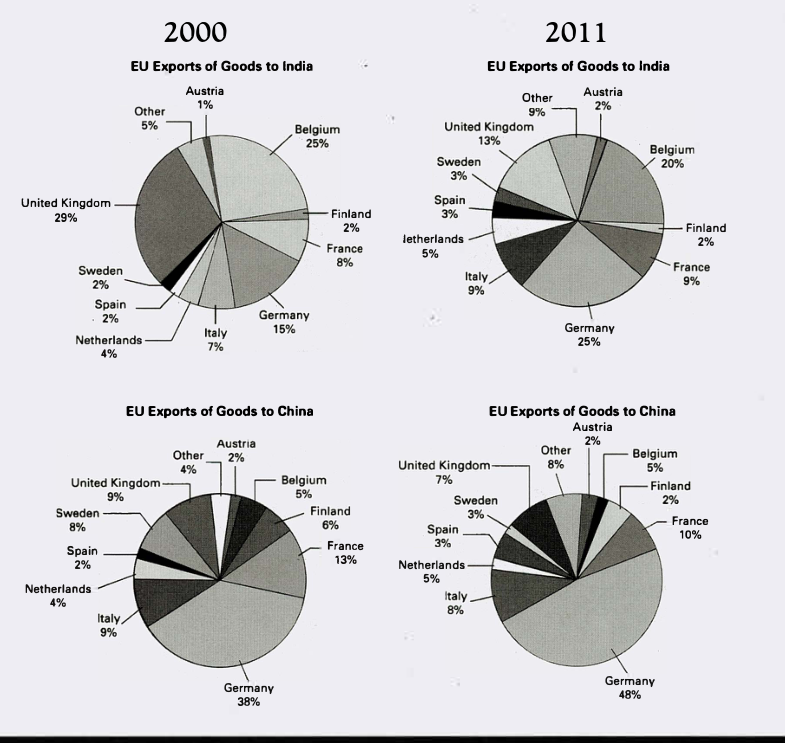
The pie charts below show exports from various EU countries to India and China in 2000 and 2011.
Summarise the information by selecting and reporting the main features, and make comparisons where relevant.
EU Exports of Goods to India and China in 2000 and 2011
Student answer (Band 5.0)
The piechart represents the exports of goods from may europe nations to the india and china in year 2000 and 2011 .
firstly , uk used to export about 29% of the goods from its own and secondly after the uk , belgium ranks on second place to export goods to india for about of 25% . then after this two bigs nations there are many nations who used to exports goods to the india like germany about 15% , italy 7% , netherland 4% and spain and sweden for total 2% and austria for 1% and many other nations for about total 5% and in year 2011 many nations started exporting goods on a large amount like germany about 25% , belgium for 20% , uk for 13% and italy for about 9% netherlands for 5% , spain and sweden for 3% in total while others nations export about 9% , there was a very big difference in the exorting ratio in year 2000 and 2011 .
while in year 2000 , germany was the biggest exporter of the china for about 38% and secondly france claiming about 13% and then uk and italy for 9% while in year 2011 germany stills rank on first place for exporting goods to china for about 48% then france for 10% , italy for 8% and uk for 7% , netherland and belgium goes about 5% . spain and sweden for 3% while 8% of other unnamed nations
AI examiner evaluation
| Criterion | Band |
|---|---|
| Task Achievement / Task Response | 5.0 |
| Coherence and Cohesion | 5.5 |
| Lexical Resource | 5.0 |
| Grammatical Range and Accuracy | 5.0 |
| Overall | 5.0 |
Task Achievement / Task Response: Band 5.0
You cover both destinations and both years, and several key figures are accurate: for example, the UK and Belgium led exports to India in 2000, while Germany was the largest exporter to China in both years. However, the response is mainly a list of figures rather than a clear summary of the main patterns. It does not provide a distinct overview, such as noting Germany’s growing dominance in China and the UK’s declining share in India. Some details are also inaccurate or unclear: Spain and Sweden each accounted for 2% of India’s exports in 2000, not 2% combined, and the 2011 India figures for Austria and France are omitted. Select the most important comparisons and state the overall trends explicitly.
Coherence and Cohesion: Band 5.5
The response has a basic, useful division between India and China, and it generally presents the 2000 figures before the 2011 figures for each destination. This gives the reader some sense of organisation. However, progression within the paragraphs is often difficult to follow because many figures are joined in long strings, with repeated sequencing such as “then” and “while.” The opening also does not lead into a clear overview, and the final paragraph ends without a concluding summary of the main contrasts. Use separate, focused paragraphs and clearer comparison links—for example, contrast Germany’s rising share in China with the UK’s fall in India—rather than listing country figures one after another.
Lexical Resource: Band 5.0
You use relevant topic vocabulary, including “exports,” “exporter,” “ratio,” and “biggest,” so the subject is usually understandable. However, the range is limited and several expressions are inaccurate or unnatural, which makes the account less precise. Phrases such as “used to export,” “from its own,” “ranks on second place,” and “exporting goods on a large amount” do not describe chart shares naturally. There are also spelling and word-form errors, including “piechart,” “exorting,” and “netherland.” Aim for standard chart language such as “accounted for,” “share,” “rose,” and “fell,” and check country names and spelling carefully.
Grammatical Range and Accuracy: Band 5.0
The response attempts to connect ideas in longer sentences, but these structures are often faulty, and sentence boundaries are not controlled consistently. For example, “firstly, uk used to export…” begins without appropriate capitalization, while the extended sentence beginning “then after this two bigs nations…” contains several clauses joined without clear punctuation. There are recurring problems with articles and number agreement, as in “the india and china” and “many nations started,” as well as verb forms such as “germany stills rank.” Most sentences therefore require the reader to work through grammatical errors. Build accuracy with shorter, complete sentences first, then add controlled comparisons using forms such as “Germany’s share rose from 38% to 48%.”
See this exact question answered at other band scores. The same prompt compared across bands.
Browse more IELTS Writing model answers or get your own writing scored by the same AI examiner.