Band 5.5 IELTS Writing Task 1 Model Answer
Overall Band Score: 5.5 · IELTS Momentum Workout · 2026-11-23
IELTS Writing Task 1 question
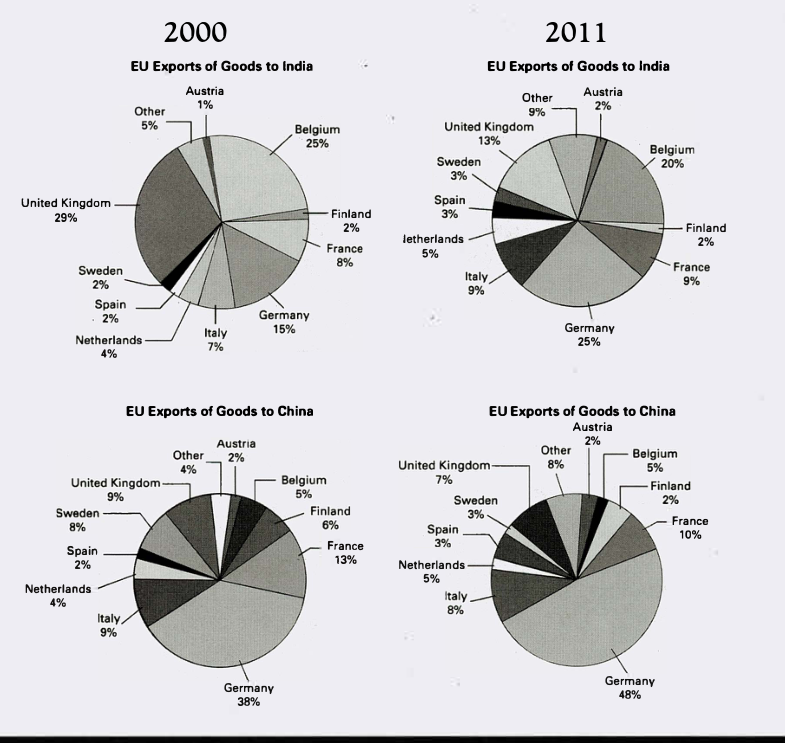
The pie charts below show exports from various EU countries to India and China in 2000 and 2011.
Summarise the information by selecting and reporting the main features, and make comparisons where relevant.
EU Exports of Goods to India and China in 2000 and 2011
Student answer (Band 5.5)
The pie charts demonstrates, proportion of exports of different EU countries to India in the year 2000 and 2011.
Overall, United Kingdom and Belgium are major Exporter EU nations to India, whereas one third of EU exporter country is Germnay to China in 2000. While a huge decline in United Kingdom exports to India with notible rise in Germnay export, On the other hand Germnay increases their export to china in 2011.
In the year 2000, more than half of EU exports to india was from United Kingdom 29% and Belgium 25%. Third highest exporter country was Germnay with 15%, while other countries like Sweden, Spain, Netherland, Italy, France, Finland and Autria exports less 10% each country. However in 2011, United Kingdom exports decline dramatilcally to 13%, with 5% decrease in Belgium but Germnay increases their export to India by 10%. While other EU countries approximatly remain same with little fluctuation.
Major export country to china from EU was germnay 38% in 2000. while other EU countries exports their good to China less than 15% each. while in 2011
AI examiner evaluation
| Criterion | Band |
|---|---|
| Task Achievement / Task Response | 5.5 |
| Coherence and Cohesion | 5.0 |
| Lexical Resource | 5.5 |
| Grammatical Range and Accuracy | 5.0 |
| Overall | 5.5 |
Task Achievement / Task Response: Band 5.5
You identify several important features accurately: the UK and Belgium were the largest contributors to India in 2000, and Germany’s share of exports to China was the largest in both years. You also report the UK’s fall to 13% and Germany’s rise to 25% for India correctly. However, the overview is incomplete and sometimes unclear: it does not summarise the strong dominance of Germany in China by 2011, when its share reached 48%. The response also stops before describing the 2011 China figures, leaving one of the four chart sets largely unreported. Some statements are too broad, such as saying other India exporters remained approximately the same without identifying notable changes. Select the main comparisons and cover both destinations across both years more fully.
Coherence and Cohesion: Band 5.0
The response has a basic structure, moving from an introduction and overview to details about India and then China. This gives the reader some sense of how the information is grouped. However, progression is weakened by abrupt or incomplete transitions, especially the final phrase, “while in 2011,” which leaves the China comparison unfinished. Several linking expressions are used inaccurately or repetitively, including “While” and “On the other hand,” and the overview combines multiple ideas in a way that is difficult to follow. Organise the body into clear comparisons—India in both years, followed by China in both years—and use linking words only where they show a genuine contrast or addition.
Lexical Resource: Band 5.5
You use some relevant chart vocabulary, including “proportion,” “decline,” “exports,” and “fluctuation,” and the reader can generally understand the intended comparisons. However, the range is limited and several word choices or collocations are awkward, such as “major Exporter EU nations,” “one third of EU exporter country,” and “exports their good.” Spelling errors—including “Germnay,” “dramatilcally,” and “Autria”—also make the writing less controlled. Use precise terms such as “share,” “accounted for,” and “contribution,” and check country names and common academic collocations carefully. This would make the descriptions clearer and more natural.
Grammatical Range and Accuracy: Band 5.0
You attempt both simple and more complex sentences, for example, “While a huge decline in United Kingdom exports to India with notible rise in Germnay export.” However, this is a fragment rather than a complete sentence, and several other structures are faulty or difficult to follow. In “The pie charts demonstrates,” the subject and verb do not agree; “Germany increases their export” also has an agreement problem and an unclear tense for past data. Articles and sentence boundaries are inconsistent, and the final China sentence is unfinished. Practise complete sentences with a clear subject and verb, and use the past tense consistently when reporting 2000 and 2011 figures.
See this exact question answered at other band scores. The same prompt compared across bands.
Browse more IELTS Writing model answers or get your own writing scored by the same AI examiner.