Band 5.0 IELTS Writing Task 1 Model Answer
Overall Band Score: 5.0 · IELTS Momentum Workout · 2026-11-24
IELTS Writing Task 1 question
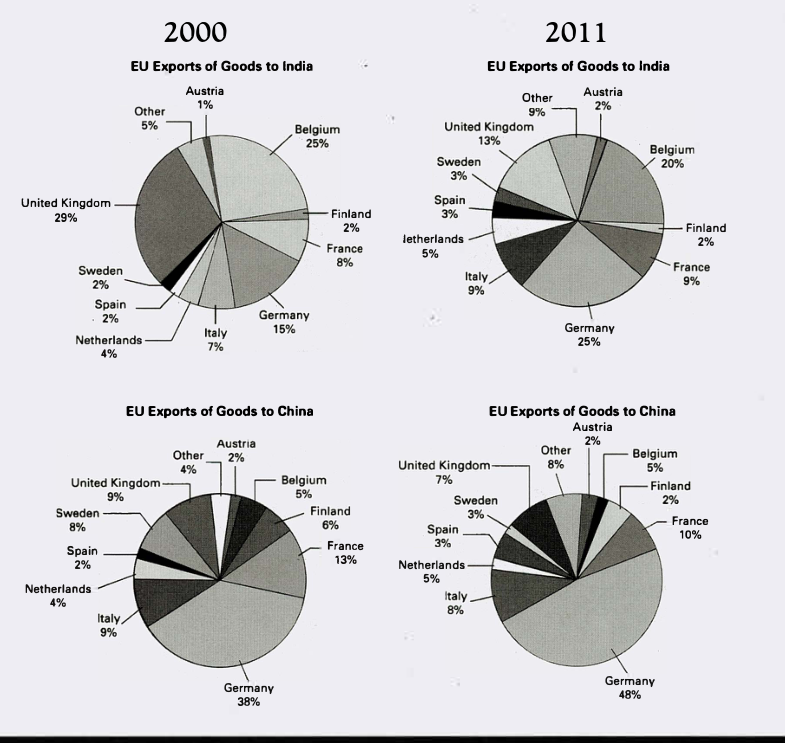
The pie charts below show exports from various EU countries to India and China in 2000 and 2011.
Summarise the information by selecting and reporting the main features, and make comparisons where relevant.
EU Exports of Goods to India and China in 2000 and 2011
Student answer (Band 5.0)
The charts below illustrates exports from EU countries like Austria, Belgium, Finland, France, Germany, Italy, Netherlands, spain, Sweden and United Kingdom to China and India in years 2000 and 2011.
Overall, in the years 2000 and 2011 there was a significant reduction in the supplies of goods from The United Kingdom to India. Exports to China in 2000 and 2011 Germany increased sightly.
EU exports of goods to india in 2000 and 2011 there was a significant increase overall in all countries like Italy, Netherlands, Spain, Italy, Sweden,
EU exports to China in 2000 and 2011 increased only in Germany while in other countries it reduced slightly.
AI examiner evaluation
| Criterion | Band |
|---|---|
| Task Achievement / Task Response | 4.0 |
| Coherence and Cohesion | 5.0 |
| Lexical Resource | 5.5 |
| Grammatical Range and Accuracy | 5.0 |
| Overall | 5.0 |
Task Achievement / Task Response: Band 4.0
You identify the countries and the two years, and your overview attempts to highlight changes for India and China. However, the response reports the data only minimally and includes a major inaccuracy: exports to China did not increase only for Germany, since the Netherlands, Spain and “Other” also rose. The claim that exports to India increased overall across the listed countries is also too broad; several shares fell, including the UK and Belgium. Important comparisons, such as Germany’s leading share in China and the UK’s fall in India, need accurate supporting figures. The response is also 43 words below the required minimum, leaving the main features substantially underdeveloped. Select the clearest trends and support them with a few correct percentages.
Coherence and Cohesion: Band 5.0
There is a basic structure: an opening sentence, an overview, and separate statements about India and China. This gives the reader some sense of how the response is organised. However, progression is limited because the final two paragraphs are incomplete or repetitive, and the India paragraph ends abruptly after a list of countries. The overview’s two points are not clearly connected to the later details, which are too sparse to develop the comparisons. Cohesive links are also limited, with repeated openings such as “EU exports … in 2000 and 2011.” Use complete paragraphs with a clear purpose: introduce the charts, summarise the main contrasts, then group the most important changes by destination.
Lexical Resource: Band 5.5
The response uses relevant basic terms such as “exports,” “goods,” “reduction,” and “increased,” so the topic is generally clear. However, the vocabulary is repetitive and some choices are imprecise: “supplies of goods” is less suitable than “share of exports,” while “increased slightly” would be more accurate than “increased sightly” and should describe a specific share. There are also spelling and capitalisation slips, including “spain,” “india,” and “sightly.” The repeated use of “significant” is not supported by figures and makes the description less precise. Build a small range of chart language—such as “accounted for,” “rose,” “declined,” and “remained stable”—and use it with accurate data.
Grammatical Range and Accuracy: Band 5.0
You attempt several sentence forms, including an overview beginning “Overall” and a sentence contrasting exports to China. Nevertheless, control is uneven, and errors sometimes make the intended meaning difficult to follow. For example, “The charts below illustrates” has a subject–verb agreement error, and “Exports to China in 2000 and 2011 Germany increased” has an unclear sentence structure. The India paragraph is a fragment rather than a complete sentence, and the final sentence uses “it” without a clear reference. There is little variety beyond simple statements and repeated time phrases. Practise writing complete subject–verb sentences, checking agreement, and using clear comparisons such as “Germany’s share rose from 38% to 48%.”
See this exact question answered at other band scores. The same prompt compared across bands.
Browse more IELTS Writing model answers or get your own writing scored by the same AI examiner.