Band 6.0 IELTS Writing Task 1 Model Answer
Overall Band Score: 6.0 · IELTS Momentum Workout · 2026-11-25
IELTS Writing Task 1 question
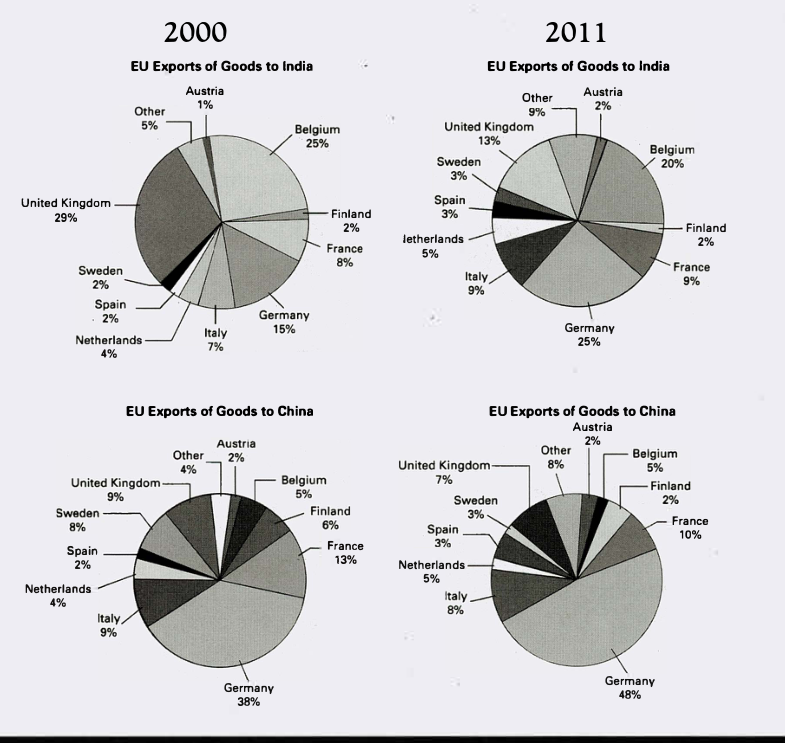
The pie charts below show exports from various EU countries to India and China in 2000 and 2011.
Summarise the information by selecting and reporting the main features, and make comparisons where relevant.
EU Exports of Goods to India and China in 2000 and 2011
Student answer (Band 6.0)
The pie chart shown in image depicts the exports of goods to India and China in 2000 and 2011. These charts highlight the countries that were the main source of goods import for China and India in those calendar years.
In 2000, India import the major portion of goods from United Kingdom while Germany was the second largest country to export the goods to India. Whereas, Germany was on the top of the list among the countries who export goods to China with 38% and France was next to Germany with 13% of total goods export.
Germany replaced United Kingdom as the largest exporter with total of 25% of goods export in 2011 to India. United Kingdom was leading the exports back in 2000 with difference of 14% as compared to Germany. On the other hand now in 2011, Germany has surpassed United Kingdom with a difference of 12%. For China, Germany remained as the top exporter in 2011 as well with total exports of 48%.
The stats overall shows that Germany has progressed a lot in exporting goods to China and India in 2011 as compared to that of 2000. They also cover all other countries on which the import of goods for India and China is dependent.
AI examiner evaluation
| Criterion | Band |
|---|---|
| Task Achievement / Task Response | 6.0 |
| Coherence and Cohesion | 6.0 |
| Lexical Resource | 6.0 |
| Grammatical Range and Accuracy | 5.5 |
| Overall | 6.0 |
Task Achievement / Task Response: Band 6.0
You identify the main shifts accurately: the UK led exports to India in 2000, Germany became the largest supplier there by 2011, and Germany remained dominant in China, rising from 38% to 48%. The comparison that Germany overtook the UK in India is a relevant overview feature. However, coverage is uneven: you give useful detail for the leading exporters but say little about the other countries or the broader contrast between the two destinations. The final claim that the charts show which countries India and China’s imports are “dependent” on is stronger than the data supports. A fuller summary would select a few additional notable changes, such as the UK’s fall in India and Germany’s increasing share in both markets.
Coherence and Cohesion: Band 6.0
The response has a clear overall sequence: an introduction, discussion of 2000, comparison with 2011, and a concluding statement. Time markers such as “In 2000” and “in 2011,” together with “On the other hand,” help readers follow the comparisons. However, some links are mechanical or unclear. “Whereas” begins a sentence without a clear paired clause, and “On the other hand now in 2011” combines transitions awkwardly. The final paragraph repeats the general point about Germany rather than adding a distinct summary of the main patterns. Grouping the information by destination, and using clearer links between each year’s figures, would make progression more controlled.
Lexical Resource: Band 6.0
You use an adequate range of task-related vocabulary, including “largest exporter,” “surpassed,” “exports,” and “difference,” so the main comparisons are understandable. There are also attempts at more formal phrasing, such as “remained as the top exporter.” Some choices are inaccurate or unnatural, however: “main source of goods import” confuses the direction of trade, while “the stats overall” and “progressed a lot” are informal or imprecise for an academic summary. Repetition of “goods,” “export,” and “countries” also limits flexibility. Use precise terms such as “share of EU exports” and “accounted for,” and vary the language used to describe increases, decreases, and rankings.
Grammatical Range and Accuracy: Band 5.5
You attempt a mix of simple and more complex sentences, including comparisons with “while” and “as compared to,” and most of the intended meaning remains clear. Some grammatical errors are noticeable, particularly in verb forms and sentence construction. For example, “India import” should be “India imported,” and “countries who export goods” needs a past-tense form such as “countries that exported goods.” The clause beginning “Whereas” is incomplete as written, and “The stats overall shows” has a subject–verb agreement error. Articles and phrasing also need attention in “with total of 25%.” Check tense consistency when describing past data and ensure each sentence has a complete, correctly linked clause.
See this exact question answered at other band scores. The same prompt compared across bands.
Browse more IELTS Writing model answers or get your own writing scored by the same AI examiner.