Band 5.5 IELTS Writing Task 1 Model Answer
Overall Band Score: 5.5 · IELTS Momentum Workout · 2026-11-25
IELTS Writing Task 1 question
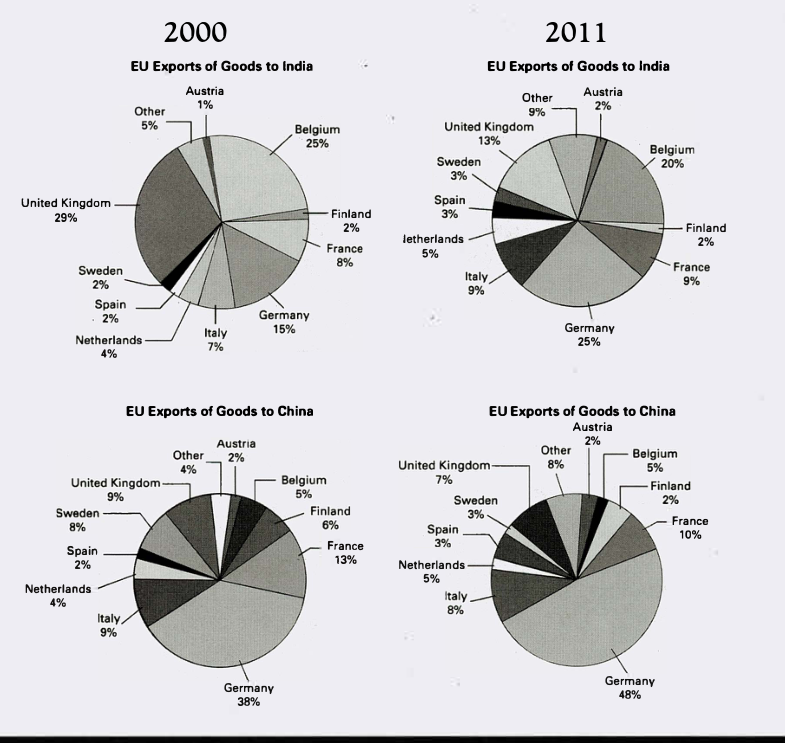
The pie charts below show exports from various EU countries to India and China in 2000 and 2011.
Summarise the information by selecting and reporting the main features, and make comparisons where relevant.
EU Exports of Goods to India and China in 2000 and 2011
Student answer (Band 5.5)
The pie charts compare the percentages of goods exported from EU countries to India and China in 2000 and 2011.
Overall, Germany become the largest exporter to both countries by 2011. Exports to India were led by the UK in 2000, while Germany had the biggest share in China in both years. The UK's fall in both markets.
In 2000, the UK and Belgium were the main exporters to India, at 29% and 25% respectively. Germany accounted for 15%, while the figure for France and Italy were 8% and 7% respectively. By 2011,Germany had risen to 25%, becoming the leading exporter. Belgium and UK fell to 20% and 13%.
For China, Germany already had highest share in 2000, at 38% and this increased to 48%.in 2011. France's figure decreased from 13% to 10%, while the UK's share dropped from 9% to 7%. Italy also fell slightly, from 9% to 8%.
AI examiner evaluation
| Criterion | Band |
|---|---|
| Task Achievement / Task Response | 5.5 |
| Coherence and Cohesion | 5.5 |
| Lexical Resource | 6.0 |
| Grammatical Range and Accuracy | 5.5 |
| Overall | 5.5 |
Task Achievement / Task Response: Band 5.5
You identify the main patterns accurately: the UK led India’s exports in 2000, Germany became the largest supplier to India by 2011, and Germany dominated China in both years, rising from 38% to 48%. The comparisons for France, the UK and Italy in the China figures are also correct. However, the overview is weakened by the inaccurate statement that Germany became the largest exporter to both countries by 2011; it was already largest for China in 2000. You also cover only a selection of the data, with little comparison of smaller shares or changes such as Belgium’s decline in India. The response is 140 words, below the 150-word minimum. Add a concise comparison of further key changes and clarify the overview.
Coherence and Cohesion: Band 5.5
The response has a recognisable structure: an introduction and overview are followed by separate paragraphs about India and China. This makes the two markets easy to distinguish, and time comparisons are generally presented in a sensible order. However, progression is weakened by the abrupt, incomplete sentence “The UK's fall in both markets,” which interrupts the overview and leaves the point undeveloped. Some links between figures are also basic, relying mainly on “while” and “by 2011.” Improve cohesion by making the overview a complete, connected summary and using clearer transitions to show contrasts and changes. The paragraphing is appropriate, but the links between ideas are not consistently smooth.
Lexical Resource: Band 6.0
You use an adequate range of task-relevant vocabulary, including “accounted for,” “share,” “led,” “increased,” and “dropped.” These terms help describe proportions and trends clearly, and the meaning is generally easy to follow. Some wording is repetitive, particularly repeated references to “figure” and “share,” and “Germany become the largest exporter” is an imprecise description of the chart’s country shares. More precise expressions such as “accounted for the largest proportion of EU exports” would suit the data better. Varying trend language and using accurate collocations would make the report more flexible and precise; for example, describe a share as “rose” or “declined” rather than repeatedly saying it “fell” or “increased.”
Grammatical Range and Accuracy: Band 5.5
You use a mix of simple statements and comparative clauses, as in “France's figure decreased from 13% to 10%, while the UK's share dropped from 9% to 7%.” Most relationships between figures remain understandable. However, some errors affect accuracy and fluency: “Germany become” needs the past form “became,” and “the figure for France and Italy were” has a subject–verb agreement error (“figures … were”). The sentence “The UK's fall in both markets” is a fragment, while “48%.in 2011” has faulty punctuation and sentence separation. There are also missing spaces after commas. Check verb forms, agreement, complete sentence structure and punctuation, while continuing to use comparative clauses.
See this exact question answered at other band scores. The same prompt compared across bands.
Browse more IELTS Writing model answers or get your own writing scored by the same AI examiner.