Band 5.5 IELTS Writing Task 1 Model Answer
Overall Band Score: 5.5 · IELTS Momentum Workout · 2026-11-26
IELTS Writing Task 1 question
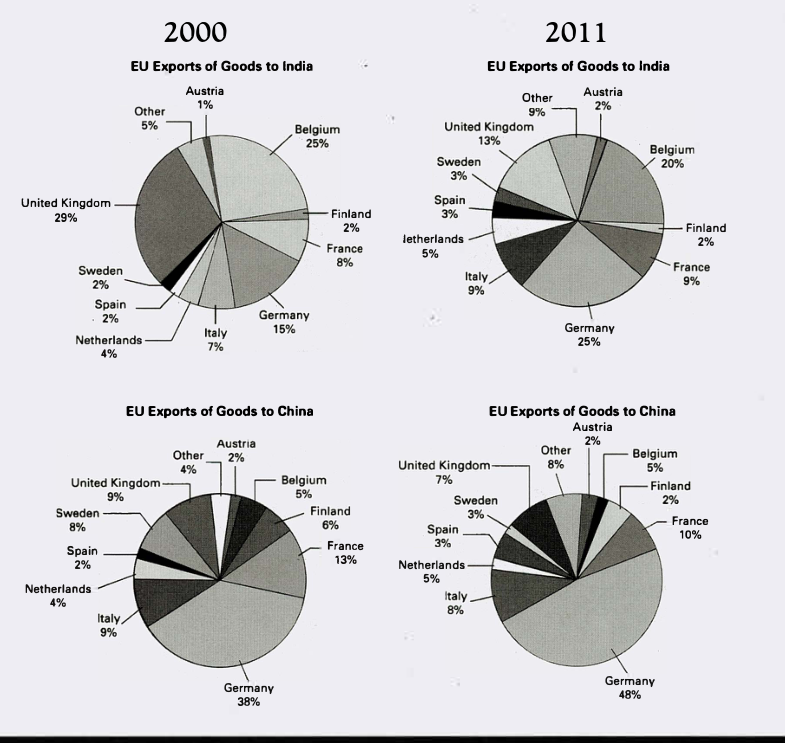
The pie charts below show exports from various EU countries to India and China in 2000 and 2011.
Summarise the information by selecting and reporting the main features, and make comparisons where relevant.
EU Exports of Goods to India and China in 2000 and 2011
Student answer (Band 5.5)
The pie charts compare proportion of goods exported by EU countries to India and China in 2000 and 2011.
Overall, Germany remained as prominent exporter throughout the period. UK exports to India declined sharply while for china it remained steady. Belgium maintained its outflows for both countries.
In 2000, UK accounted for 29% and 9% of total exports to India and China respectively, making UK major source for india but in 2011 this number sharply fell to 13% while for China it merely chopped down to 7%. Belgium being the second largest exporter for India in 2000 with 25% of volume, moved to third place in 2011 with 20% of exports. Belgium exports to China remained constant for China in both periods.
On the contrary, Germany, having third spot in 2000, for India with 15% of goods supply showed incremental growth of 25% in 2011. Similarly, Germany exports to China surged by 10%, which initially stood at 38% in 2000.
AI examiner evaluation
| Criterion | Band |
|---|---|
| Task Achievement / Task Response | 5.5 |
| Coherence and Cohesion | 5.5 |
| Lexical Resource | 5.5 |
| Grammatical Range and Accuracy | 5.5 |
| Overall | 5.5 |
Task Achievement / Task Response: Band 5.5
You identify the main contrast between India and China and include relevant figures, particularly the UK’s fall in India’s share (29% to 13%) and Germany’s rise in China (38% to 48%). However, the overview is partly inaccurate: China’s UK share did not remain steady, but fell from 9% to 7%, and Belgium’s shares did not remain constant in both markets, since its India share declined from 25% to 20%. The report also covers only a few countries and leaves out notable changes such as Germany’s rise in India and the shifts in France and the “Other” category. Some comparisons are therefore underdeveloped, and the overview needs to summarise the dominant patterns more precisely.
Coherence and Cohesion: Band 5.5
The response has a recognisable structure: an introduction, an overview and two detail paragraphs. The comparisons are generally grouped by country, and phrases such as “In 2000” and “On the contrary” signal movement between points. However, progression is limited because the final paragraph focuses on Germany without bringing the main comparisons together, and several links are awkward or unclear. For example, “Belgium exports to China remained constant for China in both periods” repeats information and is imprecise, while “Similarly” does not clearly explain the relationship between Germany’s figures for the two destinations. Organise details more systematically by destination or by the largest changes, and use referencing that makes each comparison easy to follow.
Lexical Resource: Band 5.5
You use some task-relevant vocabulary, including “accounted for,” “declined sharply,” “prominent exporter” and “surged,” which helps describe proportions and change. However, several choices are inaccurate or unnatural for this chart description: “chopped down” is not an appropriate way to describe a small decline, “outflows” does not clearly mean export shares, and “incremental growth of 25%” confuses a share reaching 25% with growth by 25%. There is also repetition of “exports” and “China,” and inconsistent capitalisation of “UK,” “India” and “China.” Aim for precise terms such as “share,” “rose to,” and “fell from … to …,” while varying wording without sacrificing accuracy.
Grammatical Range and Accuracy: Band 5.5
The response attempts a mixture of simple and more complex sentences, including clauses beginning “while” and “having third spot.” Meaning is usually recoverable, but grammatical control is uneven. The opening needs an article (“compare the proportion”), and “Germany remained as prominent exporter” has an incorrect construction and missing article. The sentence beginning “Belgium being the second largest exporter” is a fragment-like construction, while “Germany, having third spot in 2000, for India…” is difficult to parse because the sentence elements are not arranged clearly. There are also inconsistent capital letters for country names. Build comparisons with complete, direct sentence patterns and check articles, clause structure and punctuation.
See this exact question answered at other band scores. The same prompt compared across bands.
Browse more IELTS Writing model answers or get your own writing scored by the same AI examiner.