Band 5.5 IELTS Writing Task 1 Model Answer
Overall Band Score: 5.5 · IELTS Momentum Workout · 2026-11-28
IELTS Writing Task 1 question
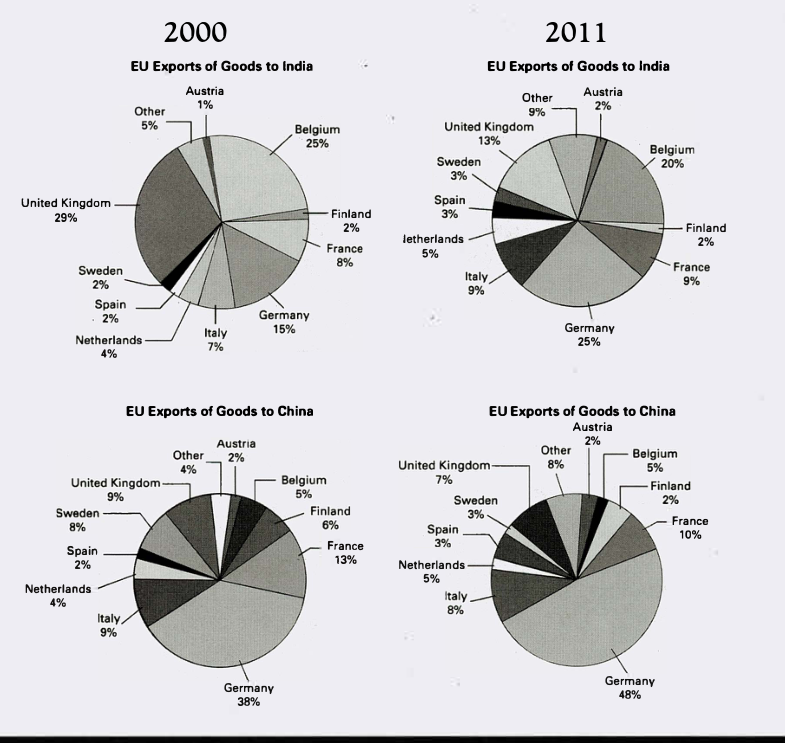
The pie charts below show exports from various EU countries to India and China in 2000 and 2011.
Summarise the information by selecting and reporting the main features, and make comparisons where relevant.
EU Exports of Goods to India and China in 2000 and 2011
Student answer (Band 5.5)
The pie charts illustrate the proportions of goods from numerious europian countries to China and India in 2000 and 2011.
Overall, It is clear that Germany accounted for the highest share of things to China in both years. Whereas, United kingdom made up more share to india in former year and then Germany took over supply later. In contrast, Austria supplied a negligible amount in both years to China and India.
Germany contribution in export to China rose from 38 to 48 percent by 2011 while Belgium Austria,spain,Neitherland and Italy almost maintained the same level in both years with 5,2,2,4 and 9 percent. There is a drop of Finland and Sweden from 6,8 to 2 and 3 percent.
AI examiner evaluation
| Criterion | Band |
|---|---|
| Task Achievement / Task Response | 5.0 |
| Coherence and Cohesion | 5.5 |
| Lexical Resource | 5.5 |
| Grammatical Range and Accuracy | 5.5 |
| Overall | 5.5 |
Task Achievement / Task Response: Band 5.0
You identify several important features, including Germany’s leading share of exports to China and the UK’s prominence in India in 2000, and you correctly report Germany’s rise in China from 38% to 48%. However, the response addresses the charts only partially: it gives almost no account of India in 2011 and omits key changes such as the UK’s fall in India from 29% to 13%, while Germany there rose from 15% to 25%. The overview is also imprecise: Austria’s shares are small, but calling them negligible is less informative than comparing the main exporters. The response is 118 words, below the required 150, which contributes to the limited coverage. Select and compare the main trends across both destinations more fully.
Coherence and Cohesion: Band 5.5
The response has a basic overall structure: an introduction, an overview, and a paragraph with figures. This helps the reader distinguish general observations from supporting detail. However, the progression is incomplete because the final paragraph discusses China only, without a clear transition to the substantial changes in India. Some linking is awkward or mechanical, as in “Whereas” beginning a sentence fragment and “In contrast” introducing a point that is not a clear contrast. The long final sentence also groups several countries and figures together, making the comparisons harder to follow. Organise the body by destination or by the most important changes, and use linking phrases to show the relationship between each comparison.
Lexical Resource: Band 5.5
You use some relevant chart vocabulary, including “proportions,” “accounted for,” “share,” and “rose,” so the main subject is generally understandable. However, the range is limited and several choices are inaccurate or unnatural for describing exports. “Things” is too vague, and “made up more share” and “took over supply” do not express the data precisely. There are also noticeable spelling errors, such as “numerious,” “europian,” “Neitherland,” and “spain.” These reduce the accuracy and polish of the report, even though the intended meaning can usually be inferred. Use precise terms such as “share of exports” and “accounted for,” and check country names and spelling carefully.
Grammatical Range and Accuracy: Band 5.5
You attempt some sentence variety, including a comparison with “while” and a sentence beginning “Overall,” and most of the intended meaning remains understandable. However, control is uneven, particularly in sentence boundaries, punctuation, and sentence construction. “Whereas, United kingdom made up more share to india in former year and then Germany took over supply later” is not a complete, well-formed comparison, and the comma after “Whereas” is unnecessary. In “Germany contribution in export to China rose,” the possessive form is missing, and the final sentence has unclear punctuation and structure. Capitalisation of country names is also inconsistent. Practise complete comparison sentences and check articles, possessives, and punctuation when editing.
See this exact question answered at other band scores. The same prompt compared across bands.
Browse more IELTS Writing model answers or get your own writing scored by the same AI examiner.