Band 5.0 IELTS Writing Task 1 Model Answer
Overall Band Score: 5.0 · IELTS Momentum Workout · 2026-11-28
IELTS Writing Task 1 question
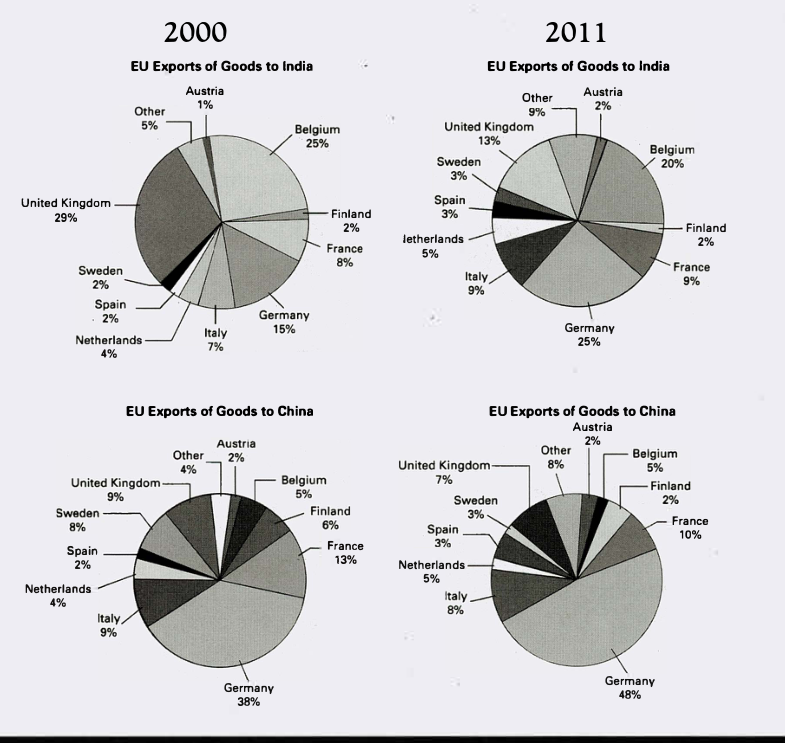
The pie charts below show exports from various EU countries to India and China in 2000 and 2011.
Summarise the information by selecting and reporting the main features, and make comparisons where relevant.
EU Exports of Goods to India and China in 2000 and 2011
Student answer (Band 5.0)
European union exports from Goods from india in 2001 and 2001 have very slight differences.Some countries of EU increses their exports from in 2001 as compared to the year 2000.The country which make a bigger increases in the rate of exports from india in 2011 as compared to 2000 is Germany they increase their export rate about 10%.While some countries like Swedwn,Spain,France and Netherland brought only 1% increase in thier export after 11 years.Austria decrease their exports to 1% and Belgium reduces the rate about 5%.But the United Kingdom bring the biggest increase of 13% in thier exports with india after 11 years.
EU exports of good to China remains almost same in 11 years.Geramy made the biggest increase of 1o% in these years.Italy,Netherland and Spain made the increase of 1%.Finland made the change of 4%.While France decrease this rate to 3%.Other countries brought the increase of 4%.
AI examiner evaluation
| Criterion | Band |
|---|---|
| Task Achievement / Task Response | 4.0 |
| Coherence and Cohesion | 5.5 |
| Lexical Resource | 5.0 |
| Grammatical Range and Accuracy | 5.0 |
| Overall | 5.0 |
Task Achievement / Task Response: Band 4.0
You identify the two destinations and report several changes, including Germany’s rise in exports to China and the UK’s fall in its share of exports to India. However, the response does not give a clear overview of the main patterns, and some figures or directions are misreported: the UK’s India share fell from 29% to 13%, rather than increasing by 13%, while Austria rose from 1% to 2%, rather than decreasing. The claim that China exports remained “almost same” also overlooks Germany’s dominant and growing share. The response is 148 words, below the required 150. To improve, summarise the dominant features accurately and compare the largest changes across both charts.
Coherence and Cohesion: Band 5.5
The response has a basic, useful division: the first paragraph discusses India and the second China. This gives the reader some sense of organisation, and words such as “while” and “as compared to” attempt to connect comparisons. However, there is little overall progression from an overview to supporting details, and several sentences read as a list of country-by-country changes. Some links are awkward or unclear, particularly “While France decrease this rate to 3%,” which does not clearly connect to the preceding point. Use a brief opening overview, then group the most important increases and decreases, with accurate linking phrases such as “by contrast” and “whereas”.
Lexical Resource: Band 5.0
You use relevant topic vocabulary, including “exports,” “increase,” “decrease,” and “rate,” so the subject is generally recognisable. However, the range is limited and several words or phrases are repeated, especially “increase” and “exports.” Some choices are inaccurate or unnatural: “bigger increases in the rate” and “brought the increase” are not idiomatic ways to describe chart changes. There are also spelling errors such as “increses,” “Swedwn,” “thier,” and “Geramy,” which reduce clarity. Build a more precise set of chart-description expressions, such as “share,” “accounted for,” “rose by,” and “declined from … to …,” and check spelling carefully.
Grammatical Range and Accuracy: Band 5.0
The response communicates its general subject, but grammatical control is inconsistent and the sentence patterns are mostly simple, with some attempted longer constructions that are faulty. For example, “The country which make a bigger increases … is Germany they increase” contains problems with agreement and sentence boundaries. “Finland made the change of 4%” and “France decrease this rate” also show errors in verb form and sentence construction. Tense and number are not consistently controlled, and punctuation is often missing after sentence openings or between clauses. Practise forming clear past-tense comparison sentences, for example, “Germany’s share rose from 15% to 25%,” and use full stops to separate complete ideas.
See this exact question answered at other band scores. The same prompt compared across bands.
Browse more IELTS Writing model answers or get your own writing scored by the same AI examiner.