Band 5.0 IELTS Writing Task 1 Model Answer
Overall Band Score: 5.0 · IELTS Momentum Workout · 2026-11-08
IELTS Writing Task 1 question
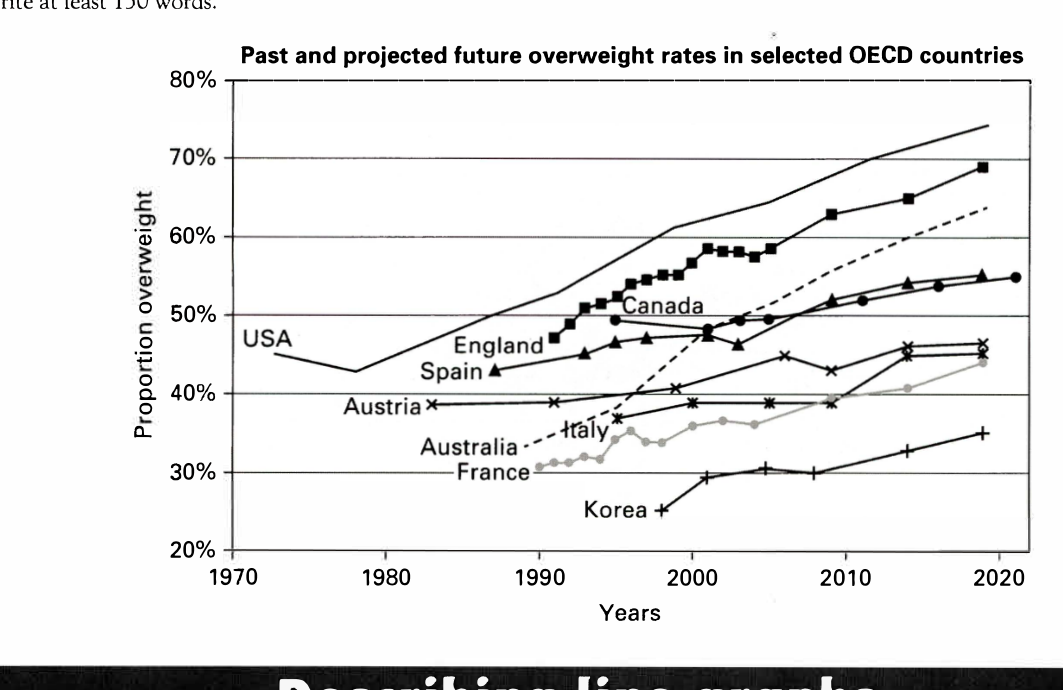
The line graph below shows past and current overweight rates, as well as a projected future overweight rate in nine selected countries.
Summarise the infonnation by selecting and reporting the main features, and make comparisons where relevant.
Past and projected future overweight rates in selected OECD countries
Student answer (Band 5.0)
The graphs illustrate the trends of overwieght in nine different region of the world and demonstrate a comparison bwtween future and past rates.
In nine diffrent countaries USA,England.Canada,Spain,Austria,Italy,France,Korea the BMI rates with respect to population has been increasing with each passing year.USA has maximum number of overweight population throughout the years starting from 50% to crossing the highest rate of 70% while Korea shows zero number of people for almost 25 years from 1970 to somewhere between 1995,however from 1997 to onwards 2020 there is minimum increase in overwieght people about 35%. While other countaries shoe a positive trand as well.Meawhile canada has almost constant rate throughout years starting from 1995 it has percentage of almost 50 and ends at 55% in the year of 2020.Second highest is England starting from year of 1990 with 49% and ends in 2020 with maximum percentage of 70%. While other countaries shows same trends like these france start from 30% and ends at 45
AI examiner evaluation
| Criterion | Band |
|---|---|
| Task Achievement / Task Response | 4.5 |
| Coherence and Cohesion | 4.5 |
| Lexical Resource | 5.0 |
| Grammatical Range and Accuracy | 5.0 |
| Overall | 5.0 |
Task Achievement / Task Response: Band 4.5
The response identifies the broad upward pattern and gives a few relevant comparisons, including the USA’s high rates, Korea’s low level, and Canada’s rise from about 50% to 55%. However, coverage is partial and several details are inaccurate: the USA begins at about 45%, not 50%; Korea does not show zero overweight rates, and its data begin around 1998 at 25%; England starts near 47%, rather than 49%. The overview is also incomplete: it does not clearly compare the countries’ overall positions or describe the projected endpoint, and most countries receive little or no specific reporting. To strengthen the response, select the main high and low trends, report them accurately, and include a concise overview of the overall pattern and forecast.
Coherence and Cohesion: Band 4.5
There is some attempt to group information by country, and linking expressions such as “while” and “meanwhile” show an effort to connect comparisons. However, the response is presented as one dense paragraph, so the overview and supporting details are not clearly separated. The sequence moves from the USA to Korea, Canada, England, and France without a consistent organising principle, and “other countries” is repeated without specifying which trends are being compared. The final sentence also ends abruptly. Use a clear introduction and overview, followed by logically grouped details—for example, the highest-rate countries and then the lower-rate countries—and make each comparison explicit.
Lexical Resource: Band 5.0
The response uses some task-relevant vocabulary, including “percentage,” “rate,” “increasing,” and “constant,” and the general subject remains understandable. However, the range is limited and several word choices or collocations are inaccurate, such as “maximum number of overweight population,” “zero number of people,” and “positive trend.” Repeated use of “countaries” and “overweight” also makes the writing less precise, while spelling errors such as “overwieght,” “diffrent,” and “Meawhile” are noticeable. Aim for accurate chart language and varied terms such as “proportion,” “share,” and “rose.” Check spelling carefully and describe rates rather than numbers of people when the graph reports percentages.
Grammatical Range and Accuracy: Band 5.0
The response attempts longer sentences and uses some subordinate links, for example, “while Korea shows…” and “starting from 1995,” but sentence structures are often difficult to follow. Errors in agreement and sentence construction appear in phrases such as “nine different region,” “other countaries shows,” and “USA has maximum number.” Punctuation is also weak: several ideas are joined into long sentences, and the opening list, “USA,England.Canada,” is not punctuated clearly. Tense and phrasing are inconsistent, as in “starting from year of 1990 with 49% and ends in 2020.” Practise writing shorter, complete sentences with consistent subject–verb agreement, clear articles and plurals, and accurate punctuation.
See this exact question answered at other band scores. The same prompt compared across bands.
Browse more IELTS Writing model answers or get your own writing scored by the same AI examiner.