Band 5.0 IELTS Writing Task 1 Model Answer
Overall Band Score: 5.0 · IELTS Momentum Workout · 2026-11-10
IELTS Writing Task 1 question
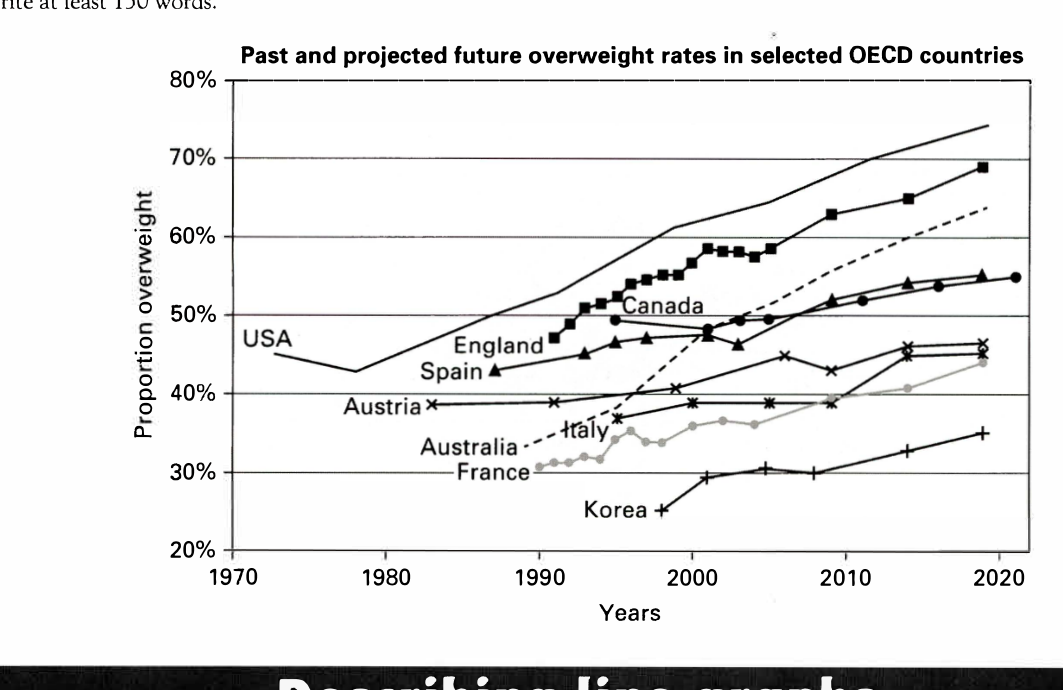
The line graph below shows past and current overweight rates, as well as a projected future overweight rate in nine selected countries.
Summarise the infonnation by selecting and reporting the main features, and make comparisons where relevant.
Past and projected future overweight rates in selected OECD countries
Student answer (Band 5.0)
This line garph shows about the and current overweigth rates and as welll as projected future overweigth rate in nine selected countries
OVERLL this line garph shows about the past and current rate s and this also shows about the future overweight which helps a lot in future to be contiued same a ways to be rate nine
In 1970 the usa had the highest starting point with nealy 45 of its populations being overweight .This figure grow steadily decades .ulitimently reaching approximately 75% by 2020 england and canada followed a remarkably simliar upward trajectory :beging their data collection in the late 1980 at arounds 45%to 50% both nations expriensed and sharp rise to finish at roughly 65% and 70% respectivly by thr end of thr period .spain also saw a significant climb mirroring england trajectory from mid 1990s onwards
Among the remains counterirs austriallla italy ans austirala and fracne all started with overwiegth rates between 30%and 40% in the 1980s and 1990s by 2020 thse nations saw moderates increases with their proportions rising to fluctuate between 45% and 55% korea which entered the datesets last in the mid -1990s at just over 20% also expreienced steaady upward trend ,doubling its rate to roughly 40% by 2020"
AI examiner evaluation
| Criterion | Band |
|---|---|
| Task Achievement / Task Response | 5.0 |
| Coherence and Cohesion | 5.5 |
| Lexical Resource | 5.0 |
| Grammatical Range and Accuracy | 5.0 |
| Overall | 5.0 |
Task Achievement / Task Response: Band 5.0
You identify the broad pattern of rising overweight rates and include several relevant comparisons, such as the USA reaching about 75% and Korea starting at a much lower level. However, the overview is unclear and does not accurately summarise the main contrasts. Some details are misreported: England ends at about 69%, while Canada is around 55%, not 65% and 70%; Korea reaches roughly 35%, rather than 40%. The claim that England and Canada followed a remarkably similar trajectory also overlooks their different end points. The final paragraph groups countries together without clearly distinguishing their trends. A clearer overview and more accurate selection of key comparisons would make the report more complete.
Coherence and Cohesion: Band 5.5
The response has a basic paragraph structure: an introduction, an attempted overview, and two paragraphs describing groups of countries. This gives the reader some sense of organisation, and phrases such as “Among the remaining countries” signal a shift. However, progression is weakened by the unclear overview and by grouping several countries together without a clear organising principle. The second body paragraph also repeats “Austria” and combines countries in a confusing way, making it difficult to follow which figures belong to which line. Linking is limited, and punctuation around colons and sentence boundaries is inconsistent. Organise the report around clear comparisons—for example, the highest rates, middle group, and lowest rate—and use transitions to show how each paragraph relates to the overview.
Lexical Resource: Band 5.0
You attempt some task-appropriate vocabulary, including “trajectory,” “significant climb,” “proportions,” and “upward trend.” These choices show an effort to describe change rather than simply list figures. However, spelling errors are frequent and sometimes make the intended meaning difficult to identify, as in “overweigth,” “simliar,” “expriensed,” and “respectivly.” Several phrases are also inaccurate or unnatural, such as “starting point,” “finish at,” and “saw moderates increases.” Repetition of “rate” and “shows about” further limits precision. Work on accurate spelling and common graph-description collocations, such as “the proportion rose to” or “the rate increased steadily,” so that your vocabulary communicates the data clearly.
Grammatical Range and Accuracy: Band 5.0
You attempt to combine information in longer sentences, for example when describing the USA and when comparing several countries. However, these attempts are often difficult to follow because sentence boundaries, verb forms, and grammatical patterns are not controlled consistently. The opening contains incomplete or unclear constructions, including “This line graph shows about…” and “which helps a lot in future to be continued.” In the body, “This figure grow steadily” lacks correct tense marking, while the long sentence beginning “Among the remains…” has unclear structure and agreement. Punctuation is also unreliable, with run-on sentences and inconsistent use of capitals and full stops. Practise writing shorter, complete sentences first, then add subordinate clauses while checking tense consistency and sentence boundaries.
See this exact question answered at other band scores. The same prompt compared across bands.
Browse more IELTS Writing model answers or get your own writing scored by the same AI examiner.