Band 4.5 IELTS Writing Task 1 Model Answer
Overall Band Score: 4.5 · IELTS Momentum Workout · 2026-11-10
IELTS Writing Task 1 question
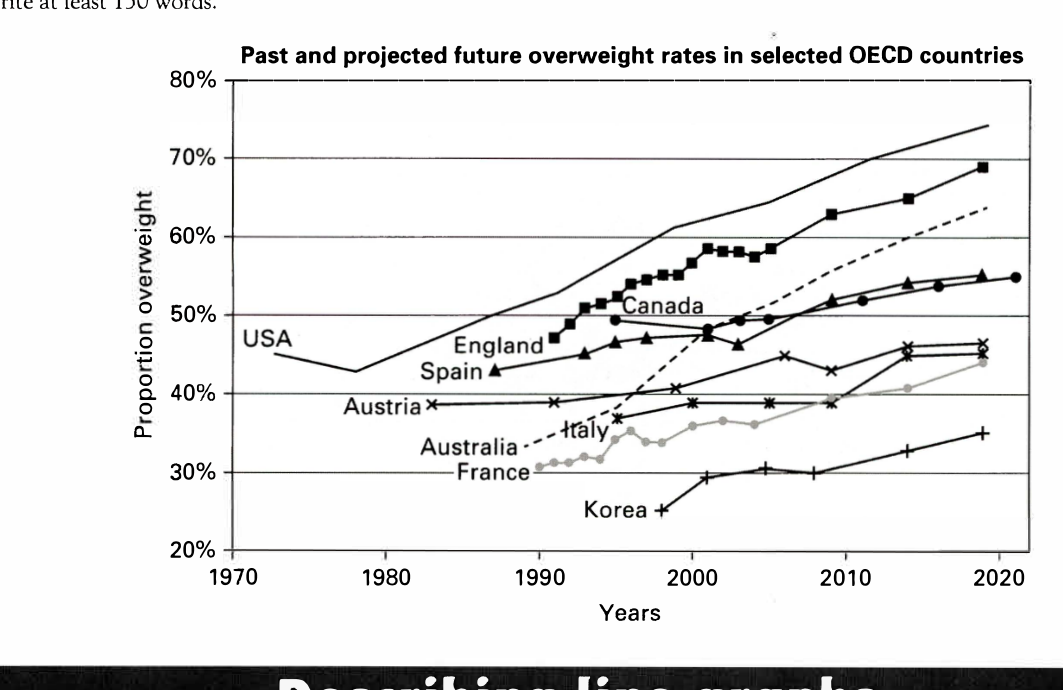
The line graph below shows past and current overweight rates, as well as a projected future overweight rate in nine selected countries.
Summarise the infonnation by selecting and reporting the main features, and make comparisons where relevant.
Past and projected future overweight rates in selected OECD countries
Student answer (Band 4.5)
The line graph illustrates the obesity rates in the past and current time, as well as expected rates in selected OECD countries.
Overall, in 1970, the rate of obesity was 42% in USA compared to other countries; it was very dominant except for Korea.
Primarily, I started with USA, England and Spain where the rate of projected overweight rates were very high that lie between 50% and 80%
AI examiner evaluation
| Criterion | Band |
|---|---|
| Task Achievement / Task Response | 3.0 |
| Coherence and Cohesion | 4.5 |
| Lexical Resource | 5.5 |
| Grammatical Range and Accuracy | 5.5 |
| Overall | 4.5 |
Task Achievement / Task Response: Band 3.0
The response identifies the graph’s subject and attempts an overall comparison, but it does not adequately summarise the main features. The statement that the USA rate was 42% in 1970 is inaccurate: the chart shows about 45% in 1972, and it provides no 1970 figure. The claim that the USA was dominant “except for Korea” is unclear and does not capture the overall pattern; the USA is highest in the later years, while Korea is lowest. The final sentence only names three countries and gives a broad range, without explaining their trends or making supported comparisons. The response is also substantially below the required 150 words. To improve, include a clear overview and select key starting, ending, and trend comparisons across the countries.
Coherence and Cohesion: Band 4.5
There is a basic attempt to organise the response: an opening sentence is followed by an overview and then a sentence introducing selected countries. However, the progression is very limited, and the final sentence ends without completing the comparison or developing the point. Linking is also sparse: “Overall” and “Primarily” signal stages, but the relationship between the claims is not made clear. For example, the statement about the USA being dominant is not connected to the later reference to USA, England and Spain. Use separate paragraphs for the introduction, overview and grouped details, and organise the details around clear comparisons, such as the highest and lowest rates or countries with similar trends.
Lexical Resource: Band 5.5
The response uses some relevant task vocabulary, including “line graph,” “rate,” “selected OECD countries” and “projected,” so the topic is generally recognisable. However, the range is narrow and some choices are imprecise or repetitive. “Obesity rates” is not the graph’s wording and may imply a different measure from the proportion overweight; “past and current time” is awkward, while “projected overweight rates” is repeated in a cumbersome phrase. “Very dominant” does not clearly describe a numerical comparison. Aim for precise terms such as “proportion of people who were overweight,” “rose,” “remained,” and “was higher than.” This would make the limited comparisons clearer and more appropriate for an academic report.
Grammatical Range and Accuracy: Band 5.5
The response shows some control of basic sentence forms, and the opening sentence communicates the graph’s general subject. There is also an attempt at a more complex structure in “where the rate … were very high that lie between…,” but the clauses are not joined grammatically: “rate” is singular, and “that lie” has no clear grammatical link to the preceding phrase. The sentence also lacks a completed final punctuation mark. In “in USA,” the article is missing, and the tense and time reference in “in the past and current time” are not well controlled. Use straightforward, complete sentences first, then add accurate comparisons—for example, “The USA’s rate was about 45% in 1972 and is projected to reach roughly 74% by 2020.”
See this exact question answered at other band scores. The same prompt compared across bands.
Browse more IELTS Writing model answers or get your own writing scored by the same AI examiner.