Band 5.0 IELTS Writing Task 1 Model Answer
Overall Band Score: 5.0 · IELTS Momentum Workout · 2026-11-10
IELTS Writing Task 1 question
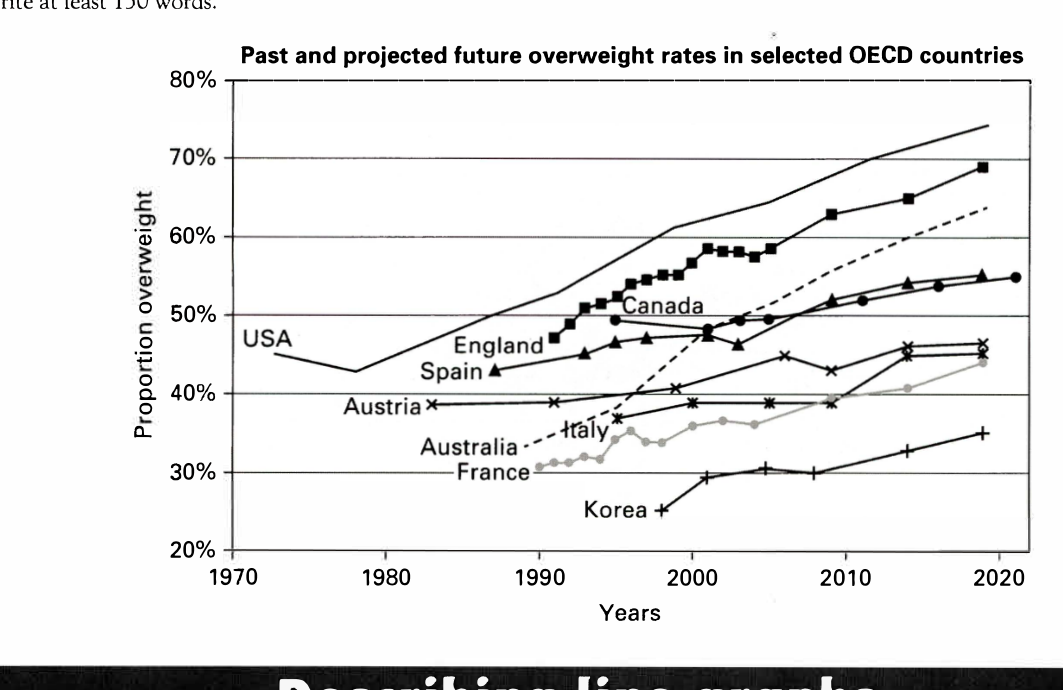
The line graph below shows past and current overweight rates, as well as a projected future overweight rate in nine selected countries.
Summarise the infonnation by selecting and reporting the main features, and make comparisons where relevant.
Past and projected future overweight rates in selected OECD countries
Student answer (Band 5.0)
The line graph illustrates the past overweigh rates as well as for the future in nine selected countries.
Overall, usa has the highest proportion in the past and future overweight rates while korea has the lower proportion for its overweight rates throughout the years.followed by the remaining countries that are also pushing for their overweight rates.
By analyzing the graph, it is concluded that there was no overweight rates for korea until in 1997, the number increased to 25% and then significantly rose to 35% in 2020.However, france has 30% overweight rates in 1990 and it rises to 45% in 2020.Also italy has the same number of overweight in the 2020 as of that france.Furthermore, australia in 1990 its number roses from 33% to 65% in t2020 becoming the third largest country after usa and england.
Although austria has the same number of overweigh as the same for italy and france.spain has a balanced overwiegh until 2005 it decreased a bit and then it increased to 60% in 2020.Canada is also significant and same as spain overweigh.Furthermore, England has the larger number of overweight which increased to 69% in 2020 becoming 2 largest and the first one i
AI examiner evaluation
| Criterion | Band |
|---|---|
| Task Achievement / Task Response | 5.0 |
| Coherence and Cohesion | 5.0 |
| Lexical Resource | 5.0 |
| Grammatical Range and Accuracy | 5.0 |
| Overall | 5.0 |
Task Achievement / Task Response: Band 5.0
You identify the broad pattern that rates generally rise and note that the USA is highest while Korea is lowest, which gives the response a relevant overview. However, the account only partially reports the graph’s main features, and several comparisons or figures are inaccurate. For example, Australia reaches about 64% in 2020, not 65% (a small difference), but Spain is around 55%, not 60%, and Austria does not have the same final rate as Italy and France. Korea also has data from 1998, rather than having no overweight rate until 1997. The overview would be clearer if it highlighted the overall rise and the contrast between the highest and lowest countries, then supported this with accurate key comparisons.
Coherence and Cohesion: Band 5.0
The response has an introduction, an overview, and two body paragraphs, and it attempts to group countries together. This provides some organisation, but the progression is difficult to follow because comparisons shift abruptly and some links do not explain the relationship between the figures. For instance, “Although Austria has the same number…” is left as an incomplete thought, while “Furthermore” is used repeatedly without adding a clear logical connection. The final sentence also stops mid-idea, leaving the comparison unfinished. Organise the body paragraphs around clear groups, such as the highest-rising countries and those with lower rates, and use linking phrases only when they accurately show contrast or addition.
Lexical Resource: Band 5.0
You use some relevant graph vocabulary, including “proportion,” “increased,” “decreased,” and “significantly rose,” so the topic is generally recognisable. However, the range is limited and several noticeable word-choice, collocation, and spelling errors make parts difficult to interpret. Repeated forms such as “overweigh rates” and “overweigh” are inaccurate, while “balanced overweight” does not clearly describe a stable trend. Phrases such as “pushing for their overweight rates” and “the same number of overweight” are also unnatural. Use precise terms such as “rate,” “proportion,” and “figure,” and describe movement with “remained stable,” “rose steadily,” or “fell slightly.” Check spelling and use country names consistently.
Grammatical Range and Accuracy: Band 5.0
There are attempts to form longer sentences and use contrast, for example, “However, France has…” and “Although Austria…,” but complex structures are often faulty and the range remains limited. Errors in sentence construction and verb forms occur frequently: “Furthermore, Australia in 1990 its number roses…” lacks a clear grammatical structure, and “Spain has a balanced… until 2005 it decreased” combines clauses without correct punctuation or tense control. The sentence beginning “Although Austria…” is incomplete, and the final sentence is unfinished. Capitalisation and spacing after full stops are also inconsistent. Practise writing complete sentences with a clear subject and verb, and use past tense for historical data and future forms only where the graph projects future figures.
See this exact question answered at other band scores. The same prompt compared across bands.
Browse more IELTS Writing model answers or get your own writing scored by the same AI examiner.