Band 5.5 IELTS Writing Task 1 Model Answer
Overall Band Score: 5.5 · IELTS Momentum Workout · 2026-11-10
IELTS Writing Task 1 question
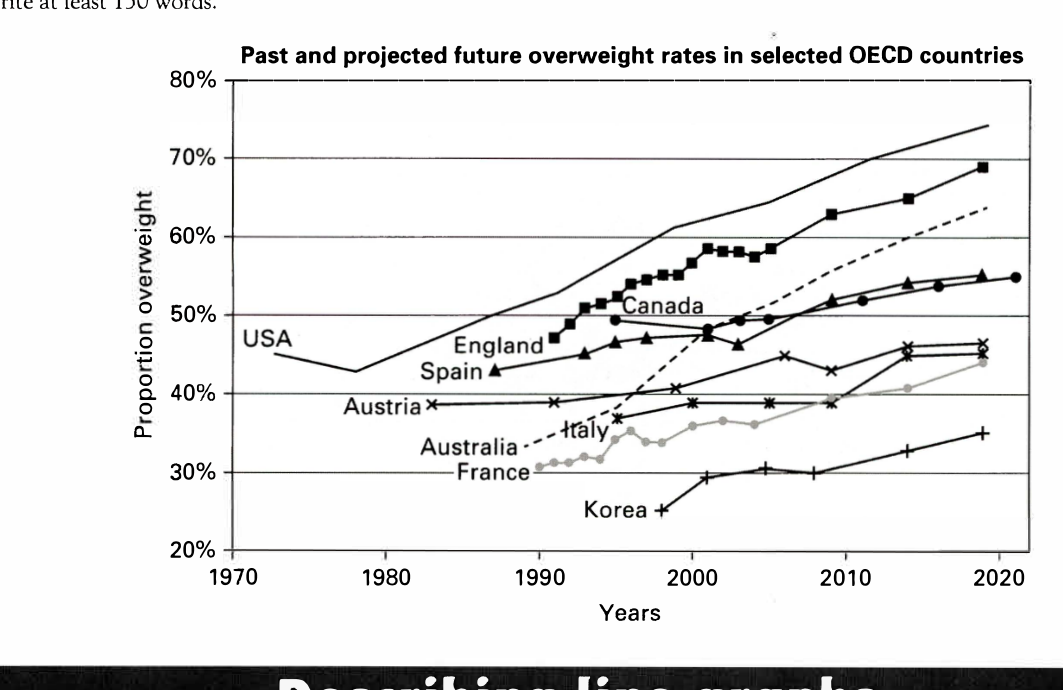
The line graph below shows past and current overweight rates, as well as a projected future overweight rate in nine selected countries.
Summarise the infonnation by selecting and reporting the main features, and make comparisons where relevant.
Past and projected future overweight rates in selected OECD countries
Student answer (Band 5.5)
The line chart represent a set a nine selected country's by comparing its past, present and future overweight rate. The list of country's are selected from OECD.
Overall, the USA accounted for the highest through out the entire timeline, England chassing from second and Korea with least percentile all over the period.
During 1970, The USA started with slightly higher than 45% and stayed in first till 2020 reaching more than 70% at the end. Unlike USA, England started a little late in middle between the year [redacted phone] however leading at second consistently till 2020 accounted very close to USA approximately 70%.
There is a huge race between countries namely, Australia, Canada, Spain, Austria, France and Italy.
All these countries started sightly late after 1980, but Australia started with 35% behind Italy, got a sudden rose and took over many other country and reached third sport nearly 65%. Canada and spain have a similar growth satrting with 45% and finished at 55% equaly. Similarly other countries like Italy, Ausria, France recorded for equal growth(close to 45%) except Korea accounted for the least all over the period with less than 40%.
AI examiner evaluation
| Criterion | Band |
|---|---|
| Task Achievement / Task Response | 5.5 |
| Coherence and Cohesion | 6.0 |
| Lexical Resource | 5.5 |
| Grammatical Range and Accuracy | 5.0 |
| Overall | 5.5 |
Task Achievement / Task Response: Band 5.5
You identify the broad pattern that the USA remains highest and Korea lowest, and you include several relevant comparisons, such as Australia rising to third place and Canada and Spain ending at similar levels. However, some key details are inaccurate or unclear: the USA did not lead throughout the entire period, as England’s data begin later, and Australia’s starting point is about 34%, not 35% behind Italy. The claim that Canada and Spain both start at 45% is also not supported; Canada’s recorded series begins near 50%. The overview is useful but the report does not clearly distinguish historical data from projections or summarise the range of outcomes precisely. More accurate selection and explanation of the main trends would strengthen the response.
Coherence and Cohesion: Band 6.0
The response has a recognisable structure: an introduction, an overview, and two paragraphs describing the countries. This gives the reader a coherent overall route through the information, and phrases such as “Unlike USA” and “Similarly” attempt to connect comparisons. However, the grouping in the final paragraph is not consistently clear: “There is a huge race between countries” does not explain how the countries are being grouped, and the following comparisons move between several series without a clear order. Some linking is mechanical or imprecise, and references such as “all these countries” are difficult to interpret. Organise the details into clearer groups, for example higher, middle and lower rates, and use explicit comparisons to guide the reader.
Lexical Resource: Band 5.5
You use some relevant chart vocabulary, including “accounted for the highest,” “reaching,” “growth,” and “similar,” so the main trends are generally understandable. There are also attempts at more descriptive language, such as “a huge race,” but this is not a natural way to describe changes in a graph. Several word-choice and spelling problems reduce precision, including “chassing,” “sudden rose,” “third sport,” “equally,” and “percentile” where “percentage” or “rate” is intended. “Country’s” is also used where the plural “countries” is needed. Aim for accurate, conventional trend language such as “rose sharply,” “ranked third,” and “remained the lowest”; careful proofreading would make your vocabulary more reliable.
Grammatical Range and Accuracy: Band 5.0
You attempt both simple and more complex sentences, including the contrast beginning “Unlike USA” and the sentence describing Australia’s rise. However, errors are frequent enough to make some sentences awkward or difficult to follow. For example, “The line chart represent a set a nine selected country's” has problems with subject–verb agreement, articles and sentence structure; “England started a little late … however leading at second” is also incomplete and unclear. Tense and agreement are inconsistent in phrases such as “Canada and spain have a similar growth … and finished.” Work on complete sentence patterns, consistent past tense for historical data, and agreement between subjects and verbs. Shorter, accurately controlled sentences would help before adding more complex structures.
See this exact question answered at other band scores. The same prompt compared across bands.
Browse more IELTS Writing model answers or get your own writing scored by the same AI examiner.