Band 4.0 IELTS Writing Task 1 Model Answer
Overall Band Score: 4.0 · IELTS Momentum Workout · 2026-11-10
IELTS Writing Task 1 question
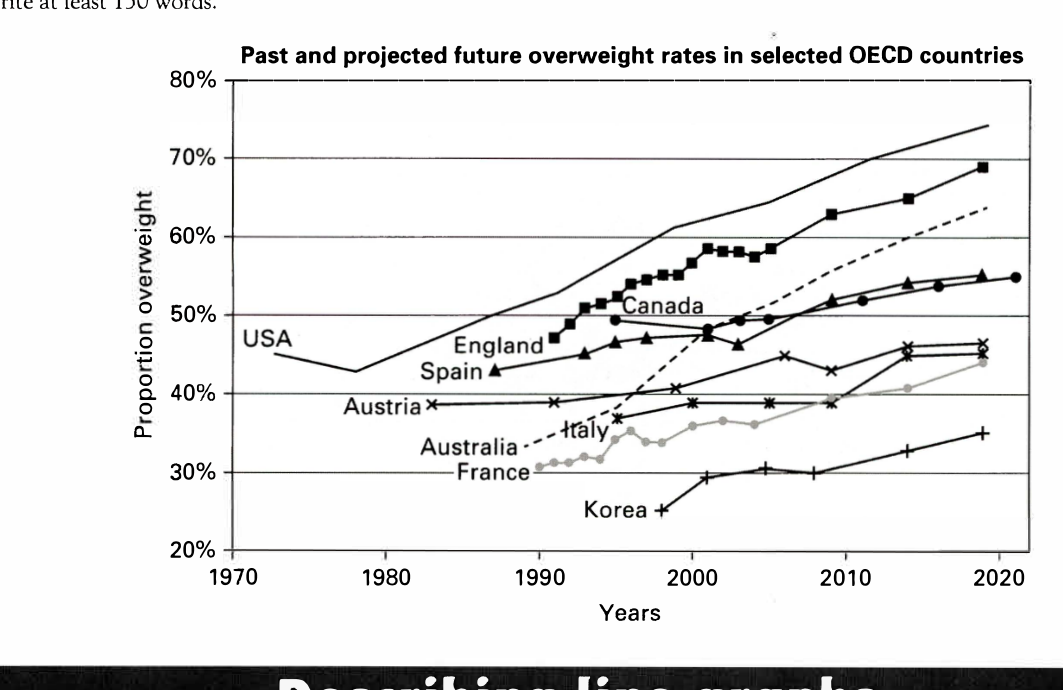
The line graph below shows past and current overweight rates, as well as a projected future overweight rate in nine selected countries.
Summarise the infonnation by selecting and reporting the main features, and make comparisons where relevant.
Past and projected future overweight rates in selected OECD countries
Student answer (Band 4.0)
The line graph showcases the past and present overweight rates as well as projected in future obesity prevalence in nine specific states.
overall, it can be observed at a glance, between 1970 and 1980 the overweight is noticed only in America which is fluctuate under 42% to 48% among these lands. in European union the spaing got position on top from 1985 with rate of 42% which is increased throughout to 2000 with 28% sirprisingly,
AI examiner evaluation
| Criterion | Band |
|---|---|
| Task Achievement / Task Response | 2.5 |
| Coherence and Cohesion | 3.5 |
| Lexical Resource | 5.0 |
| Grammatical Range and Accuracy | 4.5 |
| Overall | 4.0 |
Task Achievement / Task Response: Band 2.5
The response makes a limited attempt to describe the graph, but it does not provide a clear overview of the main trends across the nine countries or compare the past, current and projected figures. It mentions America and Spain, yet the claim that overweight is seen “only in America” between 1970 and 1980 overlooks that the graph’s other series begin later, rather than establishing that no other countries had overweight rates. The statement that Spain rose “throughout to 2000 with 28%” is unclear and conflicts with the chart, where Spain is around 47% in 2000. The response also stops before covering the other countries or the overall pattern. It is 75 words below the required minimum, which leaves the task substantially incomplete. To improve, give a concise overview and select accurate comparisons from the chart.
Coherence and Cohesion: Band 3.5
There is a basic attempt to organise the response: an opening sentence introduces the graph, followed by a sentence beginning “overall” that appears intended to summarise a trend. However, the ideas do not develop in a clear sequence, and the second sentence shifts abruptly from America to the European Union and Spain. The unfinished phrase “with rate of 42% which is increased throughout to 2000” makes the relationship between the figures difficult to follow. There is no clear paragraphing or concluding overview, and linking is limited. Use separate paragraphs for the introduction, overview and selected details, and connect each comparison explicitly—for example, by contrasting the highest and lowest rates or describing how they change over time.
Lexical Resource: Band 5.0
The response shows some useful topic vocabulary, including “overweight rates,” “prevalence,” and “projected,” and it attempts to paraphrase the graph’s subject. However, word choice and collocation are often inaccurate or awkward: “projected in future obesity prevalence” is not a natural phrase, and “the spaing got position on top” does not clearly express a ranking. “States” is also unsuitable for these countries, while “showcases” is less appropriate than a neutral reporting verb in this context. Spelling errors such as “spaing” and “sirprisingly” further reduce precision. Aim for straightforward, accurate expressions such as “the proportion of people who were overweight,” “Spain had the highest rate,” and “is projected to rise.”
Grammatical Range and Accuracy: Band 4.5
The response attempts to form longer sentences using clauses, as in “between 1970 and 1980 the overweight is noticed only in America which is fluctuate,” but control of these structures is weak. Verb forms are inconsistent: “is noticed” and “is fluctuate” do not fit the past-time description, and “which is increased” is not correctly formed. Articles and sentence boundaries are also problematic, as in “with rate of 42%,” while the opening “overall” should be capitalised after the full stop. The final sentence fragment ending “sirprisingly,” leaves the thought incomplete. These errors make parts of the message difficult to interpret. Practise accurate past-tense descriptions and build shorter, complete sentences before adding subordinate clauses.
See this exact question answered at other band scores. The same prompt compared across bands.
Browse more IELTS Writing model answers or get your own writing scored by the same AI examiner.