Band 5.0 IELTS Writing Task 1 Model Answer
Overall Band Score: 5.0 · IELTS Momentum Workout · 2026-11-12
IELTS Writing Task 1 question
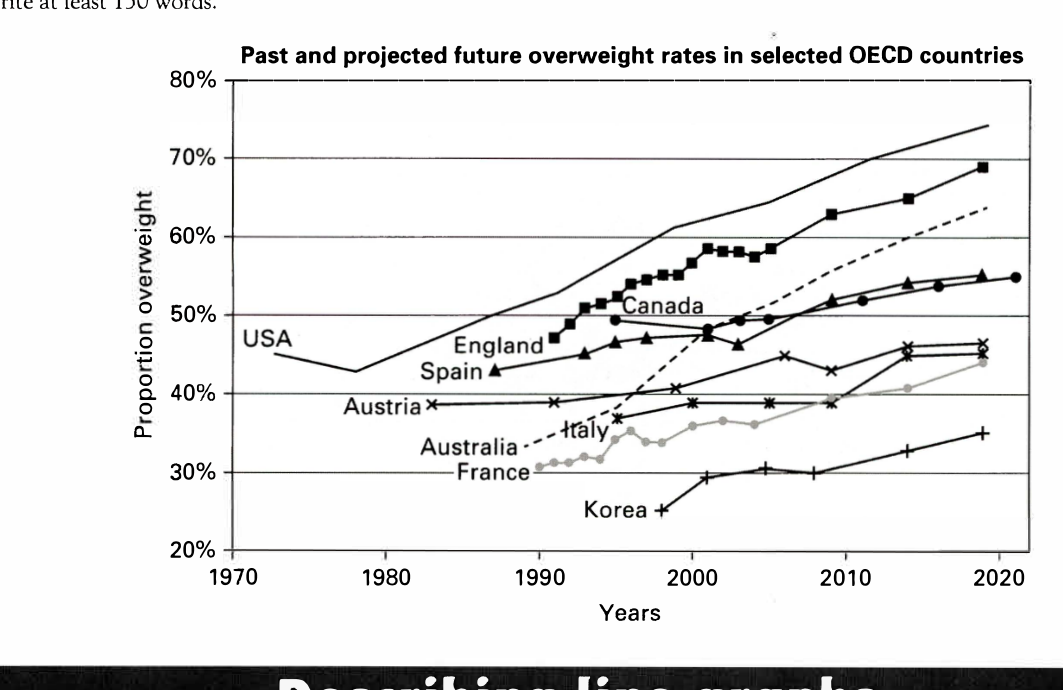
The line graph below shows past and current overweight rates, as well as a projected future overweight rate in nine selected countries.
Summarise the infonnation by selecting and reporting the main features, and make comparisons where relevant.
Past and projected future overweight rates in selected OECD countries
Student answer (Band 5.0)
The given line graph illustrates the previous and the on going overweight rates from the year 1970 to 2020 also the coming projected overweight rate in future among the nine countries.
Overall,lKorea has 25 percentage of overweight in 1999 that rised up to 35% till 2020. Similarly, France was only 30% in 1990 and remained between 30-40% till 2010 and reaching 2020 it was almost 44%. Australia ganied more attention as it was only 32% in 1990s while reaching 2000 it increased upto 50% and with continuous rise it increased to 63% in 2020.
Italy was 38% in 1995 and remained under 40% til 2010. By reaching 2010 it increased to 45%. Austria remained 40% in overweight till 2000 and reached to 47% in last year.Spain was 43% in 1988 and reached to 50% til 2010 and in 2020 it was 55%.
England had a significant rise in proportion overweight it was only 48% in starting and reached almost 70% in 2020. Canada was 50% in start with early decrease in 2000 and agin increased to 55% in 2020. USA had the most steady and significant increase in proportion overweight little rise and fall in starting later on boost up to75% in 2020.
AI examiner evaluation
| Criterion | Band |
|---|---|
| Task Achievement / Task Response | 5.0 |
| Coherence and Cohesion | 5.0 |
| Lexical Resource | 5.5 |
| Grammatical Range and Accuracy | 5.0 |
| Overall | 5.0 |
Task Achievement / Task Response: Band 5.0
You cover all nine countries and identify several broad trends, including the rise in the USA and the comparatively low rate in Korea. However, the overview is not clearly separated from the country-by-country details, and some key comparisons are missing. Several figures or dates are inaccurate: Korea starts at about 25% in 1998, not 1999; Australia is about 34% in 1990 and 46% in 2000, rather than 32% and 50%; and Italy is about 37% in 1995, not 38%. The claim that Italy rose to 45% by 2010 is also premature; it reaches that level around 2014. Select the most important overall patterns and check dates and values against the graph to make the summary more accurate and fully developed.
Coherence and Cohesion: Band 5.0
The response has some organisation: it moves through countries and uses signals such as “Overall,” “Similarly,” and “By reaching 2010.” This helps readers follow the general topic. However, the opening overview immediately becomes a sequence of individual country details, and the remaining information is presented in one long paragraph without a clear grouping or progression. The repeated pattern of naming a country and listing figures makes the report feel like notes rather than a structured summary. Group countries by meaningful similarities—for example, the highest rates, middle-range rates, and lowest rates—and use a separate overview paragraph followed by focused detail paragraphs. Also use transitions to show comparisons, not just to introduce the next country.
Lexical Resource: Band 5.5
You use relevant vocabulary for describing trends, including “increased,” “rise,” “decrease,” and “proportion overweight,” so the main meaning is generally understandable. There are also attempts at more descriptive phrasing, such as “significant rise” and “steady … increase.” However, word choice and collocation are often inaccurate or informal: “ganied more attention” does not describe a data trend, “boost up” is unsuitable here, and “remained under 40% til 2010” is imprecise. Spelling errors such as “rised,” “agin,” and “ganied” are noticeable. Build a more reliable set of trend expressions and use them precisely, for example, “rose steadily,” “fluctuated slightly,” and “stood at.”
Grammatical Range and Accuracy: Band 5.0
You attempt some longer sentences and use past-tense forms to describe changes, but control is inconsistent. Several sentences join clauses without clear grammatical structure, as in “Overall,lKorea has 25 percentage … that rised up to 35%,” and “By reaching 2010 it increased to 45%.” Tense and verb forms are also faulty: “has 25 percentage” does not fit the past data, and “rised” is not the correct past form. Punctuation and spacing are inconsistent, including the missing space after “Overall,” and the run-on sequence near the end. Use straightforward, complete sentences with accurate past-tense verbs, and vary them with controlled clauses such as “Although the rate dipped slightly, it then rose.”
See this exact question answered at other band scores. The same prompt compared across bands.
Browse more IELTS Writing model answers or get your own writing scored by the same AI examiner.