Band 5.0 IELTS Writing Task 1 Model Answer
Overall Band Score: 5.0 · IELTS Momentum Workout · 2026-11-13
IELTS Writing Task 1 question
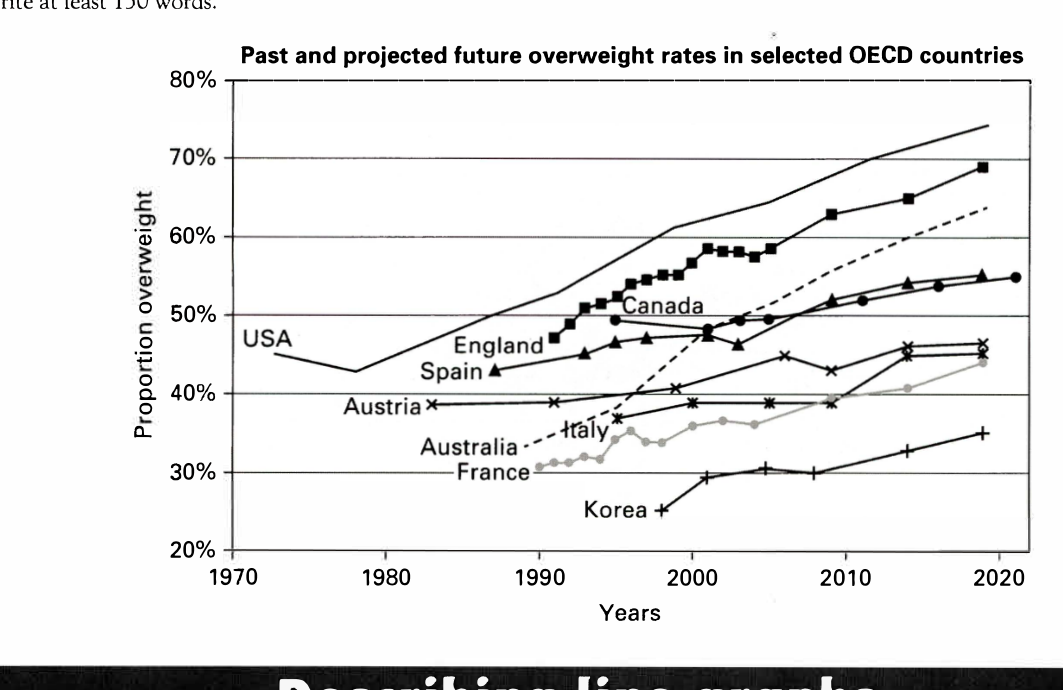
The line graph below shows past and current overweight rates, as well as a projected future overweight rate in nine selected countries.
Summarise the infonnation by selecting and reporting the main features, and make comparisons where relevant.
Past and projected future overweight rates in selected OECD countries
Student answer (Band 5.0)
The given graph represents the propotions of the previous and present overweight percentages of the OECD countries like USA, Canada, England, Spain, Italy, Austria,Australia, France and Korea from 1970 to 2020.
Overall, In all of the OECD countries USA is in overweigh over the year and Austria, Spain,Canada, and Italy was flucuating, and hence Korea was qute low over the year.
Initaily in 1970 the overweight rate of USA was 45% it went down to 40% in 1980, but after a slight fall it incresed to 70% by 2020. Also in 1990 overweight rate of England was around 47% and keep increasing to 70%by 2020. Following the trend in 1990 overweight rate of Australia was around 33% and keep rising to around 65% by the year 2020.
Other OECD countries like Canada, Spain, France, Austria, Italy was flucating by 10 to 20% from the starting to the by the year 2020. lastly overweight rate of Korea was quite loe aroubd 20% in the starting and around 35% by the Year 2020.
AI examiner evaluation
| Criterion | Band |
|---|---|
| Task Achievement / Task Response | 5.0 |
| Coherence and Cohesion | 5.5 |
| Lexical Resource | 5.0 |
| Grammatical Range and Accuracy | 5.0 |
| Overall | 5.0 |
Task Achievement / Task Response: Band 5.0
You identify the countries and give a broad account of several trends, including the USA’s high rate and Korea’s comparatively low rate. However, the overview is unclear and partly inaccurate: “Austria, Spain, Canada, and Italy was fluctuating” does not capture their overall upward movement, and the USA did not remain above 40% throughout—the rate fell from about 45% to 43% before rising. Some figures are also imprecise, such as the USA reaching about 74%, rather than 70%, and Korea starting near 25%, not 20%. The statement that other countries fluctuated “by 10 to 20%” is too general to show meaningful comparisons. Select the clearest overall patterns and support them with accurate endpoint comparisons.
Coherence and Cohesion: Band 5.5
The response has a basic structure: an introduction, an attempted overview, and paragraphs describing groups of countries. Linking phrases such as “Also,” “Following the trend,” and “Lastly” help signal movement between points. However, progression is limited because several countries are grouped together without explaining how their trends compare, and the final sentence combines Korea’s starting and ending figures without a clear time reference. The overview also introduces fluctuation as the main pattern, while the body mostly describes increases. Use a clearer overview followed by logically grouped comparisons—for example, the highest-rising countries and the lower-rate countries—and make each sentence’s relationship to the previous one explicit.
Lexical Resource: Band 5.0
You use relevant task vocabulary, including “overweight rate,” “increased,” “slight fall,” and “fluctuating,” so the reader can generally understand the topic. However, the range is limited and some choices are inaccurate or repetitive: “USA is in overweight” is not a natural way to describe a rate, while “fluctuating” is repeatedly used for countries whose figures generally rise. Spelling errors such as “propotions,” “flucuating,” and “Initaily” are noticeable and reduce precision. Aim for accurate trend language and varied comparisons, such as “rose steadily,” “remained comparatively low,” and “ended at approximately.” Check spelling carefully and avoid using a trend word unless it matches the data.
Grammatical Range and Accuracy: Band 5.0
The response uses mostly simple sentence patterns, with a few attempts to connect ideas using “but” and “and.” Frequent errors in verb forms, agreement, articles, and punctuation make some sentences difficult to follow. For example, “Austria, Spain, Canada, and Italy was fluctuating” has a plural subject with a singular verb, and “England … keep increasing” needs a past-tense form such as “continued to increase.” The opening overview also has inconsistent capitalization after “Overall,” and several sentences run together or contain awkward clause connections. Practise accurate past-tense reporting and subject–verb agreement first, then build longer sentences with controlled clauses, such as “Although the rate dipped slightly, it then rose steadily.”
See this exact question answered at other band scores. The same prompt compared across bands.
Browse more IELTS Writing model answers or get your own writing scored by the same AI examiner.