Band 5.5 IELTS Writing Task 1 Model Answer
Overall Band Score: 5.5 · IELTS Momentum Workout · 2026-11-15
IELTS Writing Task 1 question
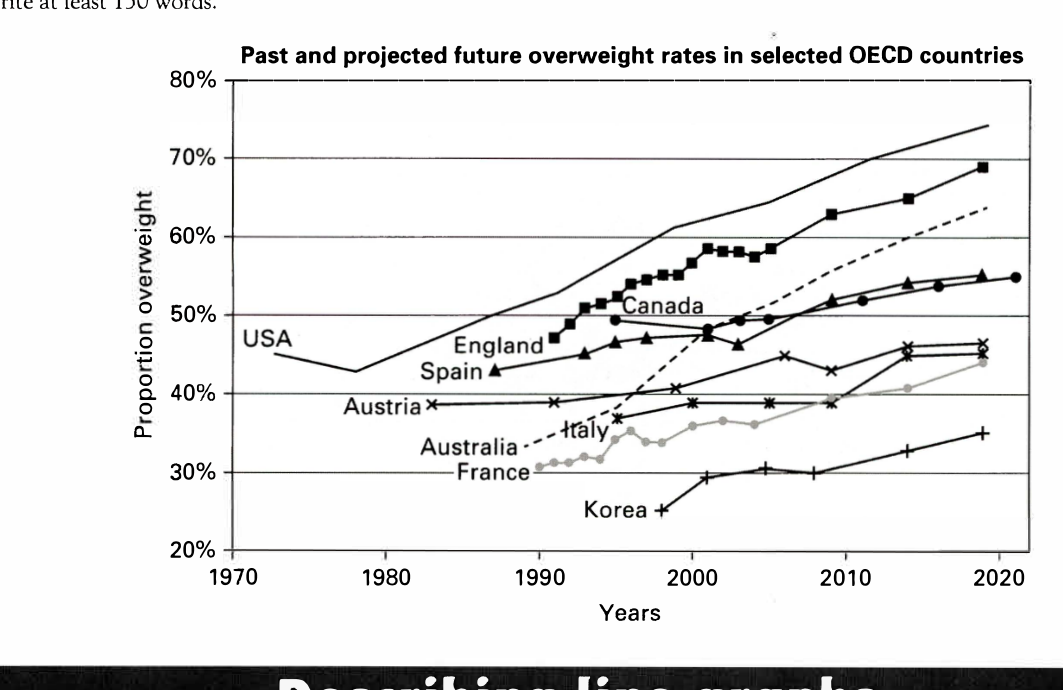
The line graph below shows past and current overweight rates, as well as a projected future overweight rate in nine selected countries.
Summarise the infonnation by selecting and reporting the main features, and make comparisons where relevant.
Past and projected future overweight rates in selected OECD countries
Student answer (Band 5.5)
The line graph illustrates the past, present and future obesity rate of nine countries.
Overall, the overweight rate is increasing across all the countries. Australia, England and USA have a speedy growth as compared to the other 6 countries. America had the highest number of overweights while korea has the lowest.
Around 1972, approximately 45% of americans were overweight the rate fell slightly to about 42% around 1980, after which it experienced a gradual increase till it reached the highest point among all other countries with nearly 75% of its population being overweight in 2019. Similarly, England had approximately 47% of overweight people but it rose significantly and in 2019 the rate was close to 70%. A small number of Australian citizens were obese in 1990 but Australia experienced a sharp growth with about 63% of residents became overweight.
On the other hand, Italy, France, Spain and Canada had relatively stable growth with less the 60% of overweight residents. Korea had the least number of overweight residents and remaind
AI examiner evaluation
| Criterion | Band |
|---|---|
| Task Achievement / Task Response | 5.5 |
| Coherence and Cohesion | 6.0 |
| Lexical Resource | 5.5 |
| Grammatical Range and Accuracy | 5.5 |
| Overall | 5.5 |
Task Achievement / Task Response: Band 5.5
You identify the broad upward trend and make relevant comparisons, including the USA’s high rate and Korea’s low rate. However, the overview is not fully accurate: “increasing across all the countries” overlooks periods of stability or slight decline, and calling Australia, England and the USA the fastest-growing is not clearly supported across the full time span. Some details are also imprecise: Australia reaches about 64% by 2020, while the USA is projected at about 74%; the response gives 63% and places the USA’s endpoint in 2019. The final comparison groups several countries as having “relatively stable growth” without explaining their different levels or trends, and the Korea point is left unfinished. Select and report the main patterns more precisely.
Coherence and Cohesion: Band 6.0
The response has a recognisable structure: an introduction, an overview and paragraphs describing higher-rate countries and the remaining group. This gives the reader a generally coherent route through the information. Linking phrases such as “Overall,” “Similarly” and “On the other hand” help signal relationships, although the contrast introduced by “On the other hand” is broad and does not clearly distinguish the countries grouped together. The final sentence is incomplete (“Korea had the least number of overweight residents and remaind”), which disrupts the ending and leaves the last point undeveloped. Improve progression by grouping countries according to comparable trends and completing each paragraph with a clear, relevant comparison.
Lexical Resource: Band 5.5
You use a reasonable range of task-related vocabulary, including “gradual increase,” “rose significantly,” “sharp growth” and “highest point,” so the main trends are usually understandable. However, some choices are imprecise or informal for describing a graph: “speedy growth” is less natural than “rapid increase,” and “number of overweights” does not accurately describe a proportion of people. “Obesity rate” also shifts from the graph’s measure of being overweight, while “a small number” is unsuitable when the data are percentages. There are spelling and word-form slips, including “korea” and “remaind.” Use consistent terms such as “proportion of people who were overweight,” and check spelling and collocations to make the descriptions more precise.
Grammatical Range and Accuracy: Band 5.5
You attempt a mix of simple and complex sentences, including clauses with “after which” and “while,” and most of the main message remains understandable. Some grammatical errors nevertheless reduce accuracy. For example, “with about 63% of residents became overweight” combines incompatible structures; write “with about 63% of residents becoming overweight” or “about 63% of residents were overweight.” In “less the 60%,” the comparison should be “less than 60%,” and “the rate fell … after which it experienced” has an unclear reference because “it” could refer to the rate or the country. The final clause is incomplete, and capitalisation and punctuation need checking. Aim for accurate sentence patterns before adding more complex clauses.
See this exact question answered at other band scores. The same prompt compared across bands.
Browse more IELTS Writing model answers or get your own writing scored by the same AI examiner.