Band 5.0 IELTS Writing Task 1 Model Answer
Overall Band Score: 5.0 · IELTS Momentum Workout · 2026-11-17
IELTS Writing Task 1 question
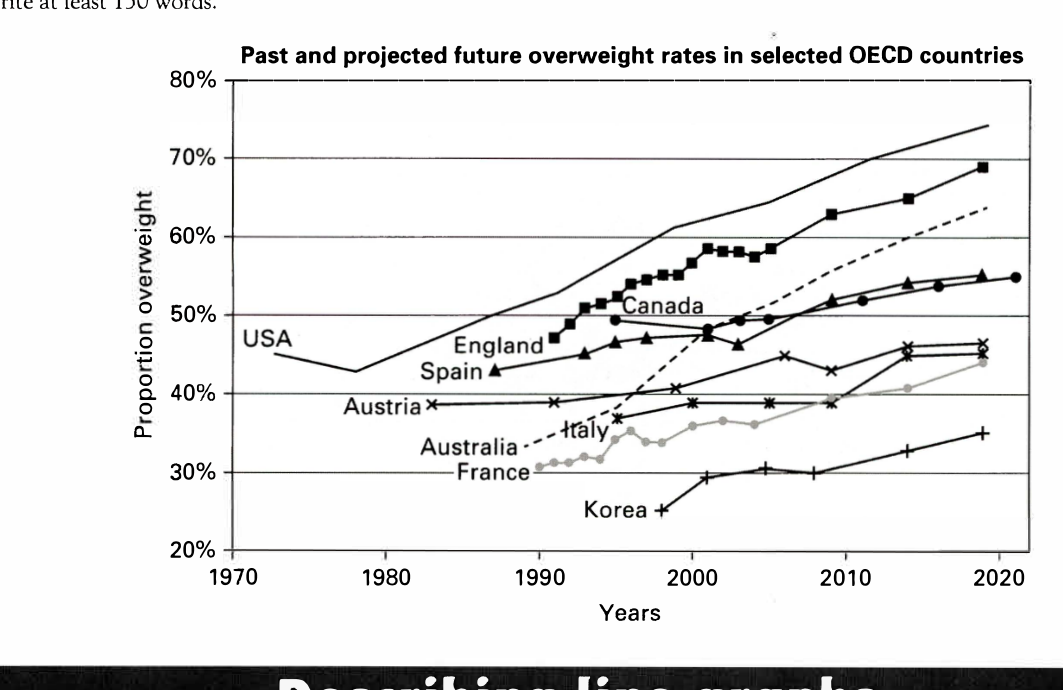
The line graph below shows past and current overweight rates, as well as a projected future overweight rate in nine selected countries.
Summarise the infonnation by selecting and reporting the main features, and make comparisons where relevant.
Past and projected future overweight rates in selected OECD countries
Student answer (Band 5.0)
The line grpah illustrates the previous and recent high prices, and forecasted future increased rate in specific nine countries.
Overall, acoross the whole countries USA and England showed the highest growth in the prices, whereas france, Italy and korea are lowest price countries in the throughout the 9 countries.
Initially, there is steady increased in prices in the USA is about 46% in 1970 and looking to be grow apprximately 75% in the year of 2020, followed by England the rates were about 47% during 1970 and will be climb up to 70% in 2020, But the prices in Australia initiated from about 30% and may increase upto 65% in the future, Furthermore, there are fluctuation in the prices of Spain, Austria, and france, although the prices will be grow up in the future in the whole regions.
In contrast, the prices of Korea were low about 10% in 1997 while will just 20% in the 2020,
AI examiner evaluation
| Criterion | Band |
|---|---|
| Task Achievement / Task Response | 4.5 |
| Coherence and Cohesion | 5.0 |
| Lexical Resource | 4.5 |
| Grammatical Range and Accuracy | 5.0 |
| Overall | 5.0 |
Task Achievement / Task Response: Band 4.5
The response identifies a broad upward pattern and attempts to compare the USA and England with lower-rate countries, so it does engage with the graph. However, several key details are inaccurate: England’s series begins around 1991, not 1970, and Korea starts at about 25% in 1998, rather than 10% in 1997; its 2019 figure is about 35%, not 20%. The overview also calls France, Italy and Korea the lowest throughout, although France and Italy finish above Korea and Austria is also relatively low. Some important comparisons are missing, and the discussion of Spain, Austria and France is vague. Select accurate start and end points and summarise the highest and lowest rates more precisely.
Coherence and Cohesion: Band 5.0
The response has a recognisable structure: an introduction, an overview, and a paragraph describing several countries, followed by a contrast about Korea. This gives the reader some sense of organisation. However, progression within the main paragraph is difficult to follow because many countries and trends are joined in one long sentence, and the final Korea point is left as a fragment-like ending. Linking words such as “followed by,” “Furthermore,” and “In contrast” are attempted, but some connections do not clearly express the relationship between the data. Use separate, focused paragraphs or sentences for the major groups, and connect comparisons explicitly—for example, contrast the high-rate countries with the lower-rate group.
Lexical Resource: Band 4.5
The response uses some task-related vocabulary, including “illustrates,” “forecasted,” “fluctuation,” and “in contrast,” and it attempts to describe trends rather than merely list figures. However, vocabulary is repetitive and often imprecise: “prices” is repeatedly used for overweight rates, while “highest growth in the prices” does not clearly describe the proportions shown. Several word forms and collocations are awkward, such as “steady increased,” “grow up,” and “lowest price countries.” There are also spelling errors, including “grpah,” “acoross,” and “france.” Use precise terms such as “proportion,” “rate,” “rose,” and “remained comparatively low,” and check spelling and collocations carefully.
Grammatical Range and Accuracy: Band 5.0
The response attempts longer sentences and uses some subordinate clauses, as in “although the prices will be grow up in the future,” but these structures are often not controlled. Errors in verb forms and agreement occur throughout: “there is steady increased,” “USA and England showed,” and “will be climb up.” Tense choices are also inconsistent when describing past data and projections, and several clauses are joined with commas, creating run-on sentences. The final sentence, “while will just 20%,” lacks a complete verb structure. These problems sometimes make the intended meaning difficult to follow. Practise accurate past-tense descriptions, simple future forms for projections, and complete sentences before attempting longer combinations.
See this exact question answered at other band scores. The same prompt compared across bands.
Browse more IELTS Writing model answers or get your own writing scored by the same AI examiner.