Band 5.5 IELTS Writing Task 1 Model Answer
Overall Band Score: 5.5 · IELTS Momentum Workout · 2026-11-17
IELTS Writing Task 1 question
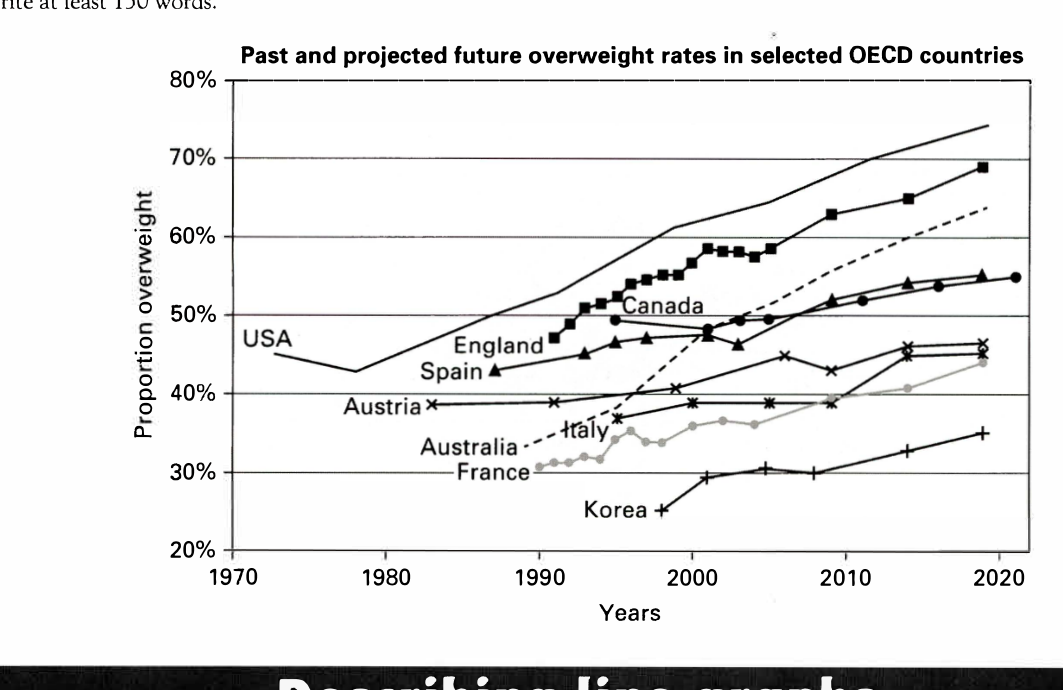
The line graph below shows past and current overweight rates, as well as a projected future overweight rate in nine selected countries.
Summarise the infonnation by selecting and reporting the main features, and make comparisons where relevant.
Past and projected future overweight rates in selected OECD countries
Student answer (Band 5.5)
The line graph illustrates the past and the current overweight rates, as well as a projected future overweight rate in nine countries.
Overall, The USA remained on the top in terms of an overwwight rates in past as well as in the future. While Korea was the least category among all.
Regarding the USA, It was around 45% in 1970, after facing a minor decline the figure rose significantly at reached 60% in 2000 and showed a peak of 75% in 2020. England started from 45% in 1990 and then the figure increased gradually and reached 58% in 2000. The fugure surge sharply and reached 70% in 2020 and ranks second amoung nine countries. Where as the figure of Canda was 50% in 2000, after facing fluctuation figure reached 55% in 2020.
Turning to remaning countires, Spain started from 45% and reached 50% same as Canda, The figure for Austria was 38% and about 45% was recorded in 2020. Australia started from just 35% and reached a peak of 65% in 2020. The proportion of Italy grew from 35% to 45% and for Franace was 30% to 45%. Korea was considered lowest figure started from 25% and ending with 35%.
AI examiner evaluation
| Criterion | Band |
|---|---|
| Task Achievement / Task Response | 5.5 |
| Coherence and Cohesion | 5.5 |
| Lexical Resource | 5.5 |
| Grammatical Range and Accuracy | 5.0 |
| Overall | 5.5 |
Task Achievement / Task Response: Band 5.5
You identify the main broad pattern: the USA is highest and Korea lowest, and you cover all nine countries. Several figures and trends are also broadly accurate, such as the USA rising to about 75% and Korea ending near 35%. However, the overview is brief and does not clearly summarise the overall rise across most countries or distinguish the countries’ relative levels at the end. Some details are inaccurate or unclear: England is said to reach 70% in 2020, whereas the graph ends near 69% in 2019; Spain is described as reaching 50%, although it ends around 55%; and France is given as rising to 45%, rather than about 44%. Select key comparisons and report them more precisely.
Coherence and Cohesion: Band 5.5
The response has a recognisable structure, with an introduction, an overview and two body paragraphs. Phrases such as “Regarding the USA” and “Turning to remaining countries” help signal a change of focus. However, the grouping of countries does not create a clear progression through the data, and several comparisons are compressed into long, loosely connected sentences. For example, the sentence beginning “The figure surge sharply” moves from England’s trend to its ranking without a clear link, while “Where as” introduces Canada awkwardly. Some references, such as “the figure” and “same as Canada,” are not sufficiently precise. Organise the body around meaningful groups or comparisons and use clearer links between each country and its figures.
Lexical Resource: Band 5.5
You use some relevant vocabulary for describing trends, including “decline,” “increased gradually,” “fluctuation,” and “reached a peak.” This gives you a basic range for reporting the graph. However, spelling errors are frequent and sometimes distract the reader, including “overwwight,” “fugure,” “amoung,” “Canda,” “remaning,” and “Franace.” Some expressions are also unnatural or imprecise: “least category” does not describe a country’s rate, and “the figure surge sharply” is not a well-controlled collocation. Aim for accurate, conventional phrases such as “the lowest rate,” “rose sharply,” and “the proportion stood at.” Proofreading spelling and choosing precise trend vocabulary would make the report clearer.
Grammatical Range and Accuracy: Band 5.0
You attempt both simple and more extended sentences, and the overall meaning is usually recoverable. However, grammatical control is inconsistent, particularly in sentence construction, agreement, articles and punctuation. For example, “the figure rose significantly at reached 60%” combines incompatible verb forms, while “Korea was the least category” does not form a correct comparison. Capitalisation after full stops is also inconsistent (“Overall, The USA”; “Regarding the USA, It”), and some sentences are fragments or awkwardly joined, such as “Where as the figure of Canda was 50% in 2000…”. Use complete subject–verb structures, check verb forms after linking words, and separate ideas into shorter sentences. More accurate control of these patterns is needed for the report to read smoothly.
See this exact question answered at other band scores. The same prompt compared across bands.
Browse more IELTS Writing model answers or get your own writing scored by the same AI examiner.