Band 5.5 IELTS Writing Task 1 Model Answer
Overall Band Score: 5.5 · IELTS Momentum Workout · 2026-11-17
IELTS Writing Task 1 question
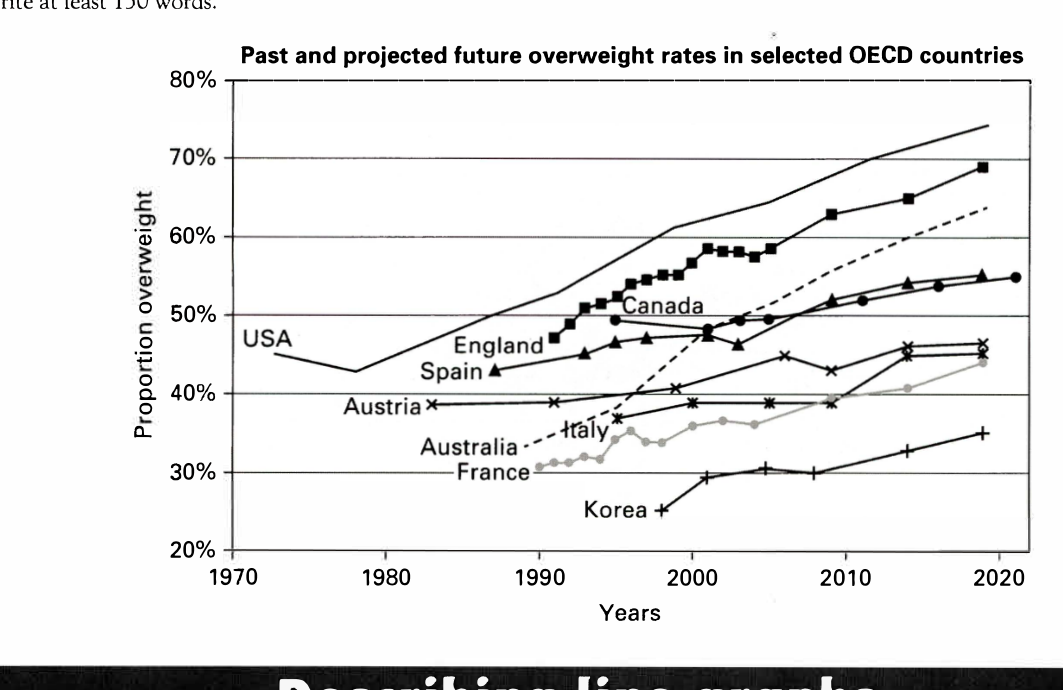
The line graph below shows past and current overweight rates, as well as a projected future overweight rate in nine selected countries.
Summarise the infonnation by selecting and reporting the main features, and make comparisons where relevant.
Past and projected future overweight rates in selected OECD countries
Student answer (Band 5.5)
The line graph shows the current and past overweight rates and estimated upcomming overweight ratio in nine countries. Selected countries are, USA, Canada, Spain, England, Austria, Italy. Australia, France and korea.
Overall, all countries continuously rising up in overweight rates from past to future. However, USA and England rates are increasing speedy. Besides,Korea overweight rates are very low in past and projected future as compared to other eight countries.
First, USA was around 50% rate of overweight and decreased in the year 1980 and rise again very speedy or goes above 70%. England, overweight rates start rising in the year 1990 and goes around 70%. However, England increased more quickly as compared to USA. Moreover, Australia extrawieght rates reported in 1990 with around 30% and stuck around 60% in the 2020.
Furthermore, Canada was at 50% in overweight rate in around 1995 and comes little bit down in the year 2000 and rise around 60% in the year 2020. Spain overweight rates proportion was low in the year around 1988 as compared to Canada but it rise very speedy and goes above Canada. Moreover, Austria, France and Italy proportion was quite same in the end times with 45%. Korea remained at the lowest proportion in overweight reported with 25% in the year 1999 and goes around 25% in the year 2020.
AI examiner evaluation
| Criterion | Band |
|---|---|
| Task Achievement / Task Response | 5.5 |
| Coherence and Cohesion | 6.0 |
| Lexical Resource | 5.0 |
| Grammatical Range and Accuracy | 5.0 |
| Overall | 5.5 |
Task Achievement / Task Response: Band 5.5
You identify the broad pattern of rising rates and correctly note that Korea remains the lowest, while the USA and England finish among the highest. Several comparisons are relevant, including the USA’s early dip and Australia’s increase. However, some key details are inaccurate or unclear: Korea is projected to reach about 35%, not remain near 25%, and Spain does not rise above Canada by the end; both finish at roughly 55%. The claim that Austria, France and Italy end at the same level is also imprecise, as their final rates are approximately 46.5%, 44% and 45.5%. The overview is too general, and the response would be stronger with more accurate end-point comparisons and clearer selection of the main trends.
Coherence and Cohesion: Band 6.0
The response has a clear overall arrangement: an introduction, an overview, and two paragraphs describing groups of countries. Sequencing words such as “Overall,” “First,” and “Furthermore” help signal the stages of the report, and the reader can generally follow the comparisons. However, some linking is mechanical, and several sentences combine information without making the relationship precise. For example, the Spain–Canada comparison is difficult to follow because the claim that Spain “goes above Canada” is not supported by the final figures. The overview also repeats the idea of rising rates without distinguishing the countries’ different patterns. Grouping countries by high, middle and low final rates, then using clearer comparisons within each group, would improve progression and cohesion.
Lexical Resource: Band 5.0
You use some relevant task vocabulary, including “proportion,” “projected,” “decreased,” and “increased,” and you attempt to describe changes and comparisons. However, the range is limited and several word choices or collocations are inaccurate, which sometimes makes the meaning unclear. Phrases such as “rising up,” “increasing speedy,” “stuck around 60%,” and “overweight ratio” are not natural ways to describe the graph. There are also spelling errors, including “upcomming,” “extrawieght,” and “korea.” Aim for precise trend language and consistent terms such as “overweight rate” or “proportion of people who were overweight.” Check spelling and use standard forms such as “rose sharply” and “levelled off.”
Grammatical Range and Accuracy: Band 5.0
You attempt both simple and more extended sentences, including comparisons introduced by “However” and “Moreover.” Nevertheless, grammatical control is uneven, and errors occur often enough to make some sentences awkward or difficult to interpret. Examples include “USA and England rates are increasing speedy,” “England, overweight rates start rising,” and “it rise very speedy and goes above Canada.” These contain problems with agreement, verb forms and sentence construction. Articles and punctuation also need attention, as in “Selected countries are, USA…” and “Besides,Korea.” Practise forming complete sentences with a clear subject and verb, and keep tense consistent when describing past data and projections. More accurate basic structures will make your comparisons easier to understand.
See this exact question answered at other band scores. The same prompt compared across bands.
Browse more IELTS Writing model answers or get your own writing scored by the same AI examiner.