Band 5.5 IELTS Writing Task 1 Model Answer
Overall Band Score: 5.5 · IELTS Momentum Workout · 2026-11-18
IELTS Writing Task 1 question
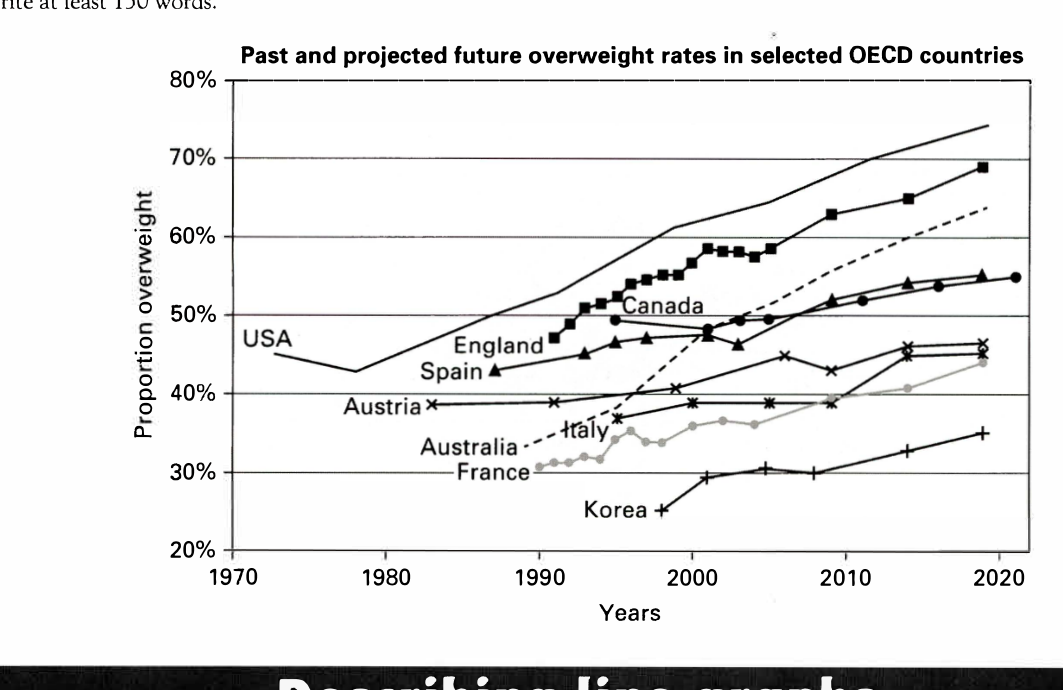
The line graph below shows past and current overweight rates, as well as a projected future overweight rate in nine selected countries.
Summarise the infonnation by selecting and reporting the main features, and make comparisons where relevant.
Past and projected future overweight rates in selected OECD countries
Student answer (Band 5.5)
The given line graph shows the significant changes in the past and current overweight rated in nine countries. The data provided shows us how overweight rated fluctuated in the past 50 years.
Overall, looking at athe bigger picture of the graph we can say that all of these nine countries experice a slight to sudden expansion in the overweight rated. The most prominent countries which surges to an exceptional rise is USA. Korea somehow remain the only country which is least affected with the overweight rates even though it does increase a bit from 2010 and then rose steadily.
After USA, English is the second country rising to the overweight rates from 47% to 70%. Spain, after seeing a drop in 2000, soar to 55% in the year 2020. Talking about Australia, it has experienced a sudden surge in overweight rated in the year 2000 and ended up with 63% in 2020. France seen some fluctuations and then rose steadily after 2000.
Austria remained the same till 2000, then experience some fluctuations and then stabilized from 2010 to 2020. Italy remain stable until year 2010 and then increased gradually a bit and then again stayed constant.
AI examiner evaluation
| Criterion | Band |
|---|---|
| Task Achievement / Task Response | 5.5 |
| Coherence and Cohesion | 6.0 |
| Lexical Resource | 5.5 |
| Grammatical Range and Accuracy | 5.5 |
| Overall | 5.5 |
Task Achievement / Task Response: Band 5.5
You identify the broad upward pattern and make relevant comparisons, especially noting the USA’s prominent rise and Korea’s comparatively low rates. However, the overview is not fully accurate or sufficiently precise: the USA rises substantially, rather than all countries showing only a “slight to sudden” increase, and Korea remains the lowest overall but does not begin rising only after 2010. Some details are also misreported: England reaches about 69% by 2019, not 70% in an unspecified endpoint; Australia ends near 64%, and Spain’s notable dip occurs around 2003, not 2000. Several countries, including Canada, are omitted. To strengthen the response, give a clearer overview of the highest and lowest rates and select accurate, representative comparisons across the countries.
Coherence and Cohesion: Band 6.0
The response has a clear overall arrangement: an introduction, an overview, and two paragraphs describing groups of countries. This makes the information reasonably easy to follow, and phrases such as “After USA” and “Talking about Australia” signal transitions. However, the progression is not consistently systematic: countries are discussed in a somewhat arbitrary order, and Canada is left out, so the account feels incomplete. Some linking phrases are conversational or imprecise, while repeated “then” constructions make the final paragraph sound list-like. The reference in “it does increase a bit” is also unclear. Grouping countries by their relative rates or overall trends, and using more precise links between comparisons, would make the progression more cohesive.
Lexical Resource: Band 5.5
You use a relevant range of trend vocabulary, including “fluctuated,” “surge,” “steadily,” and “stabilized,” which helps communicate the main patterns. However, several noticeable word-choice, collocation, and spelling problems reduce precision: “overweight rated” is repeated instead of “overweight rates,” “English” should be “England,” and “experice” and “athe” are misspelled. Phrases such as “exceptional rise,” “least affected,” and “sudden surge” are not always well matched to the data; “highest increase,” “lowest rate,” and “rose markedly” would be more natural and objective. Aim for accurate, neutral language and avoid repeating “then” when describing changes.
Grammatical Range and Accuracy: Band 5.5
You attempt both simple and more complex sentence forms, and the main message is generally understandable. Some grammatical errors remain, particularly in verb forms and agreement: “all of these nine countries experice” needs a correctly formed verb, “Korea … remain” should be “remains,” and “France seen” should be “France saw.” Tense control is also inconsistent in descriptions of past trends, as in “then experience” and “Italy remain.” Articles and sentence construction need attention in phrases such as “the overweight rates” and “the year 2000.” These errors do not usually prevent understanding, but they make the account less controlled. Check subject–verb agreement and use the past tense consistently when reporting historical data.
See this exact question answered at other band scores. The same prompt compared across bands.
Browse more IELTS Writing model answers or get your own writing scored by the same AI examiner.