Band 5.5 IELTS Writing Task 1 Model Answer
Overall Band Score: 5.5 · IELTS Momentum Workout · 2026-11-18
IELTS Writing Task 1 question
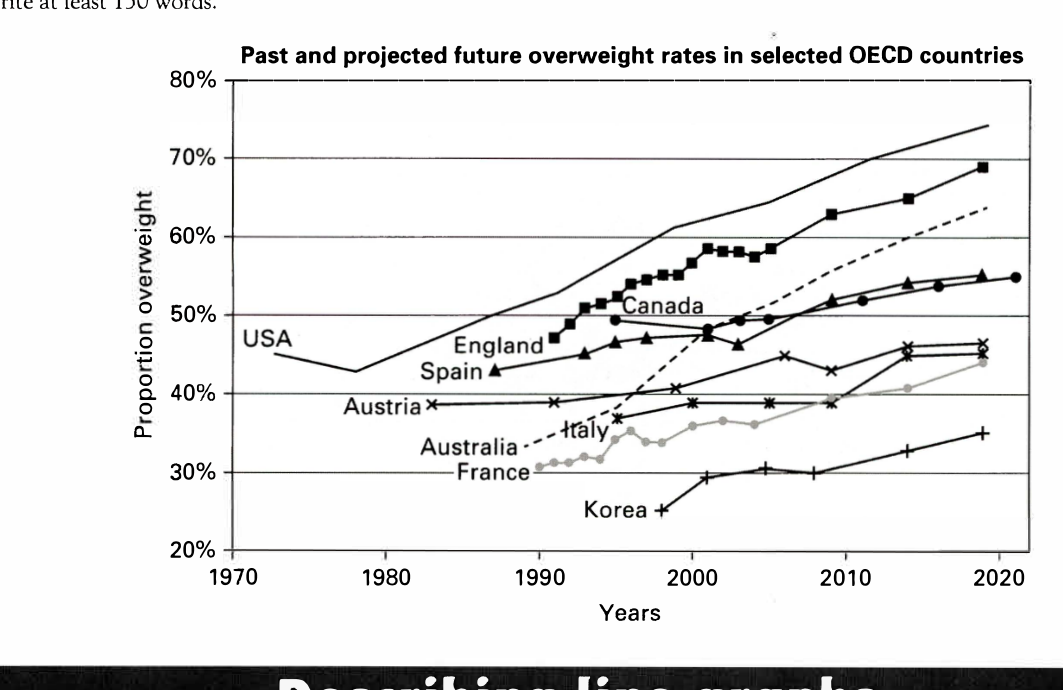
The line graph below shows past and current overweight rates, as well as a projected future overweight rate in nine selected countries.
Summarise the infonnation by selecting and reporting the main features, and make comparisons where relevant.
Past and projected future overweight rates in selected OECD countries
Student answer (Band 5.5)
The line graph illustrates the rates that had charged earlier in past and also projected the rates that should be charged in future for nine different countries which are USA, Canada, England, Spain, Austria, Australia, Italy, France, and Korea.
USA had the higher rates for overweight from all the selected countries, which is projected at around 75% in 2020, while Korea had the lower rates for overweight which is below 30% in 1997 and projected to be around 35% in 2020.
During 1970 to 1980, USA there was a decline in the overweight rates and after 1980, gradual increase in the overweight rates had been accounted which is around 75%. During 1980 to 1990, Austria had not increase their rates while France had a gradual increase in their overweight rates.
During 1990 to 2000, Canada had a decline in their rates, while Italy and Korea had a slight increase in their overweight rates. During 2000 to 2020, alomost each country had a increase in their overweight rates. Canada and Spain had almost the same overweight rates at the end while Austria, Italy, and France had the same rates in 2020.
AI examiner evaluation
| Criterion | Band |
|---|---|
| Task Achievement / Task Response | 5.0 |
| Coherence and Cohesion | 5.5 |
| Lexical Resource | 5.5 |
| Grammatical Range and Accuracy | 5.5 |
| Overall | 5.5 |
Task Achievement / Task Response: Band 5.0
You identify the countries and report the broad pattern of rising rates, correctly noting that the USA is highest and Korea lowest, with approximate endpoint figures that match the graph. However, the response only partly summarises the main features: it gives no clear overview of the overall ranking or the substantial rises in Australia and England, and several comparisons are inaccurate. For example, Austria, Italy and France do not have the same rate in 2020; their projected figures are approximately 47%, 46% and 44%, respectively. Canada and Spain finish at similar levels, but this is not the only useful endpoint comparison. Some historical statements are also unclear or unsupported. Select the most important trends and compare them accurately rather than describing isolated periods.
Coherence and Cohesion: Band 5.5
The response has a basic sequence, moving from an introduction and broad comparison to periods of time, and linking words such as “while” and “During” help show contrast and chronology. However, the organisation does not develop a clear overview followed by well-grouped details. The repeated time-based openings make the account feel like a list, and the final sentence combines several comparisons without explaining their significance. Some references are difficult to follow, as in “During 1980 to 1990, Austria had not increase their rates while France had a gradual increase.” Organise the report around an overview and then group countries with similar trends or contrasting levels. Use clearer links between each comparison.
Lexical Resource: Band 5.5
You use relevant topic vocabulary, including “rates,” “decline,” “gradual increase,” and “projected,” so the reader can generally understand the subject. However, the range and control of phrasing are limited, with repeated use of “overweight rates” and several unnatural collocations. For example, “rates that had charged earlier” and “rates that should be charged” do not describe proportions of people who are overweight; “recorded” or “the proportion of people who were overweight” would be more suitable. “Had a increase” also reflects an incorrect word form, while “alomost” is a spelling error. Aim for precise, varied expressions such as “the proportion rose” and “the figure stood at,” and check spelling and collocations during revision.
Grammatical Range and Accuracy: Band 5.5
You attempt both simple statements and longer comparisons, including clauses joined with “while,” and the main message is usually understandable. However, errors in verb forms, agreement, articles and sentence construction recur. Examples include “USA there was a decline,” “Austria had not increase,” and “almost each country had a increase”; these should be recast with accurate subjects and verb forms, such as “the rate in the USA declined” and “rates increased in almost every country.” The opening sentence also has an awkward structure that makes the relationship between past and projected figures unclear. Use a wider mix of accurate sentence patterns, and check that each clause has a clear subject and correctly formed verb before adding comparisons.
See this exact question answered at other band scores. The same prompt compared across bands.
Browse more IELTS Writing model answers or get your own writing scored by the same AI examiner.