Band 5.0 IELTS Writing Task 1 Model Answer
Overall Band Score: 5.0 · IELTS Momentum Workout · 2026-11-18
IELTS Writing Task 1 question
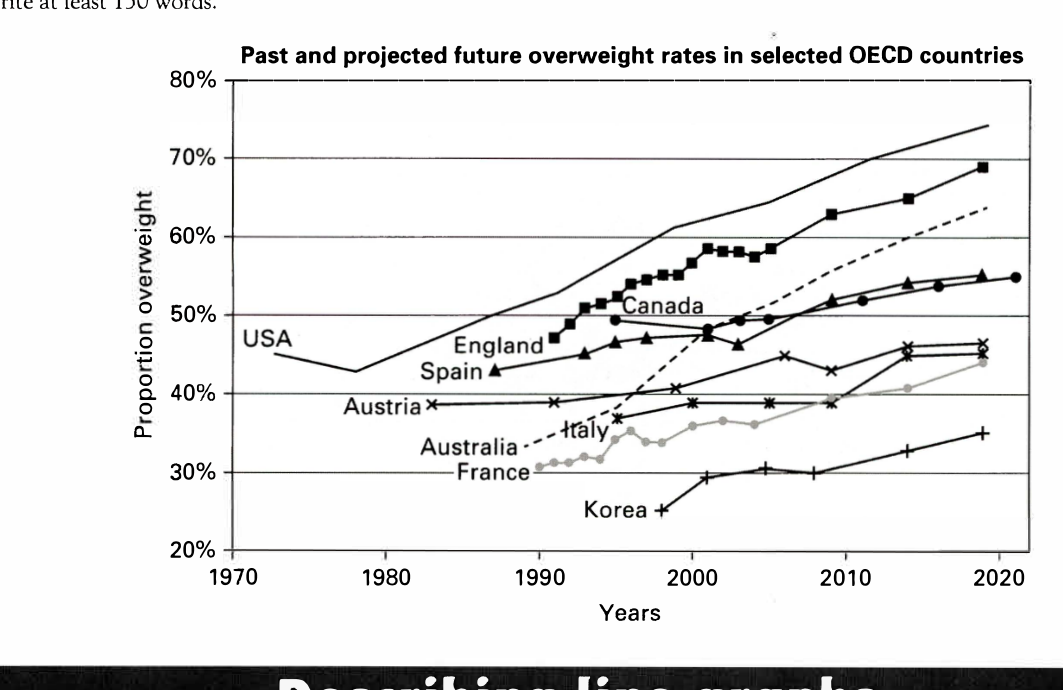
The line graph below shows past and current overweight rates, as well as a projected future overweight rate in nine selected countries.
Summarise the infonnation by selecting and reporting the main features, and make comparisons where relevant.
Past and projected future overweight rates in selected OECD countries
Student answer (Band 5.0)
The line graph portrays the present picture as well as the predicted rate of overweight prevalence in 9 countries .
Overall, we can see an increasing rate of obesity in all the countries mentioned . At the starting point of the statistics, Canada had the highest rate of proportional overweight among its population sitting at 50% and Korea with the lowest percentage ,just about 25% . which is just about the half of Canada . USA is expected to be the most obese country by the 2020's , which shows at least 70% of its demographic population is prone to be being obese, with an increase of 35% fromits starting data.
England was at 48% , witha final number of 70% ,shows a sharp 22%. Followed by Australia ,which sits at 65% with an increase of 32% in obesity rate . Canada and Spain is expected to have at least 55% of its population exposed to obesity.
Austria, Italy , Frace , being in the same region, expects a similar rate of obesity by 2020, just between 43 and 46%.
Among all the countries ,
AI examiner evaluation
| Criterion | Band |
|---|---|
| Task Achievement / Task Response | 5.5 |
| Coherence and Cohesion | 4.5 |
| Lexical Resource | 5.5 |
| Grammatical Range and Accuracy | 5.0 |
| Overall | 5.0 |
Task Achievement / Task Response: Band 5.5
You identify the broad upward trend and make relevant comparisons, including the USA’s projected position at the top and Korea’s low starting figure. However, some details are inaccurate or unclear: Canada’s highest rate is around 50% in the mid-1990s, not at the starting point of the graph, and the USA rises by about 29 percentage points from its first recorded value, rather than 35. The projected figures for England and Australia are also slightly overstated. The overview is useful, but the claim that all countries increase overlooks fluctuations, and the final sentence is unfinished. Select the main patterns more carefully and support them with accurate comparisons across the period.
Coherence and Cohesion: Band 4.5
The response has an overall structure, moving from an overview to groups of country comparisons, and phrases such as “Overall” and “Followed by” show an attempt to guide the reader. However, progression is weakened by abrupt or incomplete points: “Among all the countries,” has no continuation, while “which is just about the half of Canada” is separated from the preceding sentence. Some comparisons are grouped without a clear organising principle, and punctuation and spacing make links harder to follow. Use complete paragraphs with a clear purpose—for example, one for the highest rates and another for the lower-rate countries—and connect each comparison explicitly to the relevant period.
Lexical Resource: Band 5.5
You use some task-relevant vocabulary, including “predicted,” “increasing rate,” “highest rate,” and “increase,” so the main topic is generally clear. However, the range is limited and several expressions are imprecise or unnatural, such as “proportional overweight,” “demographic population,” and “exposed to obesity.” Repetition of “rate” and “obesity” also reduces flexibility, and spelling errors such as “Frace” are noticeable. Prefer precise chart language such as “proportion of the population who were overweight” and “rose to,” while varying verbs with “climbed,” “increased,” or “stood at.” Check spelling and use standard collocations before submitting.
Grammatical Range and Accuracy: Band 5.0
You attempt some longer structures, including clauses with “which” and comparisons using “with an increase,” but control is inconsistent. Sentence boundaries are often faulty: “Korea with the lowest percentage… . which is just about the half of Canada” leaves a fragment, and “England was at 48%, with a final number of 70%, shows…” combines clauses incorrectly. There are also agreement and tense problems, as in “Canada and Spain is expected” and “Austria, Italy, Frace… expects.” Punctuation and spacing around commas and full stops are inconsistent. Build complete sentences with a clear subject and verb, and check agreement and clause connections, especially when reporting projected figures.
See this exact question answered at other band scores. The same prompt compared across bands.
Browse more IELTS Writing model answers or get your own writing scored by the same AI examiner.