Band 5.0 IELTS Writing Task 1 Model Answer
Overall Band Score: 5.0 · IELTS Momentum Workout · 2026-11-19
IELTS Writing Task 1 question
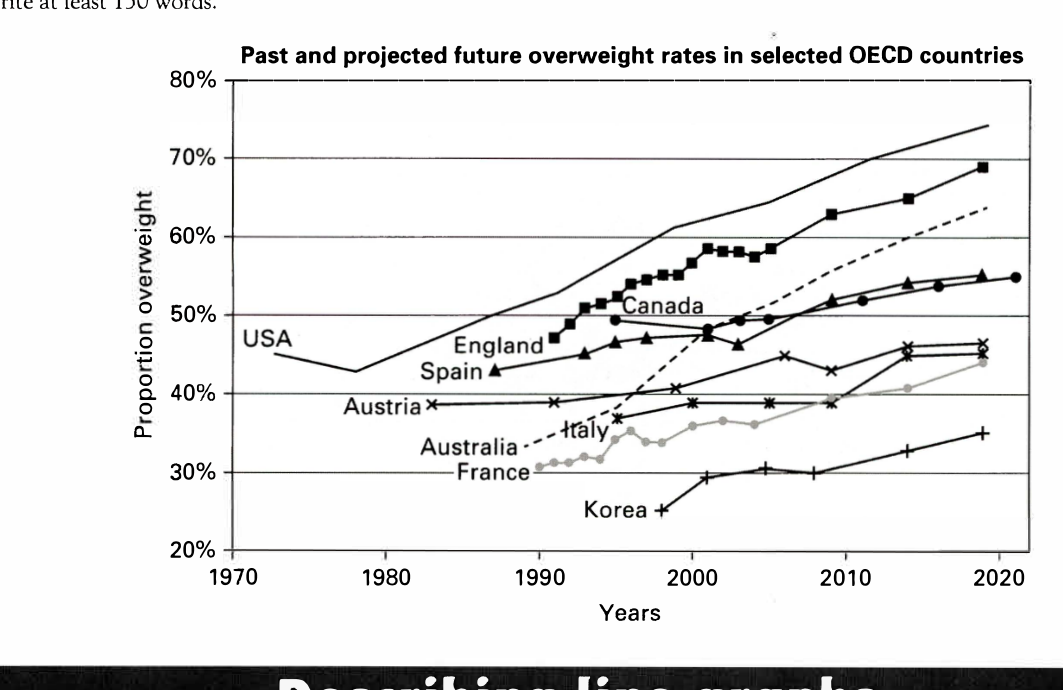
The line graph below shows past and current overweight rates, as well as a projected future overweight rate in nine selected countries.
Summarise the infonnation by selecting and reporting the main features, and make comparisons where relevant.
Past and projected future overweight rates in selected OECD countries
Student answer (Band 5.0)
The line graph illustrates the changing patterns of overweight rates in nine OECD countries over the past years.
Overall, it is clear that all of the countires have showed significant increase in proportion of overweight from 1970 to 2020. Alternatively, Some of the specific states encompassed fluctuations in rates of overweight, however, the overall trend rendered considerbale rise in weights.
Initially, USA was declining in overweight from the percentage 47% to about 41% since 1971 to 1978, alternatively, it again rose drastically approximately 74% in 2020. Some countries like Korea, France, Australia and Italy were static in 1970s and gradually increases their ratio in overweight. On the other hand, the percentange of overweight fell down in canada in 1993 to 2000, and then it increased slowly.
Italy from in 1995 showed a little rise but again in 2000, it began to decline on a slow rate, and in 2010, it increased while remained constant from 2010 to 2020. England and Korea showed little decline in 2000, while England remains unchanged till 2005 contrastly, korea again showed a bit fall in 2005. Whereas, the rates of overweight was increaing in spain from 1988, eventually, it fell down in 2000, and again started increasing from 2000 to 2020.
AI examiner evaluation
| Criterion | Band |
|---|---|
| Task Achievement / Task Response | 5.0 |
| Coherence and Cohesion | 5.0 |
| Lexical Resource | 5.5 |
| Grammatical Range and Accuracy | 5.0 |
| Overall | 5.0 |
Task Achievement / Task Response: Band 5.0
You provide an overview that recognises a general upward pattern and mention several countries, but the account only partially reports the graph’s main features. Some details are inaccurate: the USA rose from about 43% in 1980 to 74% in 2020, rather than falling from 47% to 41% before rising; Italy generally increased, not declined after 2000; and Korea’s rate rose overall rather than showing the stated fall after 2005. The claim that all countries increased significantly also overlooks the different starting years and the relatively modest rises in some cases. To strengthen the response, select the clearest comparisons—for example, the USA ending highest and Korea lowest—and report the broad trends accurately, with a few supporting figures.
Coherence and Cohesion: Band 5.0
The response has an introduction, an overview and two detail paragraphs, so there is some organisation. However, the progression is difficult to follow because countries are grouped and revisited without a clear organising principle. For example, the second paragraph moves from the USA to four other countries and then Canada, while the final paragraph returns to Italy, England and Korea before discussing Spain. Linking words such as “Alternatively,” “On the other hand” and “Whereas” are sometimes used in ways that do not clearly express the relationship between ideas. Organise the details into meaningful groups, such as higher and lower rates or countries with similar trends, and use simpler, more precise transitions.
Lexical Resource: Band 5.5
You attempt a range of vocabulary relevant to describing trends, including “fluctuations,” “gradually,” “declining” and “increased slowly.” However, the range is limited by repeated use of “overweight” and “increased,” and several word choices or collocations are inaccurate or awkward, such as “rendered considerable rise in weights” and “fell down.” There are also noticeable spelling errors, including “countires,” “considerbale” and “percentange,” which reduce the polish of the report. Use standard graph-description phrases consistently and choose verbs that match the data, such as “rose,” “remained stable” and “fluctuated.” This would make the meaning clearer and more precise.
Grammatical Range and Accuracy: Band 5.0
You attempt both simple and more complex sentences, including clauses introduced by “while,” “however” and “whereas.” Nevertheless, complex structures are often faulty, and errors occur frequently enough to make some sentences difficult to interpret. Examples include “all of the countires have showed,” “Some countries … gradually increases,” and “the rates of overweight was increaing,” where verb forms or subject–verb agreement are incorrect. Sentence boundaries and punctuation also need attention: the long final sentence joins several country trends in a way that obscures their relationships. Practise accurate past-tense reporting and agreement, and divide multi-part comparisons into shorter sentences before adding more complex clauses.
See this exact question answered at other band scores. The same prompt compared across bands.
Browse more IELTS Writing model answers or get your own writing scored by the same AI examiner.