Band 5.0 IELTS Writing Task 1 Model Answer
Overall Band Score: 5.0 · IELTS Momentum Workout · 2026-11-19
IELTS Writing Task 1 question
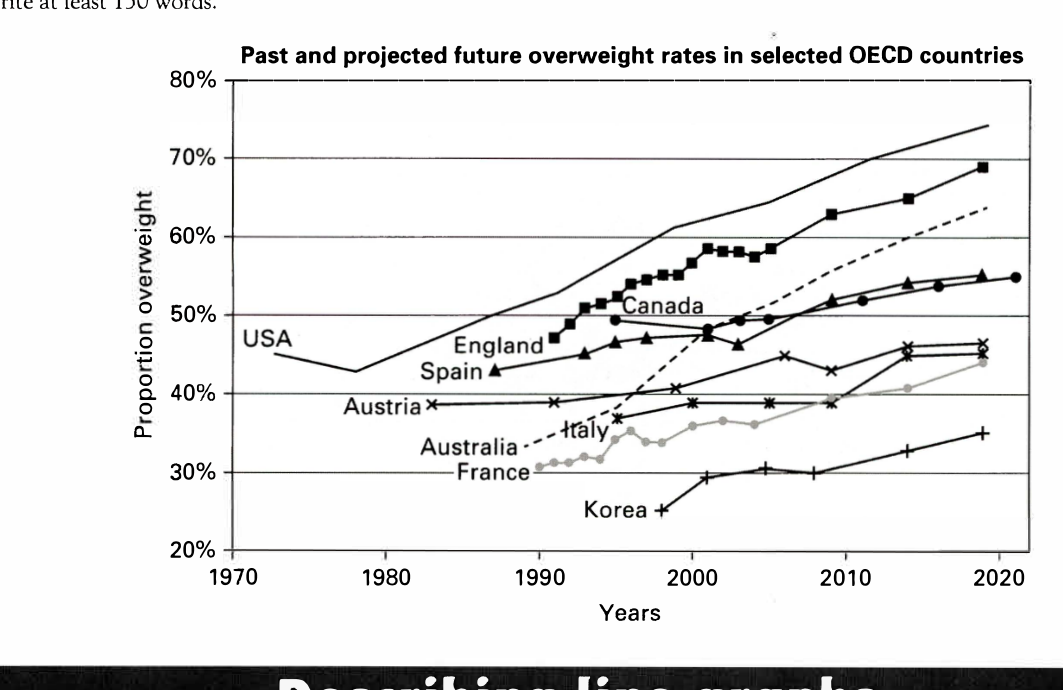
The line graph below shows past and current overweight rates, as well as a projected future overweight rate in nine selected countries.
Summarise the infonnation by selecting and reporting the main features, and make comparisons where relevant.
Past and projected future overweight rates in selected OECD countries
Student answer (Band 5.0)
The given graph depicts past and and present overweight scores,and so on predicted forthcoming overweight rate in nine chosen countries.
In 1970 USA start 47%with slightly decline and skyrocketing with the percentage of 75%and other hand.England with steadily initiation from 47%to around the peak of 70% and Canada slightly close to 50% and reach to 53% Spain was the similar to England in terms of starting and similar to CANADA in terms of ending.
On other hand Austria starting with around 35% stability fluctuatly reached at around 45%and france IN 1986 around 30% with steady start and reach to 42% Italy was slow progress with 33% and reach to 40%, Korea journey was start 1998 25% and target to 35% in the year 2020
The conclusion is the past and future projected overweight score in OECD countries gradually increase and decrease year wise some time stable and some time fluctuate
AI examiner evaluation
| Criterion | Band |
|---|---|
| Task Achievement / Task Response | 4.5 |
| Coherence and Cohesion | 5.0 |
| Lexical Resource | 5.0 |
| Grammatical Range and Accuracy | 4.5 |
| Overall | 5.0 |
Task Achievement / Task Response: Band 4.5
You identify the broad pattern of rising overweight rates and mention all nine countries, which gives the response some relevant coverage. However, the main features are not selected or reported clearly enough: there is no distinct overview, and the final sentence says rates “increase and decrease” without explaining the dominant upward trend or the differences between countries. Some figures and dates are inaccurate: the USA begins at about 45%, not 47%, and reaches roughly 74% by 2020; France’s series begins around 1991, not 1986. The comparison that Spain ends similarly to Canada is broadly supported, but other comparisons are vague. To improve, give a clear overview and support it with accurate, representative comparisons across the highest and lowest rates.
Coherence and Cohesion: Band 5.0
The response has a basic sequence: it first discusses the USA, England, Canada and Spain, then turns to the other countries, and ends with a general conclusion. This grouping gives the reader some sense of organisation. However, progression within the paragraphs is difficult to follow because several countries and figures are compressed into long, loosely connected statements. Connectors such as “On other hand” are repeated or used awkwardly, and the final sentence does not clearly summarise the preceding details. Use separate paragraphs for an overview and for logically grouped comparisons, and make each sentence focus on one or two related countries. Clearer linking and reference would make the information easier to track.
Lexical Resource: Band 5.0
You attempt some task-relevant language, including “slightly decline,” “steadily,” “fluctuatly,” and “slow progress,” and use terms such as “percentage” and “projected.” However, the range is limited and several word choices or collocations make the meaning unclear. “Overweight scores” is not a natural description of the graph’s proportions, while “skyrocketing” is too informal for an academic report. “Steadily initiation” and “target to 35%” are also unsuitable expressions for describing trends. Spelling and capitalisation are inconsistent, including “france” and “CANADA.” Practise precise trend vocabulary and standard collocations, such as “the proportion rose,” “remained stable,” and “is projected to reach.”
Grammatical Range and Accuracy: Band 4.5
The response attempts to describe changes over time, but sentence structures are limited and errors are frequent enough to make several relationships difficult to understand. For example, “In 1970 USA start 47%with slightly decline” lacks an article and has an incorrect verb form and sentence structure. The long sentence beginning “England with steadily initiation” does not form a clear grammatical comparison, and the final sentence has problems with agreement and word order. Punctuation and spacing also interfere with sentence boundaries, as in “75%and” and the run-on sequence of country comparisons. Build accurate simple sentences first, using past-tense verbs for historical data and “is projected to” for forecasts, then add controlled comparisons.
See this exact question answered at other band scores. The same prompt compared across bands.
Browse more IELTS Writing model answers or get your own writing scored by the same AI examiner.