Band 5.0 IELTS Writing Task 1 Model Answer
Overall Band Score: 5.0 · IELTS Momentum Workout · 2026-11-21
IELTS Writing Task 1 question
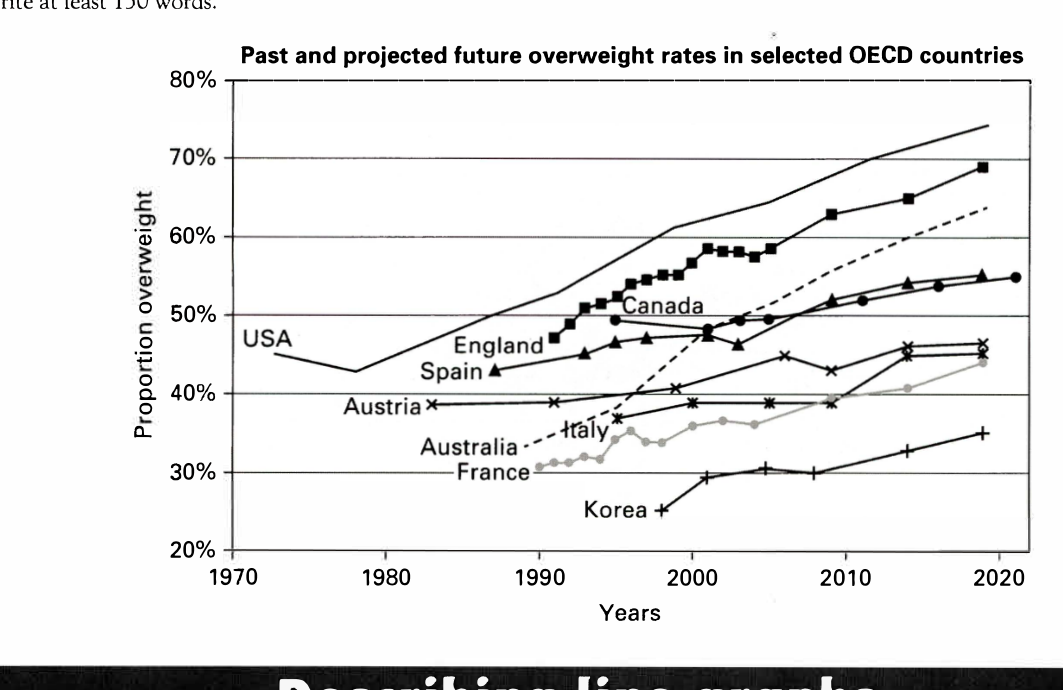
The line graph below shows past and current overweight rates, as well as a projected future overweight rate in nine selected countries.
Summarise the infonnation by selecting and reporting the main features, and make comparisons where relevant.
Past and projected future overweight rates in selected OECD countries
Student answer (Band 5.0)
The line graph campares the past overweight rate with the current one and also expected overweight rate in the future in nine OECD countires over the 60 year period.
Overall,the overweighting is a big concern in USA in over the 60 years period,the rate start from 45% and close at 75% which is highest overweight rate among the other countries,while the damn side of this graph is korea stand at the bottom out campare the other countires,moreover its rate begin from 15% and ends up at 35%.
The proportion of overweigh in USA, this country is one of the overweight country campare the all other countires in OECD,moreover the overweight rate start from 45% and after the one decade it starts to rise up slowly and in 1990 it touch the 50% mark,furthermore it is continuesly rose up and hit the highest point.While the overweight rate in three different countires England,Canada and spain is fluctuate at the 40 to 50% mark.In contrast, the four ther other countires also fluctuate at 30 to 40% mark respectively.So that, the overweight rate is very low campare to USA.Realted to this, Korea is a country where this rate is reach the bottom out in all over the period.Its start from 20% and ends up at 35% .
AI examiner evaluation
| Criterion | Band |
|---|---|
| Task Achievement / Task Response | 5.5 |
| Coherence and Cohesion | 5.0 |
| Lexical Resource | 5.0 |
| Grammatical Range and Accuracy | 5.0 |
| Overall | 5.0 |
Task Achievement / Task Response: Band 5.5
You identify the broad pattern that the USA has the highest rate and Korea the lowest, and you include an overview as well as some country comparisons. However, several details do not match the graph: Korea begins at about 25%, not 15% or 20%, and the USA rises to roughly 74% by 2020 rather than simply “close at 75%” after a clearly described 60-year span. The grouping of England, Canada and Spain as fluctuating between 40% and 50% is too broad, since England rises to about 69% and Spain to 55%. The response also omits important trends for Australia and the other lower-rate countries. More accurate selection and reporting of key changes would make the summary more complete.
Coherence and Cohesion: Band 5.0
The response has a recognisable structure: an introduction, an overview and a body paragraph, and it moves from the USA to comparisons among other countries. However, progression is difficult to follow because several ideas are repeated, especially the USA’s high rate and Korea’s low position. Linking expressions such as “moreover,” “furthermore” and “in contrast” are used frequently, but they do not always clarify the relationship between points. The sentence beginning “The proportion of overweigh in USA” is also followed by a fragment-like restatement, which interrupts the flow. Organise the body by clear groups or trends, and use fewer, more precise links and references to make comparisons easier to track.
Lexical Resource: Band 5.0
You use some relevant task vocabulary, including “rate,” “proportion,” “rise” and “fluctuate,” so the topic is generally understandable. However, the range is limited and several inaccurate or repeated expressions make the report less clear, such as “overweighting,” “damn side,” “bottom out” and “the overweight country.” There are also frequent spelling errors, including “campares,” “countires,” “continuesly” and “Realted,” which reduce accuracy. Aim for standard chart language and precise collocations: for example, describe a rate as “increasing,” “remaining relatively stable” or “the lowest,” rather than using unclear phrases. Check spelling carefully and avoid repeating the same wording when comparing countries.
Grammatical Range and Accuracy: Band 5.0
You attempt longer sentences with clauses and comparisons, but these are often faulty, and errors sometimes make the relationships between ideas difficult to understand. Examples include “the rate start from 45% and close at 75%,” “the overweight rate is fluctuate,” and “Korea is a country where this rate is reach the bottom.” These show problems with subject–verb agreement, verb forms and sentence construction. Articles and punctuation are also inconsistent, as in “Overall,the” and “in USA.” Most sentences rely on similar patterns, with several clauses joined by commas rather than clearly controlled sentence structures. Practise accurate simple sentences first, then add subordinate clauses, checking tense and agreement in each one.
See this exact question answered at other band scores. The same prompt compared across bands.
Browse more IELTS Writing model answers or get your own writing scored by the same AI examiner.