Band 5.0 IELTS Writing Task 1 Model Answer
Overall Band Score: 5.0 · IELTS Momentum Workout · 2026-11-23
IELTS Writing Task 1 question
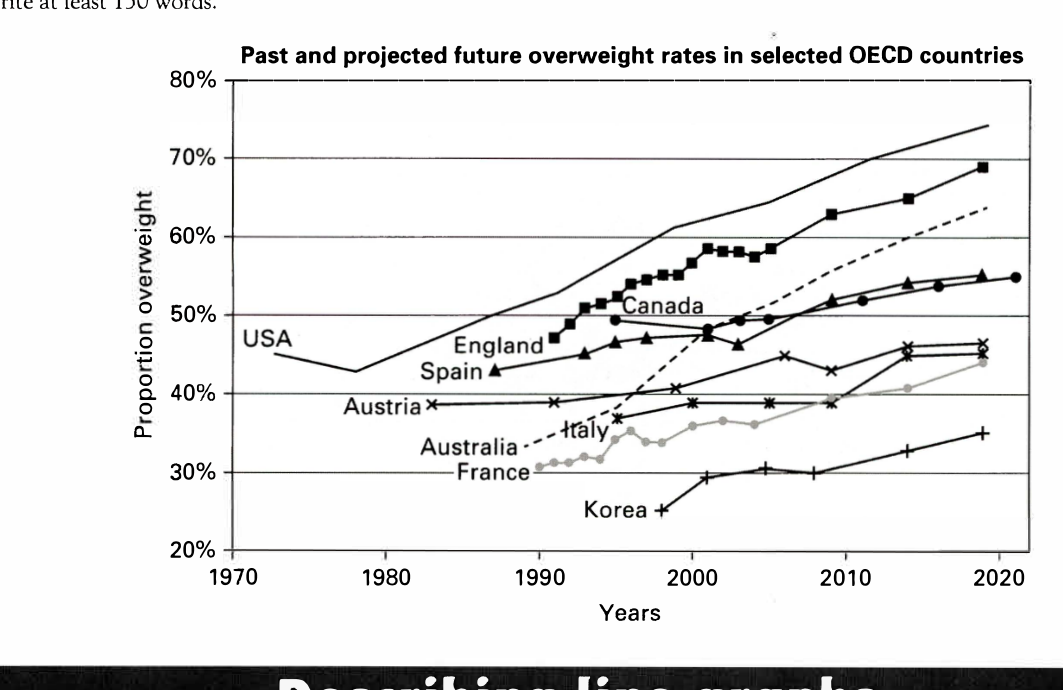
The line graph below shows past and current overweight rates, as well as a projected future overweight rate in nine selected countries.
Summarise the infonnation by selecting and reporting the main features, and make comparisons where relevant.
Past and projected future overweight rates in selected OECD countries
Student answer (Band 5.0)
The line graph represents overweight rates in the past and current time ,and tells the future overweight rates of nine given countries.
Overall,through the first glance at the line graph it can be seen that USA country has the highest proportion of overweight rate throughout while ,Korea has the lowest overweight proportion rate .It can be clearly notice that all nine countries overweight proportion rate increases with time .
A detailed study of graph illustrates that in USA the proportion rate increases from 50 percent to above 70 percent in the years after 1970 to almost year 2020 .In 1990, Australia about 40 percent proportion of overweight and there is great change as it increases upto 60 perecnt while in austria it goes to upto 40 perecnt like there is no such big change as it already have about percentage of 40 same as in france there is no such a hyge change
AI examiner evaluation
| Criterion | Band |
|---|---|
| Task Achievement / Task Response | 5.0 |
| Coherence and Cohesion | 5.5 |
| Lexical Resource | 5.0 |
| Grammatical Range and Accuracy | 5.0 |
| Overall | 5.0 |
Task Achievement / Task Response: Band 5.0
You identify the broad pattern that rates generally rise and note that the USA is highest and Korea lowest, which are relevant overview points. However, the overview is not fully accurate: the USA is not highest throughout the period shown, since its early figure is below some later country figures, and the graph includes several fluctuations rather than uninterrupted increases. The body gives only a few countries limited attention and omits useful comparisons among the other countries. Some figures are also inaccurate: the USA begins at about 45%, not 50%, and Australia rises from roughly 34% in 1990 to 64% by 2020, rather than reaching 60%. Select the main highs, lows and contrasting trends, then support them with accurate approximate figures.
Coherence and Cohesion: Band 5.5
The response has a basic structure, with an opening, an overview and a body paragraph, and the reader can identify the general subject and some comparisons. However, progression is limited: the body moves from the USA to Australia, Austria and France without a clear organising principle, and the discussion ends before the comparison is completed. Linking is also awkward or repetitive, as in “while” and “same as in France,” which do not clearly show how the figures relate. Use separate paragraphs for the overview and grouped country comparisons, and organise the body by high versus low rates or by similar trends. Clearer sentence boundaries and reference to specific years would make the sequence easier to follow.
Lexical Resource: Band 5.0
You use relevant topic vocabulary, including “proportion,” “increases,” and “overweight rates,” so the subject is generally understandable. However, the range is limited and several phrases are repetitive or unnatural, such as “overweight proportion rate” and “there is no such big change.” Some word-form and spelling errors also reduce precision, including “perecnt” and “hyge.” Aim for concise, conventional language for describing graphs, and vary verbs and comparison phrases rather than repeating “proportion” and “rate.” More accurate collocations would help you report trends clearly without making the reader work to interpret the intended meaning.
Grammatical Range and Accuracy: Band 5.0
The response attempts longer sentences and uses some time and comparison clauses, but the structures are often faulty, and sentence control is inconsistent. For example, “it can be clearly notice” has an incorrect verb form, while “all nine countries overweight proportion rate increases” lacks a possessive and has subject–verb agreement problems. The final sentence is a run-on, joining several country comparisons without clear punctuation or complete grammatical structure. Articles, commas and spacing are also inconsistently handled. Practise building accurate simple sentences first, then combine them with controlled clauses; for example, state one country’s starting and ending figures in a complete sentence before adding a comparison.
See this exact question answered at other band scores. The same prompt compared across bands.
Browse more IELTS Writing model answers or get your own writing scored by the same AI examiner.