Band 4.5 IELTS Writing Task 1 Model Answer
Overall Band Score: 4.5 · IELTS Momentum Workout · 2026-11-23
IELTS Writing Task 1 question
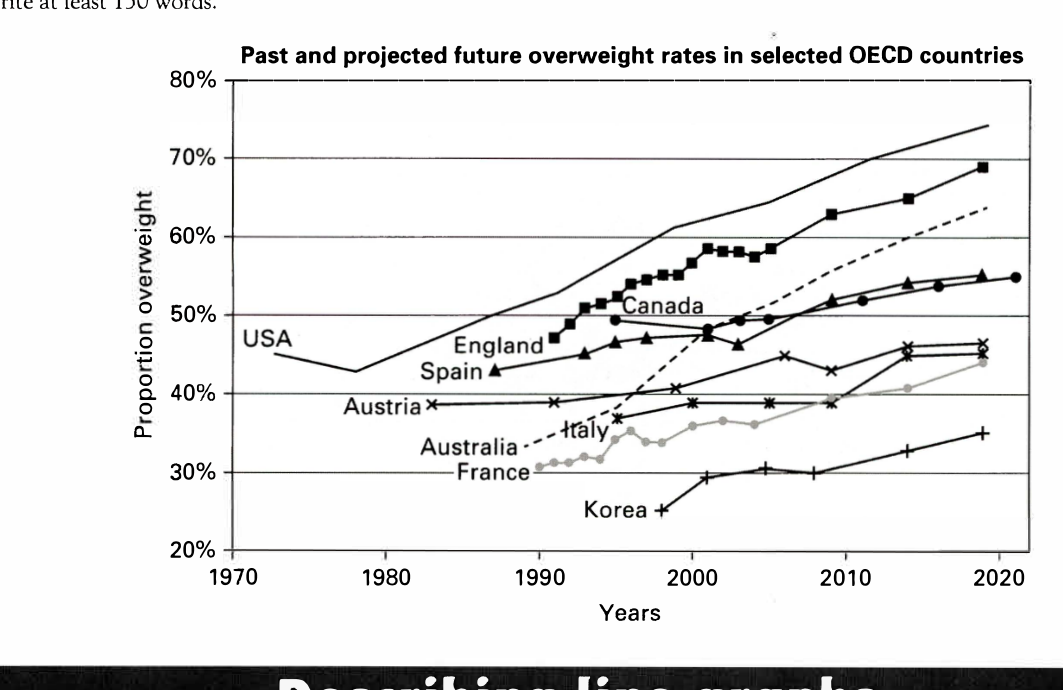
The line graph below shows past and current overweight rates, as well as a projected future overweight rate in nine selected countries.
Summarise the infonnation by selecting and reporting the main features, and make comparisons where relevant.
Past and projected future overweight rates in selected OECD countries
Student answer (Band 4.5)
Introduction, the Line gaph illustrate the past and current overweight rates about past and projected future overweight rates in selected OECD countries.
overall, the OECD countries are i increased overwieght rates in 1970 to 2020. this nine countries are Australia,spain,korea,canada,England,italy,france,Usa,
Austria.we can see past and project future overweight increase 20% to 80%.
in 1970 Usa droping overweight 1980 and suddenly increase to 70% above otherhand we can see others countries are hanging to 1980 to 2000 . in this line korea hast lowest overweight increase is 25% to 35% in 2000 to 2020.
austria increased 1980 to 2020 as we can 32% to 45% .
AI examiner evaluation
| Criterion | Band |
|---|---|
| Task Achievement / Task Response | 4.0 |
| Coherence and Cohesion | 4.0 |
| Lexical Resource | 4.5 |
| Grammatical Range and Accuracy | 4.5 |
| Overall | 4.5 |
Task Achievement / Task Response: Band 4.0
You identify the topic and make a broad attempt to describe an overall rise, and you include a few relevant details, such as the USA’s rise after 1980 and Korea’s comparatively low figures. However, the overview is unclear and partly inaccurate: the graph does not show all nine countries from 1970, and the claim that rates increased from 20% to 80% describes the axis range rather than the countries’ results. The Austria figures are also misreported: it rises from about 39% in the 1980s to roughly 46% by 2019, not from 32% to 45%. The response is 95 words, 55 short of the required minimum, so it cannot adequately summarise the main features or comparisons.
Coherence and Cohesion: Band 4.0
There is a basic attempt to organise the response into an introduction, an overview and a paragraph of details. However, the ideas are not arranged coherently enough to guide the reader through the graph. The overview lists all nine countries but does not establish a clear comparison, while the final paragraph jumps from the USA to Korea and then Austria without explaining how these examples relate. Linking expressions such as “otherhand” do not clarify the relationship between the points, and some sentences are difficult to follow. A clearer progression would be to give a concise overview first, then group the highest and lowest countries or compare their trends in separate, logically connected sentences.
Lexical Resource: Band 4.5
Your vocabulary is basic and repetitive, with some relevant terms such as “overweight rates,” “increase” and “lowest.” However, inaccurate spelling and word choice sometimes strain understanding: “Line gaph,” “overwieght,” and “hanging” make the description less clear, and “droping overweight” is not a natural way to describe a falling rate. The phrase “past and project future” also shows limited control of the vocabulary needed for this task. Use precise graph language consistently, for example “the proportion rose,” “the rate declined slightly,” and “the figure is projected to reach.” Careful spelling of country names and key terms would also make the report easier to read.
Grammatical Range and Accuracy: Band 4.5
The response relies mainly on short, simple statements, and frequent errors in sentence formation, verb forms, agreement and punctuation sometimes distort meaning. For example, “the OECD countries are i increased” has an incorrect verb construction, while “this nine countries are” has a number-agreement error. The sentence beginning “in 1970 Usa droping” lacks a complete, correctly formed clause, and “we can see past and project future overweight increase” is missing grammatical elements needed to express the idea. Capitalisation and sentence boundaries are also inconsistent. Practise forming complete sentences with a clear subject and verb, such as “The USA’s rate fell slightly by 1980, then rose steadily.” Adding a few accurate complex sentences would broaden the range.
See this exact question answered at other band scores. The same prompt compared across bands.
Browse more IELTS Writing model answers or get your own writing scored by the same AI examiner.