Band 4.5 IELTS Writing Task 1 Model Answer
Overall Band Score: 4.5 · IELTS Momentum Workout · 2026-11-24
IELTS Writing Task 1 question
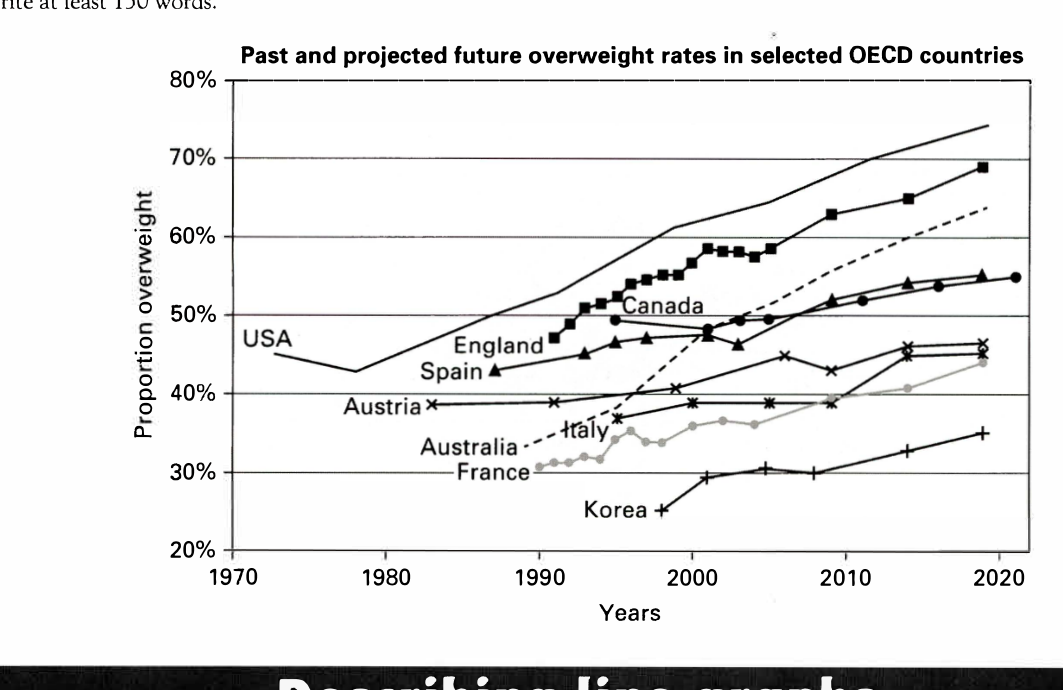
The line graph below shows past and current overweight rates, as well as a projected future overweight rate in nine selected countries.
Summarise the infonnation by selecting and reporting the main features, and make comparisons where relevant.
Past and projected future overweight rates in selected OECD countries
Student answer (Band 4.5)
here I start from korea which is at the verge or very low overweight rates basically its rates increase from 2000 to 2020 and the trend showing that it will increase further than it comes a France which has been shiwn by light colour line at its ioverweight increase but has alot of fluctuations than in the graph we have Australia shown by dashed lines which has very high trend and we have Austria in which the trend is very much upto constant line , England has also very much fluctuations in overweight rates seems like in future it would be like this . Belown the England trend we have Spain whose overweight starts from 1985 and in future it would be also increasing. On the top we have USA whose graph does not have any fluctuations althoigh it line decreases and than increases but from the graph it can be seen in future its overweight rates increases.
AI examiner evaluation
| Criterion | Band |
|---|---|
| Task Achievement / Task Response | 4.5 |
| Coherence and Cohesion | 3.5 |
| Lexical Resource | 5.0 |
| Grammatical Range and Accuracy | 5.0 |
| Overall | 4.5 |
Task Achievement / Task Response: Band 4.5
You identify several relevant countries and recognise the broad upward direction, especially for Korea, France, Australia and the USA. However, the response gives no clear overview of the main comparisons and does not accurately report some key features. For example, the USA is described as having no fluctuations, although its rate first falls and then rises; Australia is called a “very high” trend without explaining that it rises from about 34% to 64%; and the claim that England has “very much fluctuations” overstates its generally rising pattern. Several countries are named without figures or meaningful comparisons, and the opening focuses on Korea rather than summarising the overall picture. Select the highest and lowest rates, compare notable increases, and support these points with approximate data.
Coherence and Cohesion: Band 3.5
The response attempts to guide the reader through the graph using phrases such as “On the top” and “Belown the England trend,” so there is some effort to organise the countries by position. However, the ideas are presented as one long sequence rather than in clear paragraphs or a logical overview followed by details. Connections between countries are often unclear, and repeated use of “and” makes the progression feel like a list. Some references, such as “its rates” and “this,” do not clearly identify the country or trend being discussed. Group the countries into meaningful comparisons—for example, the highest-rising lines and the lower-rate countries—and use clear topic sentences and accurate referencing.
Lexical Resource: Band 5.0
You use some relevant graph vocabulary, including “rates,” “trend,” “increase,” “decreases,” and “fluctuations,” which helps communicate the general subject. However, the range is limited and several expressions are imprecise or awkward, such as “at the verge or very low overweight rates,” “very high trend,” and “upto constant line.” Repetition of “trend” and “overweight rates” also limits flexibility. Spelling errors such as “shiwn,” “ioverweight,” and “althoigh” make parts harder to read. Use more precise terms for direction and magnitude, and describe a line as rising steadily, remaining relatively stable, or reaching a higher proportion rather than calling its trend “high.”
Grammatical Range and Accuracy: Band 5.0
You attempt to combine ideas in longer sentences, for example, “although its line decreases and than increases,” but these structures are often faulty or difficult to follow. There are recurring problems with sentence boundaries, verb forms and agreement: “the trend showing” needs a finite verb, while “its overweight rates increases” has a plural subject with a singular verb. The response also omits articles or uses them inconsistently, as in “comes a France,” and punctuation is insufficient to separate the many clauses. These errors sometimes make relationships between ideas unclear. Build shorter, complete sentences first, then add controlled complex structures using accurate conjunctions and punctuation.
See this exact question answered at other band scores. The same prompt compared across bands.
Browse more IELTS Writing model answers or get your own writing scored by the same AI examiner.