Band 5.0 IELTS Writing Task 1 Model Answer
Overall Band Score: 5.0 · IELTS Momentum Workout · 2026-11-25
IELTS Writing Task 1 question
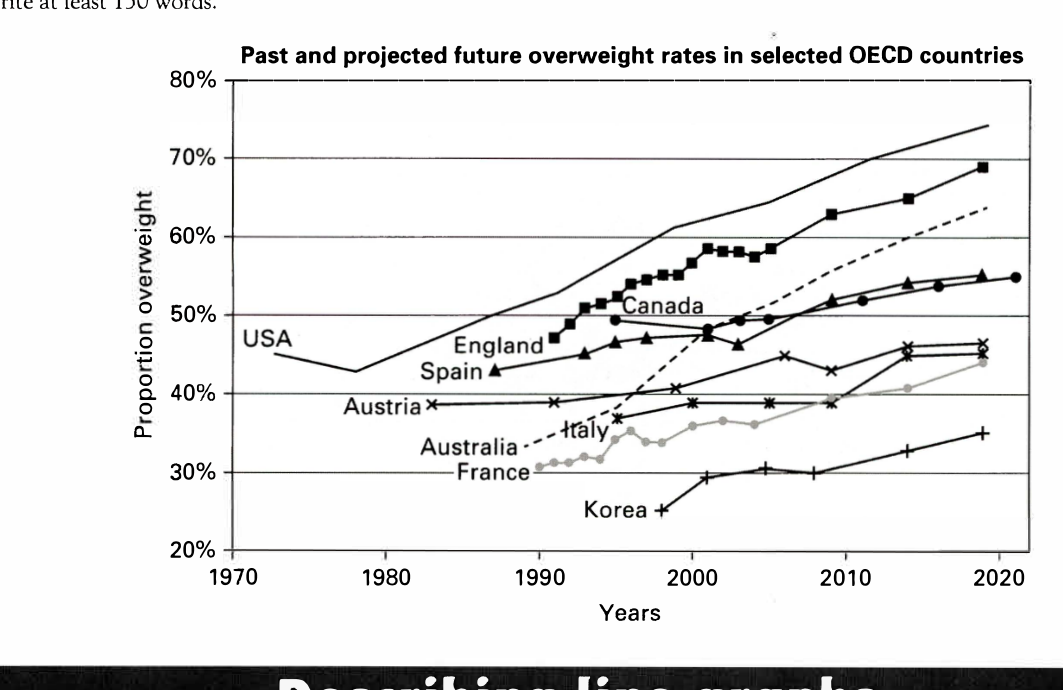
The line graph below shows past and current overweight rates, as well as a projected future overweight rate in nine selected countries.
Summarise the infonnation by selecting and reporting the main features, and make comparisons where relevant.
Past and projected future overweight rates in selected OECD countries
Student answer (Band 5.0)
The line graph illustrates the proportion of overweight people in the past and upcoming years in 9 different countries ( USA, England. Canada, Spain, Austria, Australia, Italy, France and korea.
Overall, USA was the only country had overweight people in the past. Along with Austrlia, England and Spain expected to increase in the future. While korea have less overweight people.
USA had 47 % fat people in the 1970 and it was the only country had it which, gradually increase over the year and expected to rise high among other countries 75% in the 2020. Austria, Spain, England, Australia and France had rate started between 1980 to 2000 which,started rate was 39%, 43%, 47%,33% and 31% respectively. Their rate flactuated over the year and in the future England will be second country had overweight people around 69%.
Korea have the less fat people and in the future will least country only 35% rate.
AI examiner evaluation
| Criterion | Band |
|---|---|
| Task Achievement / Task Response | 4.5 |
| Coherence and Cohesion | 5.0 |
| Lexical Resource | 5.0 |
| Grammatical Range and Accuracy | 5.0 |
| Overall | 5.0 |
Task Achievement / Task Response: Band 4.5
You identify the graph’s subject and include an overview that recognises Korea as the lowest-rate country and predicts a high figure for the USA. However, the overview contains a major factual error: the USA was not the only country with overweight people in the past; the graph shows several countries with recorded rates from the 1980s and 1990s onward. The claim that the USA had 47% in 1970 is also inaccurate (the plotted figure is about 45% in 1972). Your account gives some starting figures, but it omits important comparisons, including Australia’s strong rise and the USA’s position as the highest throughout the later period. Select the main trends accurately and support the overview with relevant comparisons.
Coherence and Cohesion: Band 5.0
The response has a basic structure: an introduction, an overview, and paragraphs describing selected countries. This gives the reader some sense of how the information is organised. However, progression is limited because several countries are grouped together without a clear comparison, and the final sentence repeats the point that Korea has the lowest rate rather than adding a new feature. Linking words such as “Overall,” “Along with,” and “While” are attempted, but the relationships they express are sometimes unclear; for example, “Along with Austrlia, England and Spain expected to increase” does not clearly connect the countries or their trends. Organise the body around meaningful comparisons, such as the highest-rising countries and the lower-rate group, and use clearer links between ideas.
Lexical Resource: Band 5.0
You use some relevant vocabulary for describing a graph, including “proportion,” “rate,” “gradually increase,” and “fluctuated.” However, the range is limited and several choices are inaccurate or informal for this task. “Fat people” is not an appropriate substitute for “overweight people” or “the proportion of people who were overweight,” while “rise high” and “had it” are unclear or unnatural. There are also noticeable spelling errors, including “Austrlia,” “korea,” and “flactuated,” which reduce precision. Aim for accurate graph language and vary expressions for increases, levels, and comparisons. For example, describe a rate as “climbing steadily” or “remaining the lowest,” rather than relying on general wording.
Grammatical Range and Accuracy: Band 5.0
You attempt both simple and longer sentences, but control is inconsistent, and errors often make relationships between ideas difficult to follow. Examples include “USA was the only country had overweight people,” which needs a relative clause (“the only country that had…”), and “England will be second country had overweight people,” which has an incomplete structure. Subject–verb agreement is also faulty in “korea have” and “which, gradually increase.” Sentence boundaries and punctuation need attention: the opening sentence has an unmatched parenthesis, and commas interrupt clauses in “which, started rate.” Practise accurate past and future forms, articles, and complete clauses. Shorter, well-controlled sentences would make your comparisons clearer while you build more complex structures.
See this exact question answered at other band scores. The same prompt compared across bands.
Browse more IELTS Writing model answers or get your own writing scored by the same AI examiner.