Band 4.5 IELTS Writing Task 1 Model Answer
Overall Band Score: 4.5 · IELTS Momentum Workout · 2026-11-25
IELTS Writing Task 1 question
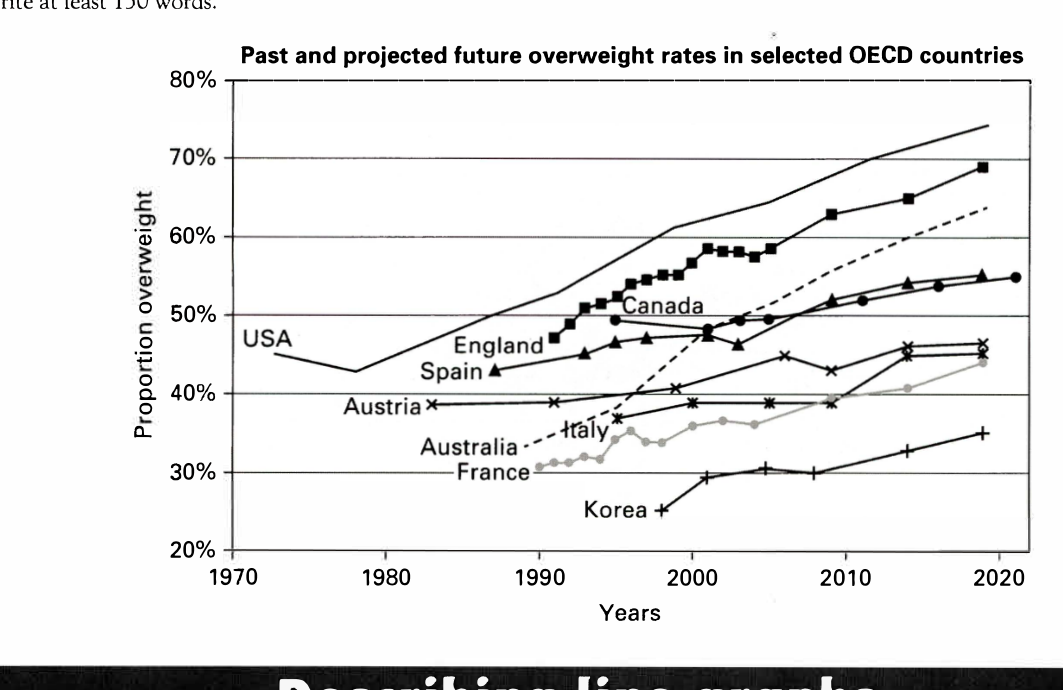
The line graph below shows past and current overweight rates, as well as a projected future overweight rate in nine selected countries.
Summarise the infonnation by selecting and reporting the main features, and make comparisons where relevant.
Past and projected future overweight rates in selected OECD countries
Student answer (Band 4.5)
The following line graph illustates past and current overweight rates and projected future overweight rate in nine different countries from 1970 to 2020.
Overall, the graph shows multiple types of lines for each OECD country.
Starting with the USA, Initially it contains 43% proportation for overweight in 1978 then the country continously reached its peak at almost 75% in 2020, which was a major jump in the health concern.
Next, England was also on the same space like in 1990 its overweight ratio was 48% approximately. However, the percentage were slightly jumpped to 70% which also a huge number in the graph. On the other hand, Australian were serious about their health issues, Although their figure fluctuated slightly, it remained reletively stable throghout the period.
AI examiner evaluation
| Criterion | Band |
|---|---|
| Task Achievement / Task Response | 3.5 |
| Coherence and Cohesion | 4.5 |
| Lexical Resource | 5.5 |
| Grammatical Range and Accuracy | 5.0 |
| Overall | 4.5 |
Task Achievement / Task Response: Band 3.5
The response identifies the topic and gives a few relevant figures, including the USA’s rise to about 75% by 2020 and England’s increase to around 70%. However, it does not provide a meaningful overview of the main patterns: “multiple types of lines” merely describes the chart, and the claim that Australia remained “relatively stable” is inaccurate, as its rate rose substantially from about 34% to 64%. The USA’s starting point is also given as 1978 rather than around 1972. Most countries are omitted, and the comparisons are very limited. The response is 25 words below the required minimum, further restricting its coverage. To improve, summarise the overall ranking and broad upward trends, then compare several countries accurately with selected figures.
Coherence and Cohesion: Band 4.5
There is a basic sequence, moving from an introduction and overview-like statement to the USA, England and Australia. Connectors such as “Starting with,” “Next” and “On the other hand” show an attempt to guide the reader. However, the progression is not fully logical: the overview does not identify a real trend, and the final contrast about Australia is unsupported by the data. The response also ends without a concluding comparison or coverage of the remaining countries. Some transitions are awkward or incorrectly punctuated, which makes relationships between ideas less clear. Grouping countries by their rates or trends, and using a concise overview followed by two organised detail paragraphs, would create clearer progression.
Lexical Resource: Band 5.5
The response uses some task-relevant vocabulary, including “overweight rates,” “percentage,” “fluctuated” and “remained relatively stable,” and the meaning is generally recoverable. There is also an attempt to vary wording with “ratio” and “figure.” However, several spelling and word-choice errors reduce precision: “illustates,” “proportation,” “continously,” “jumpped,” “reletively” and “throghout.” Some expressions are unnatural for describing data, such as “on the same space” and “a huge number.” The phrase “serious about their health issues” also introduces an unsupported interpretation rather than neutrally reporting the graph. Use accurate trend language and check spelling and collocations carefully.
Grammatical Range and Accuracy: Band 5.0
The response attempts both simple and more extended sentences, including a contrast introduced by “However” and a clause beginning “Although.” Basic meaning is usually understandable, but control is inconsistent. For example, “the percentage were” has a subject–verb agreement error, while “Australian were serious” uses an incorrect noun form and agreement. The sentence beginning “On the other hand” joins “Although” to a main clause with faulty punctuation and capitalisation. “Starting with the USA, Initially” also has unnecessary capitalisation and awkward sentence construction. Most sentences rely on straightforward patterns, and the longer attempts are not consistently controlled. Practise accurate agreement, sentence boundaries and punctuation while building clear comparisons using subordinate clauses.
See this exact question answered at other band scores. The same prompt compared across bands.
Browse more IELTS Writing model answers or get your own writing scored by the same AI examiner.