Band 4.5 IELTS Writing Task 1 Model Answer
Overall Band Score: 4.5 · IELTS Momentum Workout · 2026-11-26
IELTS Writing Task 1 question
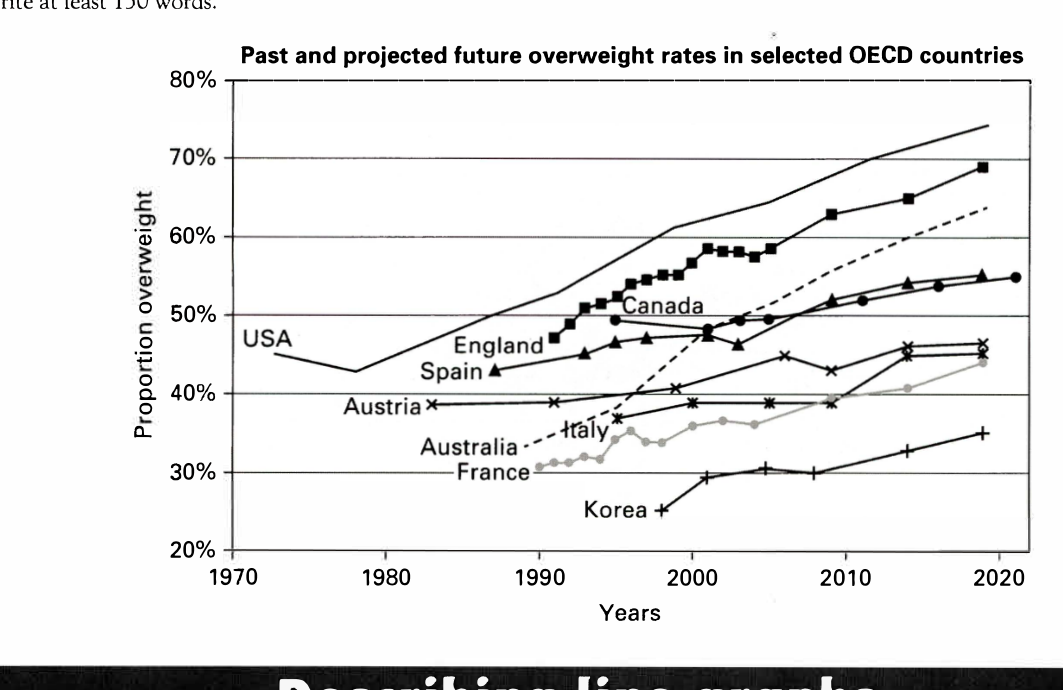
The line graph below shows past and current overweight rates, as well as a projected future overweight rate in nine selected countries.
Summarise the infonnation by selecting and reporting the main features, and make comparisons where relevant.
Past and projected future overweight rates in selected OECD countries
Student answer (Band 4.5)
The line graph compares past, current and projected future overweight rate in selected OECD countries. Moreover, the nations include are Canada, England, Spain, Italy, Australia, Austria, France, Korea and USA.
Overall, fluctuating trend seen be seen.
Permia facie, it can be lucid that in USA percentage increase drastically after 1980. Furthermore, the lowest proportion is given for korea which is 35 percent approx. In Spain, the highest proportion is given in 2020 which is above 50 percent. In addition to this England is the second highest countries in overweight rate which is 70%. Furthermore, Italy, Austria
AI examiner evaluation
| Criterion | Band |
|---|---|
| Task Achievement / Task Response | 3.5 |
| Coherence and Cohesion | 4.0 |
| Lexical Resource | 5.5 |
| Grammatical Range and Accuracy | 4.5 |
| Overall | 4.5 |
Task Achievement / Task Response: Band 3.5
You identify the chart’s subject and list the countries, and you make some relevant observations, such as the USA rising after 1980 and Korea having the lowest rate at about 35% in 2019. However, the overview, “fluctuating trend seen be seen,” does not summarise the dominant pattern: rates generally rise across the countries. Some details are inaccurate or unclear: Spain’s 2019 figure is about 55%, not a 2020 value, and England is around 69% in 2019 rather than 70% as a precise figure. The response also ends mid-sentence after “Italy, Austria,” leaving key comparisons undeveloped. It is 96 words, below the required 150, so the task is addressed only minimally. Add a clear overview and select several accurate comparisons across the period.
Coherence and Cohesion: Band 4.0
There is a basic attempt to organise the response: an opening identifies the graph, followed by an overview and a paragraph of details. The sequence of observations is understandable in places, and linking expressions such as “Furthermore” and “In addition to this” show an effort to connect ideas. However, the progression is weak because the overview is too vague to guide the reader, and the details are presented as a list rather than grouped into meaningful comparisons. Repeated use of “Furthermore” also makes cohesion mechanical. The final phrase, “Furthermore, Italy, Austria,” is incomplete and leaves the response without a conclusion. Group countries by higher and lower rates or by similar trends, and use clear topic sentences to create a logical progression.
Lexical Resource: Band 5.5
You use some task-relevant vocabulary, including “proportion,” “percentage,” “increase,” and “overweight rate,” and the country names are generally clear. There is also an attempt to use more formal language through “Moreover” and “In addition to this.” However, several choices are inaccurate or unnatural: “fluctuating trend” does not describe the broad upward pattern, “the highest proportion is given for Spain” is an awkward way to report a figure, and “second highest countries” uses the wrong form. “Permia facie” appears to be a misspelling or misapplication of a Latin phrase and is not suitable here. Aim for precise chart language such as “rose,” “stood at,” and “the lowest rate,” and avoid ornate expressions that obscure meaning.
Grammatical Range and Accuracy: Band 4.5
The response includes some simple sentence forms and attempts longer structures, for example, “In addition to this England is the second highest countries in overweight rate which is 70%.” However, grammatical control is inconsistent, and errors sometimes make the intended meaning difficult to follow. In the opening, “the nations include are” has an incorrect verb construction; “fluctuating trend seen be seen” contains a faulty passive form; and “the second highest countries” has a number-agreement problem. The sentence about Spain also lacks a clear, accurate time reference. The final clause is unfinished, so it cannot demonstrate control of sentence completion. Practise accurate subject–verb patterns and complete sentences, and use a wider range of structures only when you can control them.
See this exact question answered at other band scores. The same prompt compared across bands.
Browse more IELTS Writing model answers or get your own writing scored by the same AI examiner.