Band 5.5 IELTS Writing Task 1 Model Answer
Overall Band Score: 5.5 · IELTS Momentum Workout · 2026-11-26
IELTS Writing Task 1 question
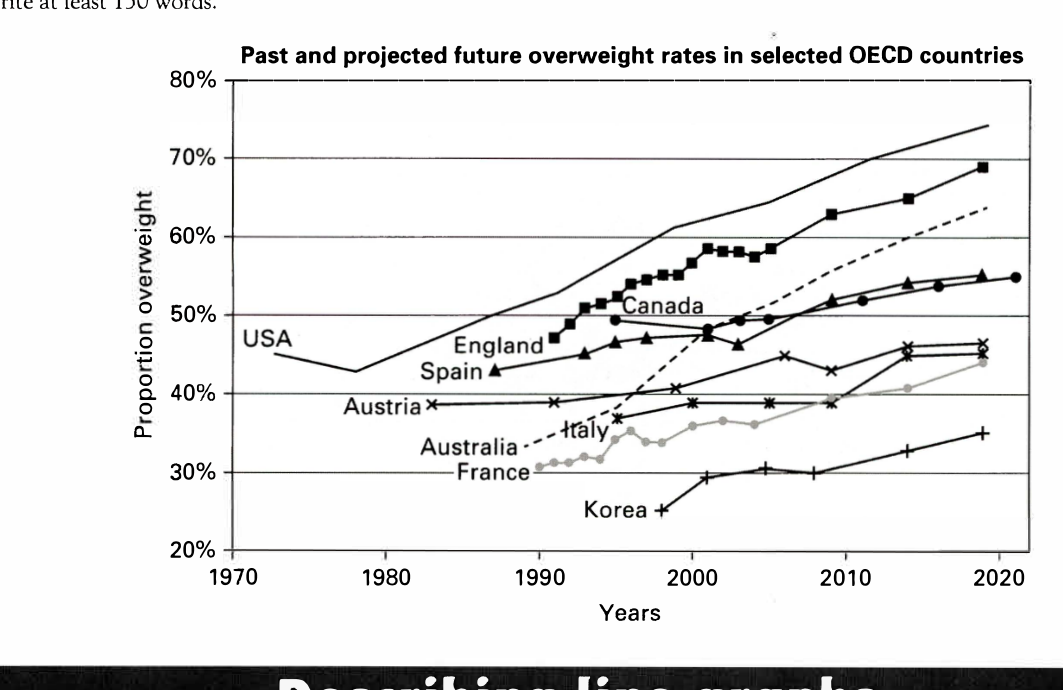
The line graph below shows past and current overweight rates, as well as a projected future overweight rate in nine selected countries.
Summarise the infonnation by selecting and reporting the main features, and make comparisons where relevant.
Past and projected future overweight rates in selected OECD countries
Student answer (Band 5.5)
The line chart illustrates the past and current overweight rates, as well as a projected future overweight rate in different countries. The ranging from roughly 20% to just over 70%.
Overall, the overweight rates clearly shows the upward trend in every countries. Although, the USA overweight has completely highest level of rates in selected OCED countries, While the Korea has lowest number of overweight rates compared to all other countries. Moreover, the England experience substantial rise, climbing from roughly 48% to around 65% approximately.
However, the other countries shows the different patterns of growth. We see the Australia the overweight rates starts from 31% to rose up about 65%. While the France range inclined slowly around 30% to 42%. Meanwhile, the other countries include Canada, Spain, Italy, Austria and etc. generally sit in the middle range from 30% to 60%.
To conclude, the highest overweight rates grows steadily has the one of the most popular country and that is the USA. It was around 40% to 80%. While the lowest country overweight rates is the Korea. It around upto 20% to 40% approximately.
AI examiner evaluation
| Criterion | Band |
|---|---|
| Task Achievement / Task Response | 5.5 |
| Coherence and Cohesion | 5.5 |
| Lexical Resource | 5.5 |
| Grammatical Range and Accuracy | 5.0 |
| Overall | 5.5 |
Task Achievement / Task Response: Band 5.5
You provide an overview that identifies the broad rise in rates and correctly names the USA as highest and Korea as lowest by the end. However, several details do not match the graph: Australia begins at about 34%, not 31%, and reaches roughly 64%, while France rises from about 31% to 44%, rather than 30% to 42%. The USA is projected to reach about 74%, not 80%, and Korea ends near 35%, not 40%. The claim that every country rises also overlooks small fluctuations in several lines. Much of the middle-country comparison is vague, so select a few accurate figures and describe the main contrasts more fully. (Fourteen words copied from the task prompt were not counted.)
Coherence and Cohesion: Band 5.5
The response has a recognisable structure, with an introduction, an overview, and paragraphs describing trends, so the reader can identify the intended stages of the report. However, progression is weakened by repeated or loosely connected conclusions: “To conclude” restates the USA/Korea comparison without adding a useful summary. Connectors such as “Although,” “While,” and “Moreover” are sometimes used awkwardly or without a clear relationship between clauses, and “and etc.” makes the country grouping imprecise. Organise the body around clear comparisons—for example, the highest-rising countries and the lower-rate group—and use linking phrases only where they clarify how the information relates.
Lexical Resource: Band 5.5
You use relevant chart vocabulary, including “upward trend,” “climbing,” “rates,” and “range,” and the reader can generally understand the topic. However, several word choices and collocations are inaccurate or repetitive, limiting precision: “the USA overweight,” “lowest number of overweight rates,” and “the most popular country” do not express the intended meaning naturally. “Inclined slowly” is also an unsuitable description of a gradual increase. There are spelling and form issues in “OCED” and “upto.” Aim for accurate phrases such as “the proportion of people who were overweight” and “rose gradually,” and vary the language used to compare levels and changes.
Grammatical Range and Accuracy: Band 5.0
You attempt both simple and more extended sentences, but control is inconsistent, and errors occur in basic sentence patterns as well as in longer clauses. For example, “The ranging from roughly 20%” is a sentence fragment, while “the overweight rates clearly shows” has subject–verb disagreement. Other examples include “every countries,” “the Australia the overweight rates starts,” and “from 31% to rose up,” where agreement and verb forms are faulty. The final paragraph also contains incomplete or awkward constructions, such as “It around upto 20% to 40%.” Build complete sentences with a clear subject and verb, check singular/plural agreement, and use parallel forms after “from … to …”.
See this exact question answered at other band scores. The same prompt compared across bands.
Browse more IELTS Writing model answers or get your own writing scored by the same AI examiner.