Band 5.0 IELTS Writing Task 1 Model Answer
Overall Band Score: 5.0 · IELTS Momentum Workout · 2026-11-27
IELTS Writing Task 1 question
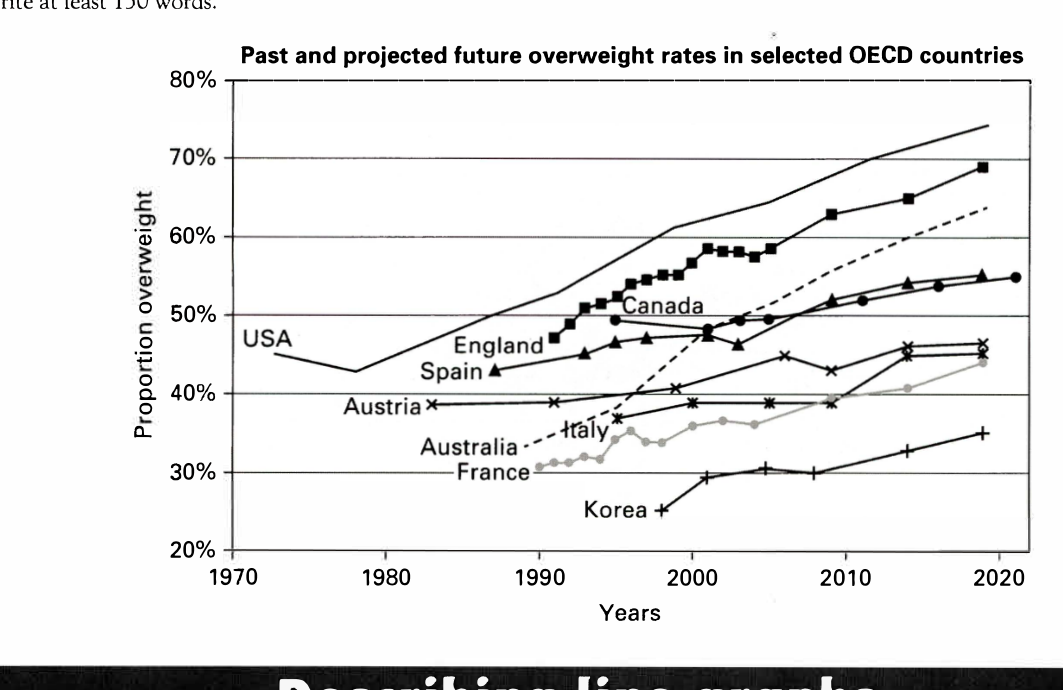
The line graph below shows past and current overweight rates, as well as a projected future overweight rate in nine selected countries.
Summarise the infonnation by selecting and reporting the main features, and make comparisons where relevant.
Past and projected future overweight rates in selected OECD countries
Student answer (Band 5.0)
the ligne graph illustrates past and current overweight rates in selected OECD countries from 1970 to 2020.
overall, all the countries recorded an increasing by the years. the higher propotion of overweight registred to USA at 45% approximatelly in 1970 and increased sharply to reach over 70% at 2020. while korea registred only 25% in 2000.
the rate of overweigh for england and spain start calculated at 1985 approximatelly with 42% and 44%, respectevely. Italy recorded 35% at 1995 and this figure remain stable to 2010.
Regarding france , the figure of proportion overweight recorded 30% in 1990 and increase slightly to 44% at 2020.
austria has also the same figure between 1980 and 1990 at 39%.this figure insease slightly to 43% at 2005 to decrease after to 42% and come back to increase to reach another time 43% at 2020. england also recorded a significant clummp from 48% at 1990 to 70% approximately at 2020
AI examiner evaluation
| Criterion | Band |
|---|---|
| Task Achievement / Task Response | 5.0 |
| Coherence and Cohesion | 5.0 |
| Lexical Resource | 5.5 |
| Grammatical Range and Accuracy | 5.0 |
| Overall | 5.0 |
Task Achievement / Task Response: Band 5.0
You identify the broad upward trend and include relevant comparisons, such as the USA rising from about 45% to above 70% and Korea having the lowest rate. However, the report only partially covers the graph: several countries are omitted, and some details are inaccurate. Korea’s 25% figure is from around 1998, not 2000; England and Spain begin around 1991 and 1987, rather than 1985; and Italy does not remain stable only to 2010, as its rate rises to about 45% by 2019. The overview also overgeneralises by saying every country increased, without highlighting the USA’s highest projected rate or Korea’s lowest. Select the main extremes and trends, then check each supporting figure against the graph.
Coherence and Cohesion: Band 5.0
The response has a basic sequence, moving from a general statement to country-specific details, and phrases such as “Regarding France” and “also” help signal shifts. However, the progression is not consistently clear: the final sentence returns to England after Austria, and the information is presented as a series of loosely connected observations rather than grouped comparisons. The overview is brief and does not clearly guide the reader through the main patterns. Some linking is also awkward, particularly the opening “while Korea…” fragment, which is not smoothly connected to the preceding sentence. Organise the report into a clear overview followed by paragraphs grouping the highest and lowest rates or countries with similar trends, and use links that show the relationship between comparisons.
Lexical Resource: Band 5.5
You use some task-relevant vocabulary, including “overweight rates,” “proportion,” “increased sharply,” and “remain stable,” so the topic is generally understandable. There is some attempt to vary wording, but inaccurate spelling and word choice are noticeable, as in “ligne,” “propotion,” “registred,” “approximatelly,” and “clummp.” Several expressions are also unnatural or imprecise: “recorded an increasing by the years” and “the rate … start calculated” do not communicate the trend fluently. Build a reliable set of graph-description collocations, such as “the proportion rose,” “stood at,” and “increased steadily,” and check spelling and word forms. This would make the limited range more precise and easier to follow.
Grammatical Range and Accuracy: Band 5.0
The response attempts both simple statements and longer sentences with comparisons, but the range is limited and errors occur frequently enough to make some sentences difficult to process. For example, “all the countries recorded an increasing by the years” has an incorrect verb pattern, while “the rate … start calculated at 1985” has faulty tense and sentence construction. There are also problems with articles, agreement, and punctuation, as in “austria has also the same figure” and the missing space after “39%.” Some clauses are fragments, including “while korea registred only 25% in 2000.” Practise forming complete sentences with accurate past-tense verbs, and use a small number of controlled complex structures to connect comparisons.
See this exact question answered at other band scores. The same prompt compared across bands.
Browse more IELTS Writing model answers or get your own writing scored by the same AI examiner.