Band 5.0 IELTS Writing Task 1 Model Answer
Overall Band Score: 5.0 · IELTS Momentum Workout · 2026-11-27
IELTS Writing Task 1 question
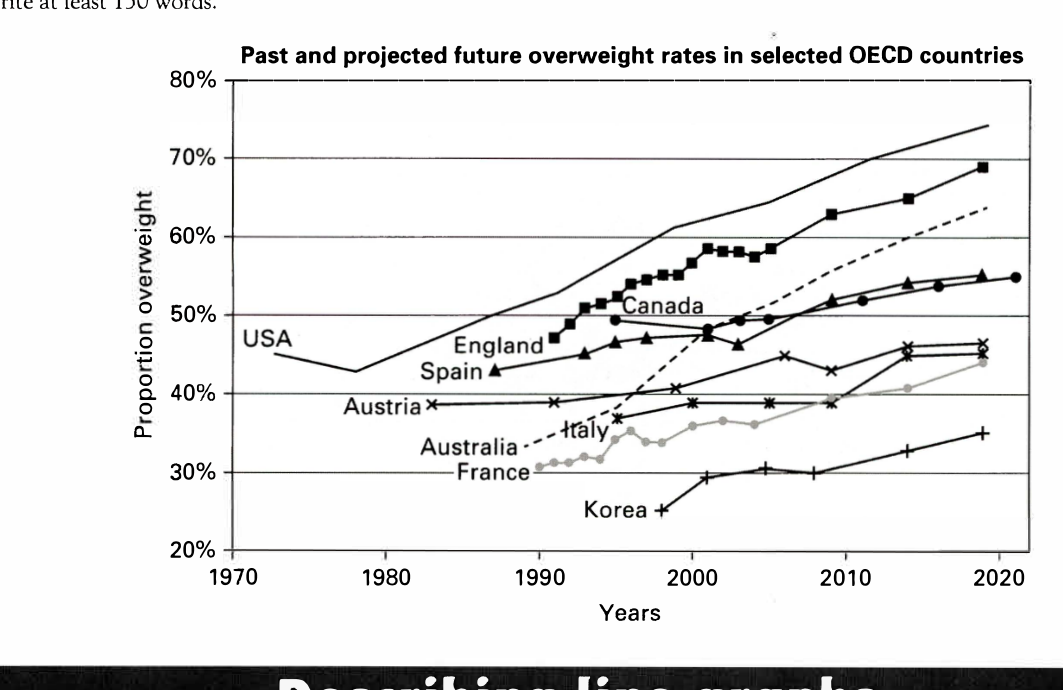
The line graph below shows past and current overweight rates, as well as a projected future overweight rate in nine selected countries.
Summarise the infonnation by selecting and reporting the main features, and make comparisons where relevant.
Past and projected future overweight rates in selected OECD countries
Student answer (Band 5.0)
The line graph illustrates the previous and latest overweight ratio; moreover, the future predection of obese in nine different countries.
Overall, the obeseity ratio of different countries; firstly, the overweigh rates of all countries will increase with the passage of time. The highest increment will occur in USA and Australia.
To begin with, different countries in USA and Australia the obesesity rate will grow quickly from 1970 to till end, furthermore England and Spain will grow with the same ratio; at the beginning the ratio of England and Spain were approximately 45% and 43%.
Canada will show the same increment in obesity. Austria and Italy will illustrates the same overfat rate; at the start the percentage were almost 38% and 35%; finally, france illustrates the second minimum growing ratio of overweight as same as italy; in Korea the ratio of overfat peoples will minimum; in the beginning it was 25% and the end it will be approximately 35%.
AI examiner evaluation
| Criterion | Band |
|---|---|
| Task Achievement / Task Response | 5.0 |
| Coherence and Cohesion | 5.0 |
| Lexical Resource | 5.0 |
| Grammatical Range and Accuracy | 5.0 |
| Overall | 5.0 |
Task Achievement / Task Response: Band 5.0
You identify the broad pattern that rates generally rise and note that the USA and Australia show strong growth, while Korea remains comparatively low. However, the overview is incomplete: the USA is projected to have the highest rate, reaching about 74%, whereas Korea is lowest, and these endpoint comparisons are not clearly stated. Several details are inaccurate or too vague. For example, England and Spain do not grow at the same rate, and Austria and Italy do not begin at the figures given: the chart places them at roughly 39% and 37% at their earliest points. The claim that France has the second-lowest growth is also unsupported. Select a few accurate comparisons and report their approximate start and end values to develop the summary more fully.
Coherence and Cohesion: Band 5.0
The response has a basic paragraph structure, moving from an introduction and overview to country details, and it groups some countries together. This gives the reader a general sense of the topic. However, progression within the body is difficult to follow because several countries and comparisons are introduced in one long sequence, without a clear organising principle. Linking words such as “moreover,” “furthermore,” and “finally” are sometimes used inaccurately or mechanically, and the opening overview sentence is incomplete, which weakens the connection between ideas. Organise the details into clear groups—for example, the highest-rising countries and the lower-rate countries—and use precise links such as “by contrast” or “while” to show the relationships between them.
Lexical Resource: Band 5.0
You attempt a range of topic vocabulary, including “ratio,” “increment,” “percentage,” and “overweight,” and the general subject remains understandable. However, word choice and spelling errors are frequent enough to make some phrases unclear or unnatural. Examples include “predection,” “obeseity,” “overweigh rates,” and “overfat rate”; “obesity rate” is also not always an accurate substitute for the chart’s measure of people who are overweight. Phrases such as “grow quickly” and “same increment” are imprecise for describing trends. Use a smaller set of accurate, natural expressions consistently, such as “the proportion of people who were overweight,” “rose steadily,” and “increased by around 20 percentage points.”
Grammatical Range and Accuracy: Band 5.0
You attempt longer sentences and use some time-related clauses, but the range of structures is limited and errors occur frequently. The opening sentence lacks a complete main clause, while “the overweigh rates of all countries will increase” has an awkward subject construction and does not clearly distinguish historical from projected data. Agreement and verb-form problems appear in “Austria and Italy will illustrates” and “the percentage were.” Other sentence patterns, including “at the beginning the ratio … were,” need more accurate articles and sentence punctuation. Practise building clear subject–verb sentences, keeping past and future tenses consistent with the chart, and checking agreement in plural and singular clauses. Shorter, controlled sentences would make your comparisons easier to understand.
See this exact question answered at other band scores. The same prompt compared across bands.
Browse more IELTS Writing model answers or get your own writing scored by the same AI examiner.