Band 5.0 IELTS Writing Task 1 Model Answer
Overall Band Score: 5.0 · IELTS Momentum Workout · 2026-11-28
IELTS Writing Task 1 question
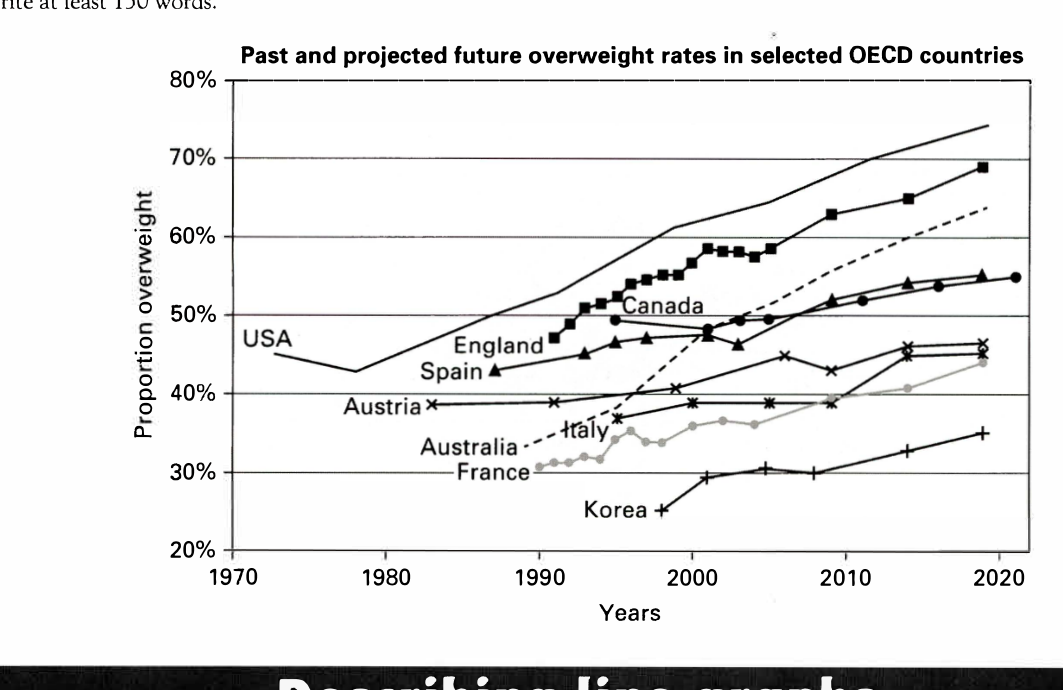
The line graph below shows past and current overweight rates, as well as a projected future overweight rate in nine selected countries.
Summarise the infonnation by selecting and reporting the main features, and make comparisons where relevant.
Past and projected future overweight rates in selected OECD countries
Student answer (Band 5.0)
The line chart below presents the overweight rates in nine selected countries in the past and now also the predection in the future.
Overall,overweight is a crucial problem around the world nowadays.Obesity is increasing in OECD countries such as USA,Austria,Australia,Spain,England,Canada,Italy,France,Korea.The USA has the most perentage over that periode.
USA had a slightly decrease between 1970 and 1980 then it jumped to reacgh more than 70% in 2020 .England were remaind at his place after USA,it started in 1990 by 47% to be 69% in 2020.Canada startded in 49% between 1990 and 2000 in the third place to share the fifth place in 2020.Spain began with 43% to achieve more than Canada in 2020.
Austria had 48% after 1980,then it rose to 45% after 2010 and they predect it stay plateau until 2020.Australia had a dramaticarly jumpe from 32% between 1980 and 1990 to peak over 60% before 2020.italy and france shar the same precentage in 2010 then met again at same point in 2020.Korea stay at the last place aver all the period .
AI examiner evaluation
| Criterion | Band |
|---|---|
| Task Achievement / Task Response | 5.0 |
| Coherence and Cohesion | 5.0 |
| Lexical Resource | 5.0 |
| Grammatical Range and Accuracy | 5.0 |
| Overall | 5.0 |
Task Achievement / Task Response: Band 5.0
You identify the chart’s subject and give a broad overview that rates generally rise, with the USA highest and Korea lowest. You also include several relevant country comparisons. However, the overview is imprecise: saying obesity is increasing across all the listed countries overlooks fluctuations, and the claim that the USA had the highest rate “over that period” is not accurate for the earliest years shown. Several details are misreported or unclear: Austria is described as reaching 48% and then falling to 45%, whereas it ends at about 46–47%; Australia’s rise begins around 34% in 1990, not 32% in the 1980s. Select the main trends and compare them accurately, especially the highest and lowest rates and notable rises.
Coherence and Cohesion: Band 5.0
The response has a basic structure: an introduction, an overall statement, and two paragraphs describing groups of countries. This gives the reader some organisation, and sequencing words such as “then” and “between” help show change over time. However, the progression is difficult to follow because countries are discussed in a largely list-like way, with comparisons such as Canada “to share the fifth place” left unexplained. Some links are unclear, and the final paragraph moves rapidly between Austria, Australia, Italy, France and Korea without a consistent grouping. Use clearer topic sentences and organise the details by broad patterns—for example, the highest-rising countries and those with lower rates—while making each comparison explicit.
Lexical Resource: Band 5.0
You use some relevant chart vocabulary, including “rates,” “percentage,” “jumped,” “peak,” and “plateau,” and these attempts show awareness of language for describing trends. However, the range is limited and several word choices or forms make the meaning difficult to understand, such as “the most perentage,” “dramaticarly jumpe,” and “stay at the last place aver all the period.” Spelling errors are frequent, including “predection,” “reacgh,” and “startded,” and some expressions are not natural for this task. Build a more accurate set of trend phrases and check spelling carefully. Prefer precise descriptions such as “rose steadily,” “remained the lowest,” and “was projected to reach” rather than relying repeatedly on “jumped” or “place.”
Grammatical Range and Accuracy: Band 5.0
You attempt both simple and longer sentences, and the response generally communicates that rates change over time. However, the range is limited, and errors occur frequently in verb forms, agreement, articles and sentence construction. For example, “England were remaind” combines an incorrect plural verb with an incorrect verb form, while “Canada startded” and “Korea stay” do not use appropriate past-tense forms. The sentence about Austria also shifts between “it” and “they,” making the reference unclear. Punctuation and spacing are inconsistent, particularly after commas and full stops. Practise accurate past-tense reporting and use a consistent sentence pattern, such as “The rate rose from X to Y,” before attempting more complex comparisons.
See this exact question answered at other band scores. The same prompt compared across bands.
Browse more IELTS Writing model answers or get your own writing scored by the same AI examiner.