Band 5.5 IELTS Writing Task 1 Model Answer
Overall Band Score: 5.5 · IELTS Momentum Workout · 2026-11-05
IELTS Writing Task 1 question
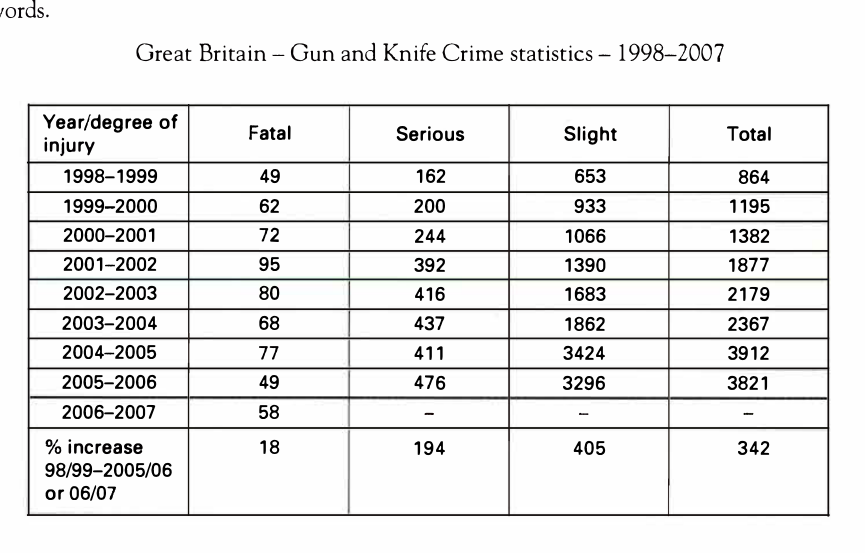
The table shows the number of fatal, serious and slight injuries resulting from gun and knife crime in Great Britain from 1998 to 2007 and the percentage increase for each degree of injury over the period.
Summarise the information by selecting and reporting the main features, and make comparisons where relevant.
Great Britain - Gun and Knife Crime statistics - 1998-2007
Student answer (Band 5.5)
The table illustrates the number of injuries resulting from a gun and knife craime in Grat Britain destrbute on 3 degree of injuries ( Fatal , serious ,and slight) and the percentage increse fro each degree from 1998 to 2007 .
Overall, all number of injuries resulting from crime incresed, the fatel degree slightly incresed comparing between the 1998 and 2006, while the incresement on serious and slight injurises was very high.
In details, the incresment on [redacted phone] was 18% only, althoghe from 2000 to 2002 the number of fatal injuries rose dramatically to 95. However, the number of fatel injuries droped constantly from 2001 to 2003 to 68, then in [redacted phone] incresed to 77, after that flactuated until became 58 in [redacted phone].
Comparing with Serios and slight degree, there are a huge incresement happened around 194% for serious and 405% for slight. the numbers staied increse sharply until they reached in serious from 162 to 476 from 1998 to 2005, and the number of slight injuries incresed from 864 in 1998 to 3821 in 2006.
AI examiner evaluation
| Criterion | Band |
|---|---|
| Task Achievement / Task Response | 5.5 |
| Coherence and Cohesion | 5.5 |
| Lexical Resource | 5.0 |
| Grammatical Range and Accuracy | 5.0 |
| Overall | 5.5 |
Task Achievement / Task Response: Band 5.5
You identify the broad pattern that injuries increased and distinguish the much larger rises in serious and slight injuries from the smaller change in fatal cases. You also include relevant figures, such as the 18% increase in fatal injuries and the 194% and 405% increases in the other categories. However, some reporting is inaccurate or unclear: 864 is the total for 1998–99, not the number of slight injuries, and the slight-injury figure rises from 653 to 3,296 by 2005–06, rather than from 864 to 3,821. The overview also misses the sharp jump in total injuries in 2004–05. Select the main trends more accurately and compare the categories with the correct figures.
Coherence and Cohesion: Band 5.5
The response has a recognisable structure: an introduction, an overview, and two paragraphs describing the figures. This gives the reader a basic route through the information, and transitions such as “Overall,” “However,” and “Comparing with” show an attempt to connect ideas. However, progression within the detail paragraphs is sometimes difficult to follow. The fatal-injury account says the figure “droped constantly from 2001 to 2003 to 68,” although the sequence includes a peak of 95 and then 80 before reaching 68; the dates and changes are therefore not clearly linked. The final paragraph also combines percentage changes and raw counts without a clear comparison. Group the data by injury type and use precise time references and linking phrases.
Lexical Resource: Band 5.0
You use some task-relevant vocabulary, including “percentage,” “fatal injuries,” “rose,” “droped,” and “fluctuated,” and you attempt to describe changes rather than simply list figures. However, the range is limited and several spelling errors make key terms harder to read, for example “craime,” “destrbute,” “increse,” and “Serios.” Some expressions are also unnatural or imprecise, such as “the fatal degree” and “a huge incresement happened.” Use standard collocations for data description, and check spelling carefully. More precise verbs such as “climbed,” “peaked,” and “declined” would help distinguish different movements in the figures.
Grammatical Range and Accuracy: Band 5.0
You attempt both simple and more complex sentences, including a contrast with “However” and a comparison beginning “Comparing with…”. Nevertheless, errors in sentence structure and grammatical forms are frequent and sometimes make relationships between figures unclear. For example, “Overall, all number of injuries … incresed” has problems with determiner and agreement, while “the numbers staied increse sharply until they reached in serious from 162 to 476” lacks a clear grammatical structure. Tense and preposition choices also need attention in phrases such as “from 1998 to 2006” and “reached in serious.” Practise writing shorter, complete sentences first, then combine them with accurate clauses to show comparisons and trends.
See this exact question answered at other band scores. The same prompt compared across bands.
Browse more IELTS Writing model answers or get your own writing scored by the same AI examiner.