Band 6.0 IELTS Writing Task 1 Model Answer
Overall Band Score: 6.0 · IELTS Momentum Workout · 2026-11-05
IELTS Writing Task 1 question
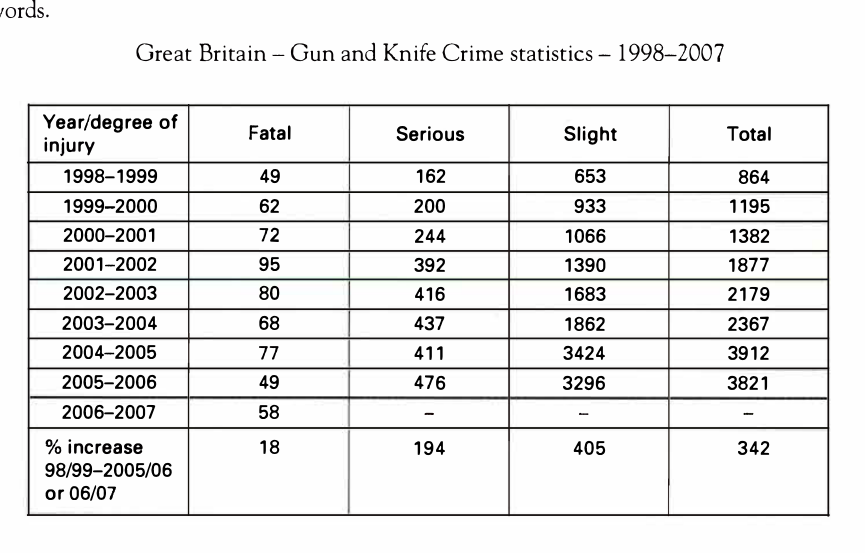
The table shows the number of fatal, serious and slight injuries resulting from gun and knife crime in Great Britain from 1998 to 2007 and the percentage increase for each degree of injury over the period.
Summarise the information by selecting and reporting the main features, and make comparisons where relevant.
Great Britain - Gun and Knife Crime statistics - 1998-2007
Student answer (Band 6.0)
The table compares the number of fatal,serious and slight injuries caused by gun and knife crime in Great Britain between 1998 to 2007 and illustrating the percentage increase for each type of injury over the same period.
Overall ,the Total number of injuries experienced a gradual increase between 1998 and 2006/2007 with percentage rise of 342 between the 1998 and 2006. While serious and slight injuries both rose signaficantly over the period of the study .Fatal injuries kept fluctuating constantly.
For Slight injuries the numbers kept rising exponentially from only 653 case in 1998 to more that 3000 after 2004.
In the other Hand ,Serious degree of injuries were considerably lower than slight type .However ,they also faced a steady Increase over the period with an exception in 2004 where it has fallen by 26 before rising back again and hitting a peak of 476.
However ,Fatal cases experienced a steady increase before hitting a peak in 2001 ,then the figure declined until 2004 .and then started oscilatting each year .
AI examiner evaluation
| Criterion | Band |
|---|---|
| Task Achievement / Task Response | 6.0 |
| Coherence and Cohesion | 6.0 |
| Lexical Resource | 6.0 |
| Grammatical Range and Accuracy | 5.0 |
| Overall | 6.0 |
Task Achievement / Task Response: Band 6.0
You identify the main overall pattern: injuries rose substantially, slight injuries were the largest category, and fatal figures fluctuated. The overview and category-by-category comparisons are relevant, but some details are inaccurate or unclear. For example, the total did not rise gradually throughout: it climbed sharply to 3,912 in 2004–05, then fell to 3,821 in 2005–06, and no total is provided for 2006–07. The serious-injury peak of 476 occurred in 2005–06, not after a rise following 2004; the 2004–05 figure was 411. Also, the table’s percentage increases refer to the stated period, but the comparison dates in your overview are imprecise. Select key figures accurately and explain the period covered.
Coherence and Cohesion: Band 6.0
The response has a clear overall arrangement: an introduction, an overview, and separate paragraphs for slight, serious and fatal injuries. This makes the main categories easy to follow. However, progression within the overview and some comparisons could be clearer. The repeated use of “However” and “In the other Hand” makes connections feel mechanical, and the opening of the serious-injury paragraph does not clearly link its lower level to the trend that follows. Some punctuation and spacing also interrupt the flow. Use more precise links such as “By contrast” or “Meanwhile,” and organise each detail in a consistent sequence—for example, starting value, major change, and ending or peak—so comparisons are easier to track.
Lexical Resource: Band 6.0
You use a suitable range of trend vocabulary, including “gradual increase,” “fluctuating,” “steady increase,” “declined,” and “peak.” These choices help communicate the broad patterns, and the meaning is generally clear. Some word choices and collocations are inaccurate or imprecise, however: “rose exponentially” overstates the pattern, “case” should be plural when referring to 653, and “oscillatting” is misspelled. “Degree of injuries” and “faced a steady increase” are also less natural ways to describe the data. Aim for precise, conventional chart language and check spelling carefully. The suggestions below offer alternatives that better match the trends and register of an IELTS report.
Grammatical Range and Accuracy: Band 5.0
You attempt a mix of simple and complex sentences, including a contrast with “While” and a sequence using “before … then.” The main message is usually understandable, but some grammatical errors and punctuation problems remain. The introduction’s “between 1998 to 2007” uses the wrong preposition, and “and illustrating” does not form a parallel structure with “compares.” The overview begins “While serious and slight injuries…” but does not complete that dependent clause as a full sentence. There are also inconsistent sentence boundaries, such as the full stop before “and then started.” Use complete sentences, check agreement and parallel forms, and punctuate clauses consistently to improve accuracy.
See this exact question answered at other band scores. The same prompt compared across bands.
Browse more IELTS Writing model answers or get your own writing scored by the same AI examiner.