Band 5.5 IELTS Writing Task 1 Model Answer
Overall Band Score: 5.5 · IELTS Momentum Workout · 2026-11-06
IELTS Writing Task 1 question
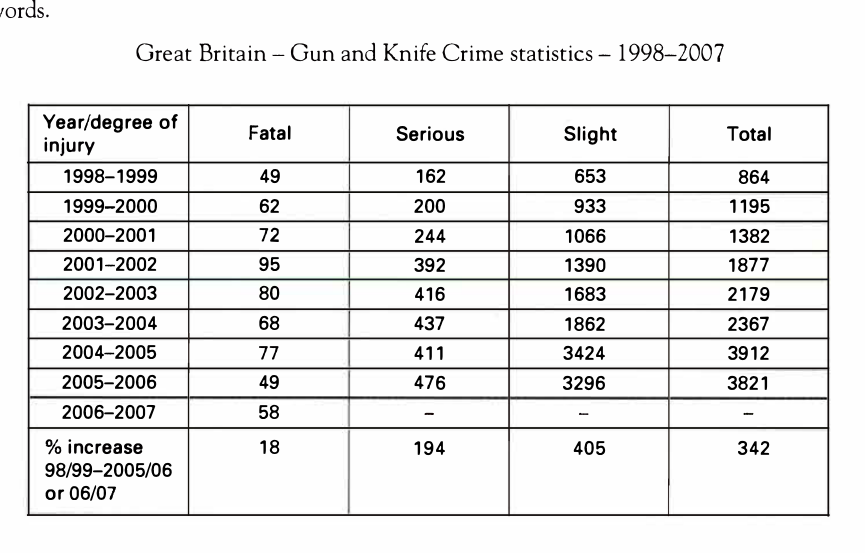
The table shows the number of fatal, serious and slight injuries resulting from gun and knife crime in Great Britain from 1998 to 2007 and the percentage increase for each degree of injury over the period.
Summarise the information by selecting and reporting the main features, and make comparisons where relevant.
Great Britain - Gun and Knife Crime statistics - 1998-2007
Student answer (Band 5.5)
The table illustrate the number of fatal, serious, and slight injuries resulting from gun and knife crime in Great Britain from 1998 and 2007, including with the percentage increased in each category.
Overall, the total number of injuries increased massively over the period. Slight category recorded the highest number of injuries in almost every year compared to fatal and serious injuries, while the fatal injuries remained lowest among all categories.
in 1998-99, there were 49 fatal injuries, 162 serious injuries, and 653 slight injuries. the total number of cases were 864. by 2005-6, fatal injuries had fluctuated but came back to 49. Whereas, the serious injuries rose significantly to 476, and the number of slight injuries increased dramatically to 3296 bringing the total to 3821.
According to the numbers the slight injuries had increased to 405%, followed by, serious injuries at 194%. In contrast the fatal injuries had the lowest percentage in increase with 18%. The total number of injuries increased to 342%.
AI examiner evaluation
| Criterion | Band |
|---|---|
| Task Achievement / Task Response | 5.5 |
| Coherence and Cohesion | 5.5 |
| Lexical Resource | 5.5 |
| Grammatical Range and Accuracy | 5.0 |
| Overall | 5.5 |
Task Achievement / Task Response: Band 5.5
You identify the main overall pattern: total injuries rose substantially, slight injuries were the largest category, and fatal injuries were the smallest. You also report several figures accurately, including the 1998–99 values and the 2005–06 serious and slight counts. However, the account is incomplete: it focuses on the first and last years rather than describing key changes across the intervening period, such as the sharp rise in slight injuries in 2004–05. The statement that fatal injuries “came back to 49” is accurate for 2005–06 but misses the final figure of 58 in 2006–07. The response is 144 words, six short of the 150-word minimum; develop the trends and comparisons further.
Coherence and Cohesion: Band 5.5
The response has a recognisable structure, with an introduction, an overview, and paragraphs giving figures and percentage changes. This helps the reader follow the main points. However, progression is limited because the data paragraph jumps from 1998–99 directly to 2005–06, leaving the intervening pattern unexplained. Some linking is awkward or mechanical: “Whereas” begins a fragment after a full stop, and “According to the numbers” adds little to the relationship between ideas. The comma after “followed by” also interrupts the comparison. Organise the figures into a clearer chronological account or group the categories, and use linking expressions to show contrast and change accurately.
Lexical Resource: Band 5.5
You use relevant vocabulary for describing data, including “fluctuated,” “rose significantly,” “increased dramatically,” and “percentage.” These choices make the broad trends understandable. However, several phrases are imprecise or awkward, such as “percentage increased,” “lowest percentage in increase,” and “bringing the total,” which reduce naturalness and precision. “Cases” is also less exact than “injuries” in this context. The range is adequate for a basic summary, but repeated use of “increased” and “number” limits flexibility. Aim for accurate collocations such as “percentage increase,” “the smallest percentage rise,” and “raising the total to,” while varying trend language where appropriate.
Grammatical Range and Accuracy: Band 5.0
The response includes both simple statements and some attempts at more complex structures, and the main meaning is generally clear. However, errors are frequent enough to affect accuracy. The opening has subject–verb disagreement in “The table illustrate,” and “from 1998 and 2007” uses an incorrect preposition. In “the total number of cases were 864,” the singular subject requires “was.” The sentence beginning “Whereas” is incomplete, and the final paragraph contains a faulty construction in “had increased to 405%.” Capitalisation is also inconsistent after full stops, as in “in 1998-99” and “the total.” Practise checking agreement, complete sentence structure, and verb patterns when reporting percentages.
See this exact question answered at other band scores. The same prompt compared across bands.
Browse more IELTS Writing model answers or get your own writing scored by the same AI examiner.