Band 5.0 IELTS Writing Task 1 Model Answer
Overall Band Score: 5.0 · IELTS Momentum Workout · 2026-11-06
IELTS Writing Task 1 question
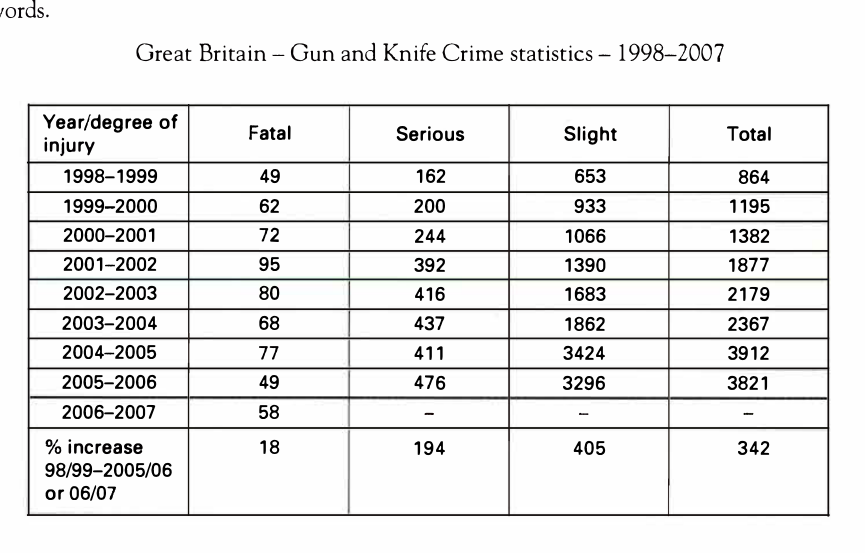
The table shows the number of fatal, serious and slight injuries resulting from gun and knife crime in Great Britain from 1998 to 2007 and the percentage increase for each degree of injury over the period.
Summarise the information by selecting and reporting the main features, and make comparisons where relevant.
Great Britain - Gun and Knife Crime statistics - 1998-2007
Student answer (Band 5.0)
The table provides the information about the three types of injuries using knife and gun, it also includes total number of crimes and percentage increase for each degree over a period from 1998 to 2007 in Great Britain.
Overall, three types of injuries are fatal, serious and slight. Initially we can see very less crimes, but as time passes the crime rate has been increased. In the final years in injuries has been increased.
In [redacted phone], the total number of crimes are 864, which includes 49 fatal crimes, 162 serious injuries and 653 slight injuries. In contrast, total crimes in [redacted phone] are 3912, fatal injuries are same, but we can see considerable increase in other two crimes. In [redacted phone], the number of serious crimes are higher, but in the year [redacted phone], serious crimes are very less.
As years passes the total number of crimes are increasing, in [redacted phone], the total injuries were 1382, with 72 fatal, 244 serious crimes and 1066 slight injuries. The total percentage increase in 342%. The percentage increase in fatal crime is 18%, 194% in serious crime and 405% in slight injuries.
AI examiner evaluation
| Criterion | Band |
|---|---|
| Task Achievement / Task Response | 5.0 |
| Coherence and Cohesion | 5.0 |
| Lexical Resource | 5.0 |
| Grammatical Range and Accuracy | 5.0 |
| Overall | 5.0 |
Task Achievement / Task Response: Band 5.0
You identify the table’s subject and report several relevant figures, including the starting total of 864 and the peak total of 3,912 in 2004–05, as well as the percentage increases. However, the overview is vague: “the crime rate has been increased” does not clearly summarise the main pattern or distinguish the sharp rise in slight injuries from the smaller changes in fatal injuries. Some details are inaccurate or unclear. Fatal injuries in 2004–05 were 77, not the same as the 49 recorded in 1998–99, and the 2005–06 serious-injury figure was 476. The response also calls injury counts “crimes” and gives limited coverage of the year-by-year trends. Select the key comparisons accurately and make the overview more specific.
Coherence and Cohesion: Band 5.0
The response has a basic structure, with an introduction, an overview and paragraphs containing figures, and the reader can follow the general subject. However, progression is limited: the final paragraph returns to the general claim that totals increased and repeats information rather than developing a clear comparison. Linking phrases such as “In contrast” and “As years passes” are used, but the contrast is not fully explained, and the latter introduces a grammatical error as well as an unclear transition. Group the data into a logical sequence—for example, overall totals and injury categories—then use clear references to connect each comparison. This would reduce repetition and make the organisation easier to follow.
Lexical Resource: Band 5.0
You use some relevant vocabulary, including “percentage increase,” “considerable increase” and the injury categories, so the topic is generally understandable. However, the range is limited and several word choices or collocations are inaccurate or repetitive. “Crimes” is repeatedly used where the table reports injuries, and phrases such as “very less crimes” and “the crime rate has been increased” do not express the data naturally. “Injuries using knife and gun” is also an awkward description of the table’s subject. Aim for precise terms such as “injury cases,” “the number of recorded injuries” and “rose,” while varying how you describe increases and comparisons. More accurate vocabulary would make the report clearer and more appropriate to an academic summary.
Grammatical Range and Accuracy: Band 5.0
You attempt some longer sentences and use basic past-tense reporting, but the range of structures is limited and errors occur frequently. For example, “the crime rate has been increased” uses an unsuitable verb form, while “As years passes the total number of crimes are increasing” has problems with agreement and tense. There are also errors in “the total number of crimes are 864” and “In the final years in injuries has been increased,” where sentence structure and agreement make the meaning difficult to follow. Use a consistent past tense for the historical figures, check singular subjects such as “the total,” and build shorter, complete sentences before attempting more complex comparisons. These changes would improve accuracy and readability.
See this exact question answered at other band scores. The same prompt compared across bands.
Browse more IELTS Writing model answers or get your own writing scored by the same AI examiner.