Band 5.0 IELTS Writing Task 1 Model Answer
Overall Band Score: 5.0 · IELTS Momentum Workout · 2026-11-06
IELTS Writing Task 1 question
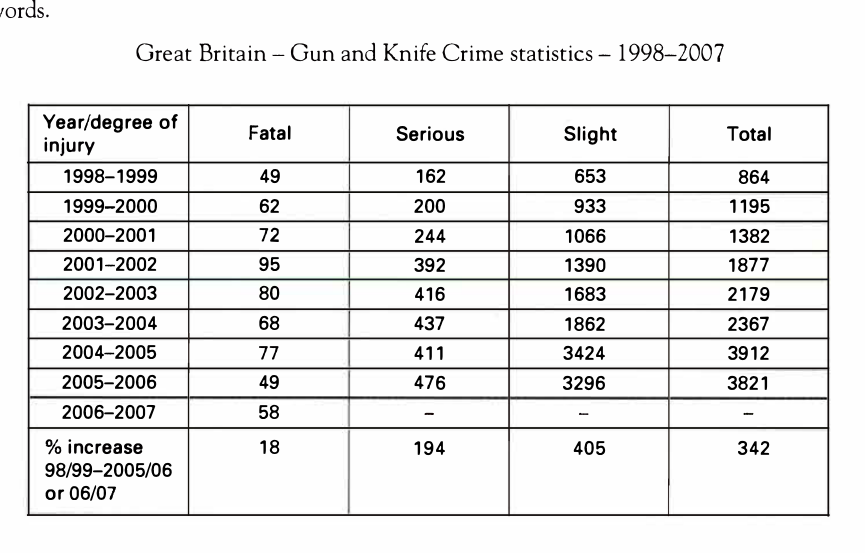
The table shows the number of fatal, serious and slight injuries resulting from gun and knife crime in Great Britain from 1998 to 2007 and the percentage increase for each degree of injury over the period.
Summarise the information by selecting and reporting the main features, and make comparisons where relevant.
Great Britain - Gun and Knife Crime statistics - 1998-2007
Student answer (Band 5.0)
From what it shows, the year [redacted phone] witnessed the most fatal crimes, and it translates to the lower amount of slight injuries compared to the year after, that year has witnessed great violance.
from what we see here, we see an increase in the number of crimes every year with fatal crimes peaking in [redacted phone] and then declining after, but serious and slight crimes are still incraesing with no drawing back, which indicates that the law is being enforced in a way that prevents fatal crimes from happening.
the year [redacted phone] has witnessed a great develoment in the crime prevention process, we see fatal crimes drop by 28 crimes, serious crimes increase by 65 crimes, slight crimes drop by ~270 crimes which indicates that there are real law enforcment enhnces going on in the country.
you might think, if we have prevented crime, rather than the past, why is it increasing, my explanation would be that it's a normal result of the increasing amount of people every day, the more people you have, the more crimes you're gonna get.
The fair comparsion would be comparing the number of crimes to the number of the population at that time.
AI examiner evaluation
| Criterion | Band |
|---|---|
| Task Achievement / Task Response | 5.0 |
| Coherence and Cohesion | 4.5 |
| Lexical Resource | 5.0 |
| Grammatical Range and Accuracy | 5.0 |
| Overall | 5.0 |
Task Achievement / Task Response: Band 5.0
You identify some relevant patterns, including the fatal-injury peak in 2001–2002 and the sharp fall in slight injuries from 2004–2005 to 2005–2006. However, the response only partially summarises the table: it lacks a clear, neutral overview and focuses heavily on explanations about law enforcement and population that the data cannot establish. Some figures are also inaccurate: fatal injuries fell from 77 to 49 (28), but serious injuries rose from 411 to 476 (65), while slight injuries fell from 3,424 to 3,296 (128), not about 270. The claim that serious and slight injuries increased continuously is also incorrect. Select the main trends, report them accurately, and avoid unsupported causes.
Coherence and Cohesion: Band 4.5
There is some organisation: the response moves from the fatal-injury peak to later changes and then to a concluding comparison with population. However, it does not follow a clear overview-and-details structure, and the ideas do not progress consistently as a data summary. The opening sentence is difficult to interpret, while repeated phrases such as “from what we see here” and “which indicates” make the links feel repetitive. The final discussion of population shifts away from comparing the figures in the table. Use a brief overview followed by grouped comparisons, and make each paragraph serve one clear purpose. More precise referencing would also help readers follow which year and injury category each claim concerns.
Lexical Resource: Band 5.0
You use some relevant topic vocabulary, including “fatal crimes,” “serious crimes,” “slight injuries,” “peaking,” and “declining,” so the main subject is generally recognisable. However, the range is limited and several choices are inaccurate or informal for an academic data report. “A great development in the crime prevention process” interprets the figures rather than describing them, and “drawing back” is not a natural way to describe a trend. There are also noticeable spelling errors, such as “violance,” “incraesing,” “develoment,” “enhnces,” and “comparsion.” Build a more precise vocabulary for describing rises, falls, peaks and proportions, and check spelling carefully.
Grammatical Range and Accuracy: Band 5.0
You attempt some longer sentences using clauses and connectors, for example, “which indicates that the law is being enforced…” and “if we have prevented crime… why is it increasing”. However, the range is limited, and complex sentences are often awkwardly joined or punctuated. The opening begins with a fragment-like construction, and the sentence starting “the year 2005-2006 has witnessed” runs through several claims without clear sentence boundaries. Tense and agreement are also inconsistent, as in “that year has witnessed” and “the more people you have, the more crimes you're gonna get.” Use straightforward past-tense sentences to report historical figures, and separate comparisons into shorter, correctly punctuated statements.
See this exact question answered at other band scores. The same prompt compared across bands.
Browse more IELTS Writing model answers or get your own writing scored by the same AI examiner.