Band 5.5 IELTS Writing Task 1 Model Answer
Overall Band Score: 5.5 · IELTS Momentum Workout · 2026-11-08
IELTS Writing Task 1 question
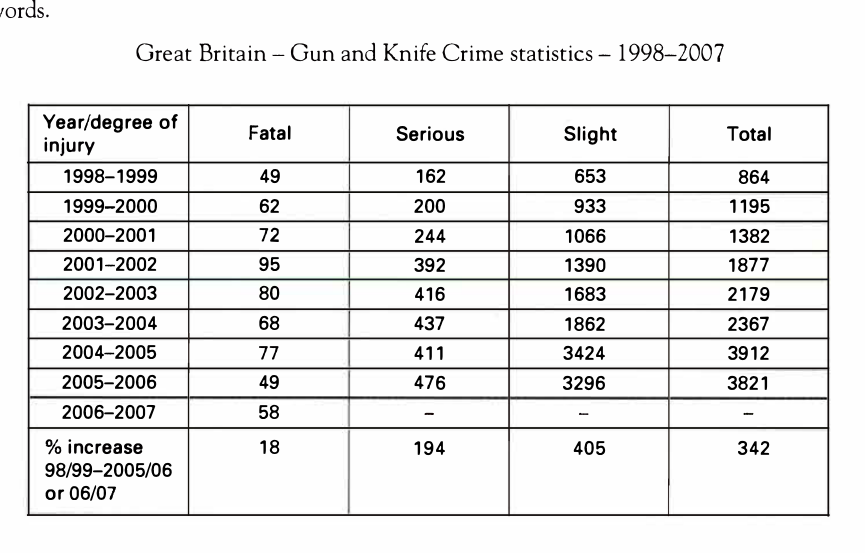
The table shows the number of fatal, serious and slight injuries resulting from gun and knife crime in Great Britain from 1998 to 2007 and the percentage increase for each degree of injury over the period.
Summarise the information by selecting and reporting the main features, and make comparisons where relevant.
Great Britain - Gun and Knife Crime statistics - 1998-2007
Student answer (Band 5.5)
The given table depicts the number of injuries namely fatal,serious and slight resulting from sharp weapons and ammunition in Great Britain from 1998 to 2007 and also the percentage rise for each degree of injury over the period.
Overall,in [redacted phone],the number of injuries were at peak.However,slight injuries were the highest whereas injuries that cause death were the least.
Moving to the details,the number of fatal injuries stood at 49 in [redacted phone].Nevertheless,the figures fluctuated over the years before it reached to its peak number at 95 in [redacted phone].Then it declined to 49 again in [redacted phone].However,it rose to 58 in [redacted phone],representing an overall increase of 18%.
Regarding Serious injuries,the wounds in [redacted phone] experienced the highest number (476).Consequently,from [redacted phone],[redacted phone] and [redacted phone], it was 416,437 and 411 correspondingly.Also,in [redacted phone] , it was the lowest(162). It represented a substantial increase of 194%.
However,slight injuries showed a dramatic increase from [redacted phone] to [redacted phone], it was 653 and 3296 respectively. It was highest in [redacted phone] .
AI examiner evaluation
| Criterion | Band |
|---|---|
| Task Achievement / Task Response | 5.0 |
| Coherence and Cohesion | 6.0 |
| Lexical Resource | 6.0 |
| Grammatical Range and Accuracy | 5.5 |
| Overall | 5.5 |
Task Achievement / Task Response: Band 5.0
You identify the main pattern that slight injuries were most numerous and fatal injuries least numerous, and you report several accurate figures, including the fatal-injury peak of 95 in 2001–2002 and the 18% increase. However, the overview is incomplete: the total peaked in 2004–2005, but the slight-injury figure peaked in that year only in the table’s reported years, then fell in 2005–2006. You omit the total figures and the 342% increase, and the serious-injury trend is not clearly summarised. The final sentence also leaves the comparison unfinished. The response is 143 words, below the 150-word minimum; 16 words copied from the prompt were not counted. Develop the overview and cover the key categories more fully.
Coherence and Cohesion: Band 6.0
The response has a recognisable structure: an introduction, an overview, and separate paragraphs for fatal, serious and slight injuries. This makes the categories easy to locate, and sequencing the fatal figures over time gives the reader a clear progression. However, transitions are sometimes mechanical or confusing. For example, “Nevertheless” and “However” are used where a straightforward continuation would be clearer, while “Consequently” does not show a logical relationship between the serious-injury figures. The final paragraph is very short and ends without completing its comparison, so the report feels unfinished. Use clearer links to show contrast or change, and organise the figures into fuller paragraphs with a concluding comparison.
Lexical Resource: Band 6.0
You use an adequate range of vocabulary for describing data, including “fluctuated,” “peak,” “declined,” “dramatic increase” and “substantial increase.” These choices generally communicate the trends, and the reader can understand the categories being discussed. Some wording is imprecise or unnatural for a statistical report: “sharp weapons and ammunition” does not accurately restate gun and knife crime, “wounds” is not a suitable substitute for serious injuries, and “correspondingly” is awkward when listing figures. “The number of injuries were at peak” also uses an unnatural expression. Prefer precise category labels and standard reporting collocations, such as “reached a peak” and “the figures were 416, 437 and 411, respectively.”
Grammatical Range and Accuracy: Band 5.5
You attempt a mix of simple and complex sentences, including clauses such as “before it reached to its peak number” and “whereas injuries that cause death were the least.” The overall meaning is usually understandable, but some grammatical errors and punctuation problems remain. For example, “the number of injuries were” has subject–verb disagreement, and “before it reached to its peak” has an incorrect preposition and an unclear pronoun reference. The sentence beginning “slight injuries showed a dramatic increase” shifts into an incomplete construction after the comma: “it was 653 and 3296 respectively.” Commas are also frequently attached to the following word. Check agreement, sentence boundaries, and punctuation, and use complete clauses when comparing figures.
See this exact question answered at other band scores. The same prompt compared across bands.
Browse more IELTS Writing model answers or get your own writing scored by the same AI examiner.