Band 4.5 IELTS Writing Task 1 Model Answer
Overall Band Score: 4.5 · IELTS Momentum Workout · 2026-11-09
IELTS Writing Task 1 question
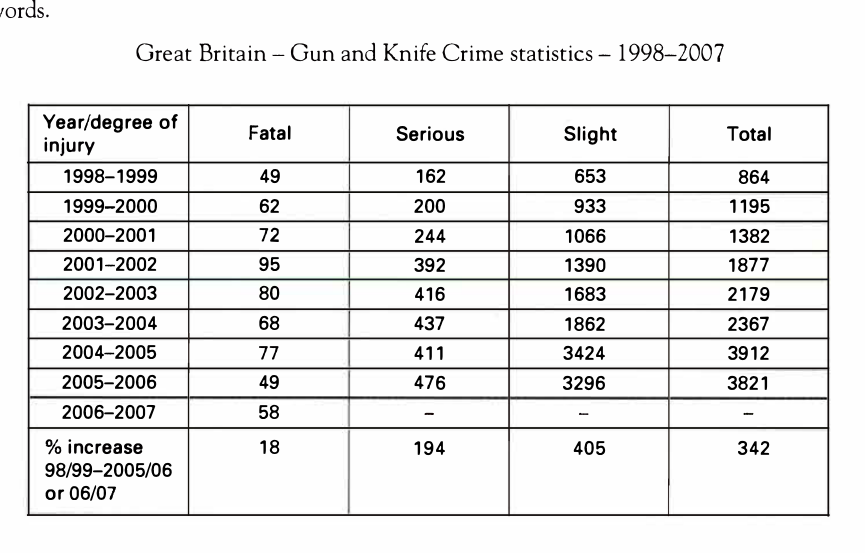
The table shows the number of fatal, serious and slight injuries resulting from gun and knife crime in Great Britain from 1998 to 2007 and the percentage increase for each degree of injury over the period.
Summarise the information by selecting and reporting the main features, and make comparisons where relevant.
Great Britain - Gun and Knife Crime statistics - 1998-2007
Student answer (Band 4.5)
The table demonstrate the data of fatal ,serious o slight injuries from guns and knife crims in Great Bitian between 1998 to 2007 .The propotion of increase of events during over the time for each deterioration.
from the year 1998 the cases of fatal injuries were 49 that increses to the peak percentage of 95 in the year 2002 but demonstrate decline gradually till 2007 to the previus level .Whereas, seriuos injuries propotion incresease drammatically that reached to the percentage of 476 till 2006 and not showin gthe data of 2007 in the table.Slight injuries do not decline from 1198 fom the percentage of 658 and shoes the trend of highest number of injuries till the year 2007 contributing mostly in the total number of injuries showing in the graph
Summaring the whole picture of data demonstrate the highest percentaage of slight injuries by Gun the
AI examiner evaluation
| Criterion | Band |
|---|---|
| Task Achievement / Task Response | 4.0 |
| Coherence and Cohesion | 4.5 |
| Lexical Resource | 4.5 |
| Grammatical Range and Accuracy | 5.0 |
| Overall | 4.5 |
Task Achievement / Task Response: Band 4.0
The response identifies the broad subject and attempts to describe changes in fatal, serious and slight injuries, but it reports the table inaccurately and does not provide a clear, reliable overview. For example, 476 is the number of serious injuries in 2005–06, not a percentage, while the slight-injury figures begin at 653 in 1998–99, not 658. The claim that slight injuries continue rising through 2007 is unsupported because the table gives no slight-injury figure for that year. The final summary is unfinished, and the response is four words below the required minimum. To improve, give a complete overview, distinguish counts from percentage increases, and select accurate comparisons, such as the strong rise in slight injuries and the fluctuating fatal figures.
Coherence and Cohesion: Band 4.5
There is a basic attempt to organise the response: it begins with an introduction, moves through the three injury categories, and ends with a summary. Linking words such as “Whereas” and “Summaring the whole picture” also show an effort to connect ideas. However, the progression is difficult to follow because several trends are combined in long, loosely connected sentences, and the final sentence stops before completing its point. References such as “the previous level” are unclear, while the shift from “percentage” to injury counts makes relationships harder to track. Use separate paragraphs for the overview and key details, and organise comparisons by trend, with clear links between each figure and its year.
Lexical Resource: Band 4.5
The response uses some relevant topic vocabulary, including “fatal injuries,” “serious injuries,” “slight injuries,” “peak,” and “decline.” However, the range is basic and several word-choice, form and spelling problems make the meaning difficult to interpret. “The proportion of increase of events” is an awkward way to describe the table’s percentage increases, and “deterioration” does not fit the injury categories. There are also frequent misspellings, including “crims,” “Bitian,” “increses,” and “seriuos,” which reduce clarity. Aim for precise, repeated terms such as “number of cases,” “rose,” “fell,” and “percentage increase,” and check spelling carefully before submitting.
Grammatical Range and Accuracy: Band 5.0
The response attempts both simple statements and longer sentences, including a contrast introduced by “Whereas,” but grammatical control is inconsistent. The opening has agreement and sentence-boundary problems: “The table demonstrate” should be “The table demonstrates,” and the following fragment beginning “The propotion” is not a complete sentence. Tense and clause construction are also faulty in phrases such as “that increses to the peak” and “do not decline … and shoes the trend.” Articles, prepositions and punctuation are often missing or misplaced, making some relationships unclear. Practise building accurate simple sentences first, then combine them with controlled clauses—for example, “Fatal injuries peaked at 95 in 2001–02 before falling.”
See this exact question answered at other band scores. The same prompt compared across bands.
Browse more IELTS Writing model answers or get your own writing scored by the same AI examiner.